
[論文レビュー] Spanning the full range of neutron star properties within a microscopic description
本研究では、非線形ベクトルメソン相互作用を含む相対論的平均場モデルにおけるベイズ推論フレームワークを用いて、中性子星の全範囲の性質を体系的に探求する。非線形ベクトル結合定数の強さに基づき、3つの異なる状態方程式(EOS)のクラスを特定し、主な結果として、弱い非線形結合では2.75 M⊙の最大質量が得られ、GW190814の二次的対象と整合的であることが示され、またpQCD制約は強い非線形ベクトル項またはハイパーポロンを含むモデルを支持する。
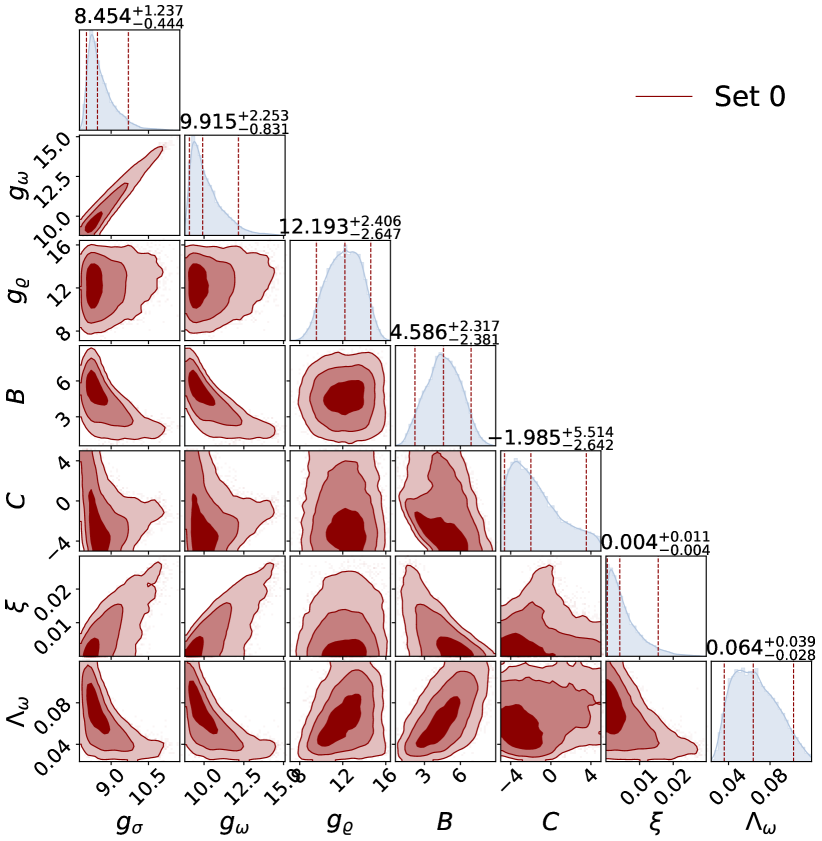
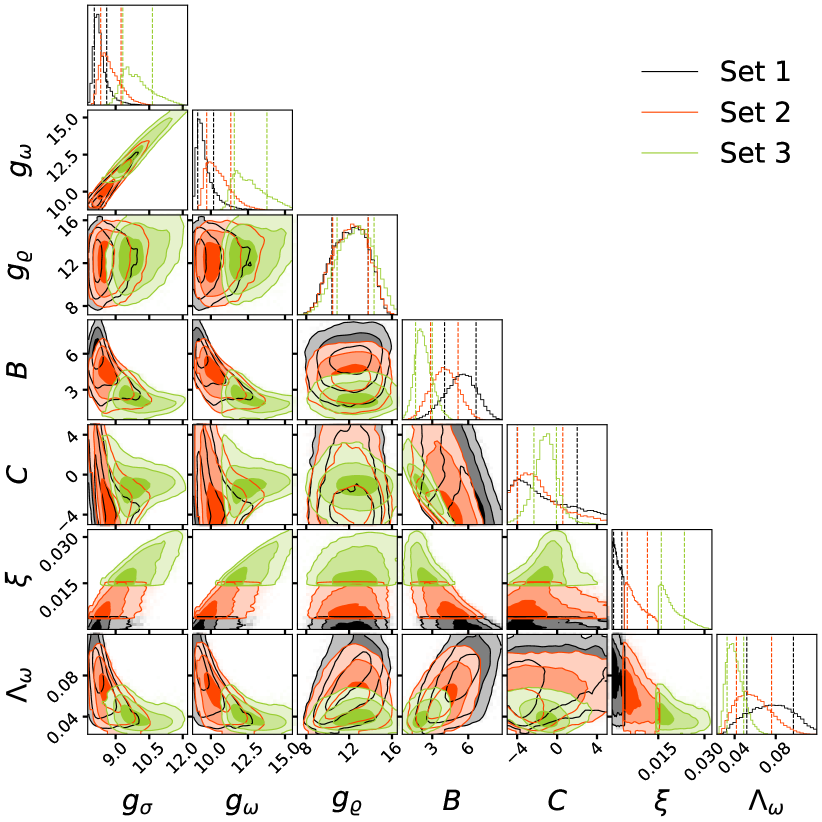
The high-density behavior of nuclear matter is analyzed within a relativistic mean-field description with non-linear meson interactions. To assess the model parameters and their output, a Bayesian inference technique is used. The Bayesian setup is limited only by a few nuclear saturation properties, the neutron star maximum mass larger than 2 M$_\odot$, and the low-density pure neutron matter equation of state (EOS) produced by an accurate N$^3$LO calculation in chiral effective field theory. Depending on the strength of the non-linear scalar vector field contribution, we have found three distinct classes of EOSs, each one correlated to different star properties distributions. If the non-linear vector field contribution is absent, the gravitational maximum mass and the sound velocity at high densities are the greatest. However, it also gives the smallest speed of sound at densities below three times saturation density. On the other hand, models with the strongest non-linear vector field contribution predict the largest radii and tidal deformabilities for 1.4 M$_\odot$ stars, together with the smallest mass for the onset of the nucleonic direct Urca processes and the smallest central baryonic densities for the maximum mass configuration. These models have the largest speed of sound below three times saturation density, but the smallest at high densities, in particular, above four times saturation density the speed of sound decreases approaching approximately $\sqrt{0.4}c$ at the center of the maximum mass star. On the contrary, a weak non-linear vector contribution gives a monotonically increasing speed of sound. A 2.75 M$_\odot$ NS maximum mass was obtained in the tail of the posterior with a weak non-linear vector field interaction. We found that pQCD favors models with a large non-linear vector field contribution or hyperons.
研究の動機と目的
- 微視的核Many-bodyモデルを用いて、中性子星の全範囲の性質を体系的に探求すること。
- 非線形ベクトルメソン相互作用が中性子星の状態方程式および観測可能な性質に与える影響を評価すること。
- GW170817、NICER、およびチャーミカルEFT制約を含む天体物理学的および核物理学的データを用いて、ベイズ的手法によるモデルパラメータの制約を行うこと。
- 高密度における摂動的QCDの境界と、得られた状態方程式の適合性を評価すること。
- ハイパーポロンおよび非線形項が、音速および最大質量構成の形状に果たす役割を調査すること。
提案手法
- スカラーおよびベクトルメソンの非線形自己および混合相互作用を含む相対論的平均場ラグランジアンを用いて、高密度核物質を記述する。
- 核の飽和性質、2 M⊙の中性子星最大質量、N3LOチャーミカル効果理論による低密度純中性子物質を用いて、ベイズ的手法でモデルパラメータを制約する。
- 非線形ベクトル(ω⁴)相互作用項の強さに基づき、3つの明確に分かれた状態方程式のクラスを特定する。
- 1.4 M⊙および最大質量の中性子星に対して、音速、質量半径関係、潮汐歪み、直接Urca過程の発生を計算する。
- 異なるQCDスケールパラメータX ∈ [1,4]の範囲で、状態方程式が摂動的QCD制約と適合するかを評価する。
- ハイパーポロンの寄与を含め、状態方程式の軟化および観測的・理論的境界との整合性を評価する。
実験結果
リサーチクエスチョン
- RQ1非線形ベクトルメソン相互作用(ω⁴項)の強さが、状態方程式および質量、半径、潮汐歪みなどの中性子星性質にどのように影響を与えるか?
- RQ2弱い非線形ベクトル結合のもとで、2.75 M⊙の中性子星最大質量を再現できるか? また、天体物理学的および核物理学的制約を満たすか?
- RQ3特に4倍飽和密度付近およびその上での密度領域において、非線形ベクトル項が音速に与える影響は何か?
- RQ4ハイパーポロンおよび摂動的QCD制約の導入が、さまざまな状態方程式の妥当性にどのように影響を与えるか?
- RQ5GW170817、NICER、チャーミカルEFT、およびpQCDの制約を統合的に満たすモデル設定はどれか?
主な発見
- 非線形ベクトル相互作用がゼロ(ξ=0)のモデルでは、最大質量の中性子星中心で約√0.4 cに達する最高の音速と、最高の最大質量が得られる。
- 弱い非線形ベクトル結合のもとで、事後分布の尾部に2.75 M⊙の最大質量が達成され、GW190814の二次的対象が中性子星である可能性が示唆される。
- 強い非線形ベクトル結合を有するモデルでは、1.4 M⊙の中性子星に対して最大の半径および潮汐歪みを予測し、最大質量構成の中心バリオン密度が最小になる。
- 強い非線形ベクトル項を有するモデルでは、4倍飽和密度以上で音速が低下し、質量の大きな星の中心部で√0.4 cに近づく。
- pQCD制約は、弱い非線形結合(ξ < 0.004)のモデルで最も厳しく違反され、X=4条件下で最大40%のモデルが条件を満たさない。
- ハイパーポロンの導入または強い非線形ベクトル項の存在により、特にX=1およびX=4の条件下でpQCD境界を満たす可能性が高まり、ハイパーポロンを含むモデルではほぼ完全な適合性を示す。
この論文を読む
Nubintのビューアで原文を開き、読みながら気になる箇所をすぐに質問できます。
Nubintでこの論文を読むこのレビューはAIが論文の原文をもとに作成しました。引用する前に原文をご確認ください。