
[論文レビュー] SparseFusion: Fusing Multi-Modal Sparse Representations for Multi-Sensor 3D Object Detection
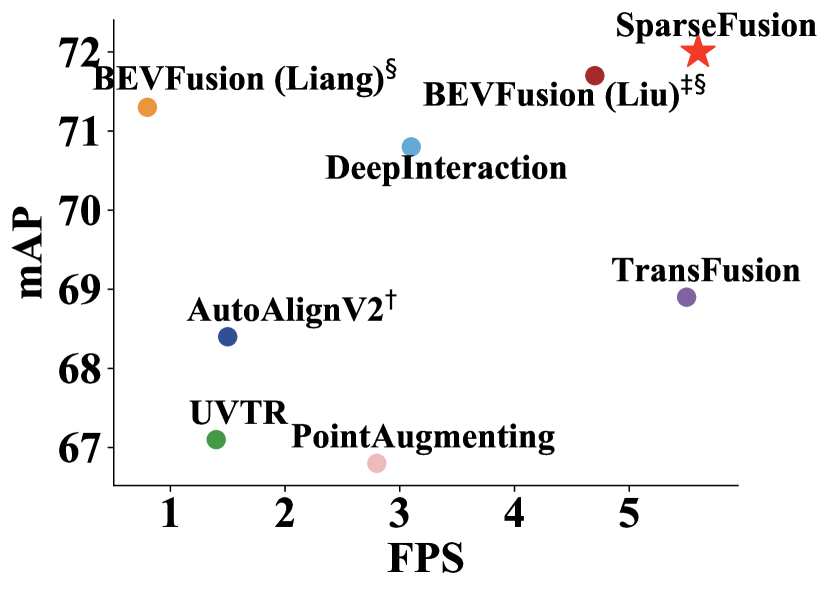
SparseFusionは、LiDARとカメラモダリティのスパースなインスタンスレベル特徴を、カメラの候補をLiDAR座標空間に変換した後、軽量な自己注意モジュールを用いて融合する、革新的な3次元オブジェクト検出フレームワークを提案する。スパース表現を採用し、セマンティックおよび幾何的クロスモダリティ転送モジュールによって負の転送を軽減することで、nuScenesで最先端の性能を達成するとともに、最も高速な推論速度を実現した。
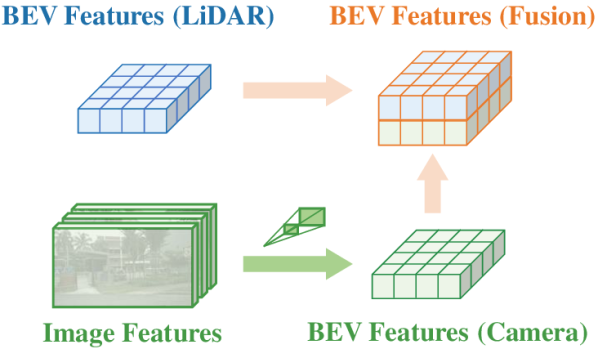
By identifying four important components of existing LiDAR-camera 3D object detection methods (LiDAR and camera candidates, transformation, and fusion outputs), we observe that all existing methods either find dense candidates or yield dense representations of scenes. However, given that objects occupy only a small part of a scene, finding dense candidates and generating dense representations is noisy and inefficient. We propose SparseFusion, a novel multi-sensor 3D detection method that exclusively uses sparse candidates and sparse representations. Specifically, SparseFusion utilizes the outputs of parallel detectors in the LiDAR and camera modalities as sparse candidates for fusion. We transform the camera candidates into the LiDAR coordinate space by disentangling the object representations. Then, we can fuse the multi-modality candidates in a unified 3D space by a lightweight self-attention module. To mitigate negative transfer between modalities, we propose novel semantic and geometric cross-modality transfer modules that are applied prior to the modality-specific detectors. SparseFusion achieves state-of-the-art performance on the nuScenes benchmark while also running at the fastest speed, even outperforming methods with stronger backbones. We perform extensive experiments to demonstrate the effectiveness and efficiency of our modules and overall method pipeline. Our code will be made publicly available at https://github.com/yichen928/SparseFusion.
研究の動機と目的
- マルチセンサ3次元検出におけるスパース表現に起因する非効率性とノイズの問題を解消すること。
- ドメインギャップに起因するLiDARとカメラモダリティ間の負の転送を克服すること。
- スパースなシーン表現ではなく、スパースなインスタンスレベル特徴に限定して動作する融合戦略を開発すること。
- 計算コストの高いスパースなシーン表現の生成を回避することで、推論速度を向上させつつ、検出精度を損なわないようにすること。
- ablationとnuScenesベンチマークを用いた評価を通じて、スパース融合の有効性を検証すること。
提案手法
- SparseFusionは、LiDAR点群とカメラ画像から独立してスパースなインスタンスレベル特徴を抽出する平行な3次元オブジェクト検出器を用いる。
- オブジェクト表現を分離することで、カメラの候補をLiDAR座標空間に変換し、統一された3次元空間での融合を可能にする。
- 軽量な自己注意モジュールが、変換されたスパースな候補を共有の3次元空間で統合し、最終的な検出を実現する。
- モダリティ固有の検出器の前段階で、セマンティックおよび幾何的クロスモダリティ転送モジュールを適用し、ドメインギャップと負の転送を低減する。
- 関連するスパースなインスタンス特徴のみを融合することで、スパースなシーン表現の生成を回避し、効率性を向上させるとともにノイズを低減する。
- カメラの候補をLiDAR座標空間に変換するビュー変換は、正確なクロスモダリティアライメントと性能向上に不可欠である。
実験結果
リサーチクエスチョン
- RQ1スパースなシーン表現に依存せずに、LiDARとカメラモダリティのスパースなインスタンスレベル特徴を効果的に融合できるか?
- RQ2従来のデュアルデュアルまたはスパースからデュアルへの融合戦略と比較して、スパースな候補の融合は、精度と速度の両面で優れているか?
- RQ3セマンティックおよび幾何的クロスモダリティ転送モジュールは、モダリティ間の負の転送をどの程度軽減できるか?
- RQ4スパースな特徴生成を排除することで、推論効率が向上し、かつ検出性能が維持または向上するか?
- RQ5自己注意、MLP、最適輸送などの融合メカニズムの選択が、最終的な検出精度にどのように影響するか?
主な発見
- SparseFusionは、nuScenesベンチマークで68.8%のNDSと66.4%のmAPを達成し、新たな最先端性能を樹立した。
- すべての手法の中で最も高速な推論速度を記録し、より強力なバックボーンを搭載したモデルを上回った。
- ablationスタディの結果、自己注意による融合がMLP、クロスアテンション、最適輸送のベースラインを上回った。
- カメラの候補をLiDAR座標空間に変換することで、mAPが0.8ポイント、NDSが0.5ポイント向上した。
- 幾何的およびセマンティックの転送モジュールは性能向上に顕著な寄与を示し、特にセマンティック転送が最大の向上をもたらした。
- 逐次的な検出器パイプラインは、平行な検出器アーキテクチャに劣っており、モダリティ固有の特徴抽出の必要性を裏付けた。
この論文を読む
Nubintのビューアで原文を開き、読みながら気になる箇所をすぐに質問できます。
Nubintでこの論文を読むこのレビューはAIが論文の原文をもとに作成しました。引用する前に原文をご確認ください。