
[論文レビュー] Sparser is Faster and Less is More: Efficient Sparse Attention for Long-Range Transformers
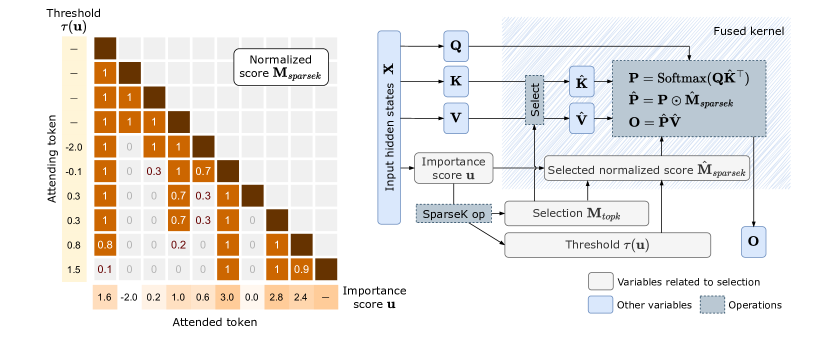
本論文では、学習可能なスコアリングネットワークと微分可能top-kマスク演算子を用いて、各クエリごとに固定数のキー値ペアを選択する微分可能でスパースなアテンションメカニズム、SparseK Attentionを提案する。この手法は推論時において線形時間計算量と定数メモリ消費量を達成し、従来の手法を上回る速度と効率性を実現しながら、長文脈言語モデリングおよび下流タスクにおいて優れた性能を維持する。
Accommodating long sequences efficiently in autoregressive Transformers, especially within an extended context window, poses significant challenges due to the quadratic computational complexity and substantial KV memory requirements inherent in self-attention mechanisms. In this work, we introduce SPARSEK Attention, a novel sparse attention mechanism designed to overcome these computational and memory obstacles while maintaining performance. Our approach integrates a scoring network and a differentiable top-k mask operator, SPARSEK, to select a constant number of KV pairs for each query, thereby enabling gradient-based optimization. As a result, SPARSEK Attention offers linear time complexity and constant memory footprint during generation. Experimental results reveal that SPARSEK Attention outperforms previous sparse attention methods and provides significant speed improvements during both training and inference, particularly in language modeling and downstream tasks. Furthermore, our method can be seamlessly integrated into pre-trained Large Language Models (LLMs) with minimal fine-tuning, offering a practical solution for effectively managing long-range dependencies in diverse applications.
研究の動機と目的
- 長文脈Transformerにおける自己アテンションの二乗計算コストとメモリコストを低減すること。
- 従来の学習可能なスパースアテンション手法の限界、特に超線形な訓練複雑度と高いKVメモリオーバーヘッドを克服すること。
- 自己回帰的デコーダーにおける長距離シーケンスモデリングのための効率的で勾配ベースの訓練と推論を可能にすること。
- KV選択とクエリアクセスを分離することで、計算効率とメモリ効率の両方を達成し、インクリメンタルで不可逆なマスキングを可能にすること。
- 最小限のファインチューニングで事前学習済みLLMにシームレスに統合し、実用的導入を可能にすること。
提案手法
- クエリに依存しない独立したKVペアの重要性評価を可能にするスコアリングネットワークを導入し、クエリに依存しない選択を実現する。
- 閾値化機構を用いて線形時間で正確なソフトゲートを計算する微分可能なtop-kマスク演算子、SparseKを提案する。
- IOに配慮した最適化のため、KV選択とアテンション計算を1つのTritonカーネルに統合し、速度を向上させる。
- 訓練時と推論時で同一のスパarsityレベルを適用することで、一貫性のある効率性を確保し、再計算を回避する。
- 自己回帰的デコーディング中にKVペアをインクリメンタルに評価することで、線形複雑度を維持する。
- SparseKと勾配計算を統合するバックワードパスカーネルを設計し、メモリと速度の両面で効率性を向上させる。
実験結果
リサーチクエスチョン
- RQ1微分可能なスパースアテンションメカニズムは、長文脈Transformerにおける訓練時および推論時の両方で線形時間計算量を達成できるか?
- RQ2KVスコアリングとクエリアクセスを分離することで、性能を維持したまま推論時に定数メモリフットプリントを実現できるか?
- RQ3提案されたSparseK演算子は、既存の学習可能なスパースアテンション手法と比較して、訓練速度と推論効率の面で優れているか?
- RQ4SparseKは、長文脈タスクのための最小限のファインチューニングで、事前学習済みLLMにどの程度シームレスに統合できるか?
- RQ516Kトークン程度の長文脈長さにおいて、全アテンションを上回る速度と精度を維持しながらスケーリング可能か?
主な発見
- SparseK Attentionは、8192の文脈長でPythia-160Mを用いた場合、訓練時間の複雑度を二乗から線形に低減し、全アテンションと比較して68.9%の相対的訓練時間にまで短縮した。
- マスクされたKVペアを即座に削除できる仕組みにより、推論時に定数メモリコストを達成した。
- 1024個のKVペアをクエリごとに選択した4096トークンのシーケンスにおいて、Tritonカーネルは、計算の統合とスパースに配慮したアクセスにより、FlashAttentionを上回る速度を達成した。
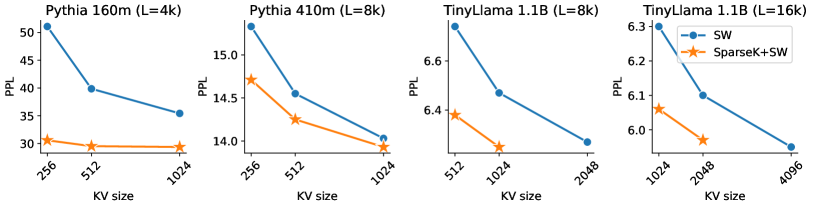
- 同等の文脈長で、言語モデリングおよび下流タスクにおいて、全アテンションや他のスパース手法と同等またはそれ以上の性能を達成した。
- GPT-2 や Pythia といった事前学習済みモデルへの統合が最小限のファインチューニングで可能であり、実用的導入の可能性を示した。
- 可視化により、ソフト選択機構が意味的に関連するトークンに集中する有意義なアテンションパターンを学習していることが確認された。
この論文を読む
Nubintのビューアで原文を開き、読みながら気になる箇所をすぐに質問できます。
Nubintでこの論文を読むこのレビューはAIが論文の原文をもとに作成しました。引用する前に原文をご確認ください。