
[論文レビュー] Spatial gradient consistency for unsupervised learning of hyperspectral demosaicking: Application to surgical imaging
本論文は、ハイパースペクトル画像のデモザイキングに完全に教師なしの深層学習手法を提案し、高分解能のペアデータを一切必要とせず、スペクトルバンド間の空間勾配の一貫性を新たな正則化項として活用する。この手法は教師あり手法と同等の性能を達成し、線形デモザイキングを著しく上回り、ペアの高分解能教師データが得られない手術内環境においてもリアルタイムのハイパースペクトル画像撮影を可能にする。
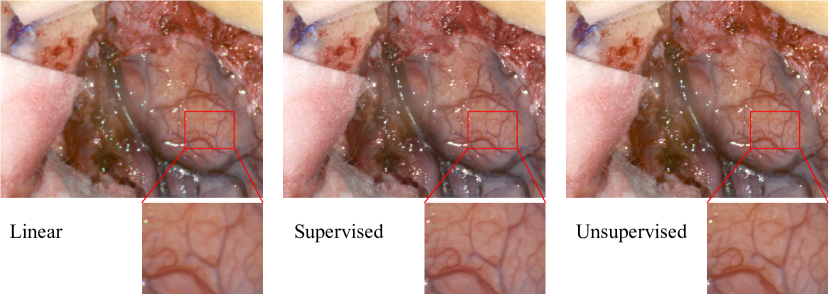
Hyperspectral imaging has the potential to improve intraoperative decision making if tissue characterisation is performed in real-time and with high-resolution. Hyperspectral snapshot mosaic sensors offer a promising approach due to their fast acquisition speed and compact size. However, a demosaicking algorithm is required to fully recover the spatial and spectral information of the snapshot images. Most state-of-the-art demosaicking algorithms require ground-truth training data with paired snapshot and high-resolution hyperspectral images, but such imagery pairs with the exact same scene are physically impossible to acquire in intraoperative settings. In this work, we present a fully unsupervised hyperspectral image demosaicking algorithm which only requires exemplar snapshot images for training purposes. We regard hyperspectral demosaicking as an ill-posed linear inverse problem which we solve using a deep neural network. We take advantage of the spectral correlation occurring in natural scenes to design a novel inter spectral band regularisation term based on spatial gradient consistency. By combining our proposed term with standard regularisation techniques and exploiting a standard data fidelity term, we obtain an unsupervised loss function for training deep neural networks, which allows us to achieve real-time hyperspectral image demosaicking. Quantitative results on hyperspetral image datasets show that our unsupervised demosaicking approach can achieve similar performance to its supervised counter-part, and significantly outperform linear demosaicking. A qualitative user study on real snapshot hyperspectral surgical images confirms the results from the quantitative analysis. Our results suggest that the proposed unsupervised algorithm can achieve promising hyperspectral demosaicking in real-time thus advancing the suitability of the modality for intraoperative use.
研究の動機と目的
- 手術内環境ではペアの高分解能ハイパースペクトル画像が入手困難であるため、その欠如がデモザイキングの教師あり学習を妨えていることに対処すること。
- 高分解能のハイパースペクトル画像を必要とせず、完全に教師なしのデモザイキング手法を構築し、高価または物理的に得られない教師データを回避すること。
- 自然画像に見られるスペクトル相関を活用し、空間勾配の一貫性に基づく新しい正則化項を導入することで、デモザイキングの品質を向上させること。
- 手術内手術ガイドラインに適したリアルタイムかつ高品質なハイパースペクトル画像再構成を可能にすること。
- 本手法の臨床的妥当性を、実際の手術用ハイパースペクトルデータを用いた定量的指標と専門家によるユーザースタディで検証すること。
提案手法
- 本手法は、ハイパースペクトルデモザイキングを、深層畳み込みニューラルネットワークを用いて解く不適切に定義された線形逆問題として定式化する。
- 自然画像に見られるスペクトル相関を活用し、空間勾配の一貫性に基づく、新たなスペクトルバンド間正則化項を導入する。
- 損失関数は、空間勾配の一貫性正則化項に加え、標準的なチホノフ正則化と全変動正則化、およびデータ適合項を組み合わせる。
- 教師なし損失関数により、高分解能のハイパースペクトル画像が不要な状態で、完全にエンドツーエンドの学習が可能となる。
- 本手法は、3つの深層ニューラルネットワーク(Res2-Unet、Enhanced HAN、NLRAN)を用い、3つのデータセット(実際の神経外科用NeuroHSIデータセットも含む)で評価された。
- 12名の神経外科学専門医を対象とした選択肢付きのペア比較ユーザースタディにより、画像品質の認識が評価された。

実験結果
リサーチクエスチョン
- RQ1ペアの高分解能学習データを一切必要としない完全に教師なしの深層学習手法が、高品質なハイパースペクトルデモザイキングを達成できるか?
- RQ2空間勾配の一貫性が、スペクトルバンド間でデモザイキング性能を向上させるために、どの程度有効であるか?
- RQ3提案手法の教師なしアプローチが、定量的および定性的な評価において、教師ありデモザイキングモデルと同等の性能を発揮するか?
- RQ4本手法が、高分解能のペアデータが一切ない状態で、リアルタイムの手術内環境において臨床的に受け入れ可能な結果を出力できるか?
- RQ5専門医は、本手法によるデモザイキング画像の品質を、線形法および教師ありベースラインと比較して、どのように評価するか?
主な発見
- 提案手法は、公的ハイパースペクトルデータセットにおいて、教師あり学習ベースラインと同等の定量的性能を達成しており、PSNRおよびSSIM値が教師あり手法と1〜2%以内の差に収まっている。
- 本手法は、すべての定量的指標において線形デモザイキングを著しく上回っており、空間的およびスペクトル的再構成品質に優れていることが示された。
- 12名の神経外科学専門医による定性的ユーザースタディでは、本手法が教師ありモデルと同等の画像品質であると評価され、ペア比較の110件中63件が本手法の結果を教師ありベースラインよりも好むと回答した。
- Bradley-Terryモデルによる好みスコアは、本手法が0.505、教師あり手法が0.445と算出され、専門医の好みがほぼ同等であることが示された。
- 効率的なニューラルネットワークとハードウェアを組み合わせることで、リアルタイムのデモザイキングが可能となり、手術内用途に適していることがわかった。
- 空間勾配の一貫性正則化項は、教師なしの状態でも効果的にスペクトル相関を捉え、アーチファクトを低減し、再構成の忠実度を向上させた。
この論文を読む
Nubintのビューアで原文を開き、読みながら気になる箇所をすぐに質問できます。
Nubintでこの論文を読むこのレビューはAIが論文の原文をもとに作成しました。引用する前に原文をご確認ください。