
[論文レビュー] Stochastic Approximation with Delayed Updates: Finite-Time Rates under Markovian Sampling
本稿は、マルコフ連鎖サンプリング下での遅延更新を伴う確率的近似(SA)の、初めての有限時間収束解析を提供し、固定点回りのノイズ領域への指数的収束を確立している。反復の有界性を保証する新規な帰納的証明技法を導入し、平均遅延τ_avgに比例する指数のスケーリングを用いる遅延適応型SAスキームを提案することで、最大遅延τ_maxに依存するのではなく、収束性能が向上し、遅延の事前知識がなくてもステップサイズの調整が可能になる。
Motivated by applications in large-scale and multi-agent reinforcement learning, we study the non-asymptotic performance of stochastic approximation (SA) schemes with delayed updates under Markovian sampling. While the effect of delays has been extensively studied for optimization, the manner in which they interact with the underlying Markov process to shape the finite-time performance of SA remains poorly understood. In this context, our first main contribution is to show that under time-varying bounded delays, the delayed SA update rule guarantees exponentially fast convergence of the \emph{last iterate} to a ball around the SA operator's fixed point. Notably, our bound is \emph{tight} in its dependence on both the maximum delay $τ_{max}$, and the mixing time $τ_{mix}$. To achieve this tight bound, we develop a novel inductive proof technique that, unlike various existing delayed-optimization analyses, relies on establishing uniform boundedness of the iterates. As such, our proof may be of independent interest. Next, to mitigate the impact of the maximum delay on the convergence rate, we provide the first finite-time analysis of a delay-adaptive SA scheme under Markovian sampling. In particular, we show that the exponent of convergence of this scheme gets scaled down by $τ_{avg}$, as opposed to $τ_{max}$ for the vanilla delayed SA rule; here, $τ_{avg}$ denotes the average delay across all iterations. Moreover, the adaptive scheme requires no prior knowledge of the delay sequence for step-size tuning. Our theoretical findings shed light on the finite-time effects of delays for a broad class of algorithms, including TD learning, Q-learning, and stochastic gradient descent under Markovian sampling.
研究の動機と目的
- マルコフ連鎖サンプリング下での遅延付き確率的近似(SA)に対する有限時間理論的解析が不足している現状に、特にマルチエージェントおよび大規模強化学習設定において、これを是正すること。
- 非同期的およびマルチエージェントRLにおける遅延SAの実験的成功と、時間的に相関のある(マルコフ連鎖的)サンプリング下での理論的裏付けの欠如の間のギャップを埋めること。
- 時間変動する遅延と、元のマルコフ過程の混合時間の両方を考慮した収束解析を開発すること。
- 最大遅延τ_maxに依存するのではなく、平均遅延τ_avgに依存する収束性能を向上させる遅延適応型SAスキームを提案・分析すること。
- 遅延シーケンスの事前知識が不要なステップサイズチューニングを提供することで、実用的応用性を高めること。
提案手法
- 反復の一様有界性を保証する新規な帰納的証明技法を構築し、時間変動する有界遅延下でもきわめてタイトな有限時間バウンドを可能にする。
- マルコフ連鎖サンプリング下での通常の遅延付きSA更新ルールを分析し、収束速度がmax{τ_max, τ_mix}に比例することを導出する。ここでτ_mixはマルコフ過程の混合時間である。
- 観測された遅延に基づいて更新ルールを動的に調整する遅延適応型SAスキームを導入し、収束指数がτ_maxに依存する度合いを低減する。
- 再帰的誤差バウンド解析を用いて、期待値の二乗誤差がτ_avgに依存するレートで指数的に減少することを示す。
- 収束レートが最適化されるための明示的なステップサイズ条件を導出し、バウンドがT反復に対してexp(−αμT/(4τ_avg + 4))のスケーリングをとることを示す。
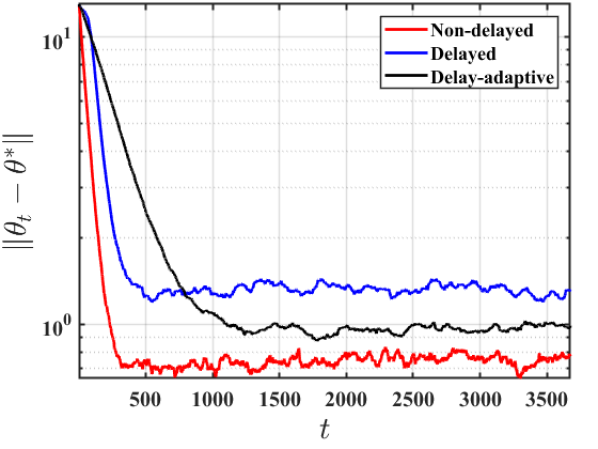
- TD(0)学習におけるマルコフ連鎖サンプリングとランダム遅延の下でのシミュレーションを通じて、理論的結果を検証し、非遅延型、通常の遅延型、遅延適応型アルゴリズムを比較する。
実験結果
リサーチクエスチョン
- RQ1時間変動する遅延とマルコフ過程の混合時間の相互作用が、遅延付き確率的近似の有限時間収束にどのように影響を与えるか?
- RQ2反復の一様有界性を保証する新規な帰納的証明技法は、遅延とマルコフ連鎖サンプリングの下で、従来の手法よりもタイトな収束バウンドを達成できるか?
- RQ3最大遅延τ_maxに依存するのではなく、平均遅延τ_avgに依存する収束性能を向上させる遅延適応型SAスキームは存在するか?
- RQ4このような遅延適応型スキームは、ステップサイズチューニングのための遅延シーケンスの事前知識がなくても設計可能か?
- RQ5理論的収束レートとノイズ領域のサイズは、通常の遅延付きSAと提案された遅延適応型スキームの間で、実際にはどのように比較されるか?
主な発見
- 通常の遅延付きSA更新ルールは、固定点回りのノイズ領域への指数的収束を達成し、収束指数がτ_maxとτ_mixの最大値に比例する。ここでτ_mixは、元のマルコフ過程の混合時間である。
- 提案された帰納的証明技法は反復の一様有界性を保証し、τ_maxおよびτ_mixの両方の依存性において最適なバウンドを導出する。
- 遅延適応型SAスキームでは、収束指数がτ_maxではなくτ_avgに比例するため、極端に大きな遅延の影響に対して著しく高いロバストネスを示す。
- 同じステップサイズ下で、遅延適応型スキームは通常の遅延型手法よりも小さな収束ノイズ領域を達成する。これはτ_maxへの感受性が低いためである。
- TD(0)学習におけるシミュレーションを通じて理論的解析を検証した結果、遅延適応型アルゴリズムは通常の遅延型よりも小さなノイズ領域に収束することが確認されたが、理論的トレードオフに従い収束速度は遅い。
- 遅延適応型スキームにより、ステップサイズの選択がより保守的でなくなる。これはτ_maxに逆比例するチューニングが不要であるため、実世界の応用においてより実用的である。
この論文を読む
Nubintのビューアで原文を開き、読みながら気になる箇所をすぐに質問できます。
Nubintでこの論文を読むこのレビューはAIが論文の原文をもとに作成しました。引用する前に原文をご確認ください。