
[論文レビュー] Stop Regressing: Training Value Functions via Classification for Scalable Deep RL
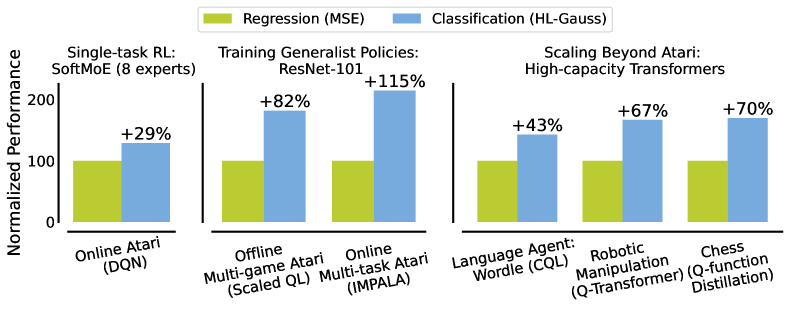
この論文は、深層強化学習における価値関数の学習において、平均二乗誤差(MSE)回帰を分類問題としての交差エントロピー損失に置き換える手法を提案している。ヒストグラムに基づく離散化(例:HL-Gauss)を用いて価値予測を分類問題として定式化することで、性能向上が顕著に得られ、マルチタスクAtariでは最大2.1倍、チェスでは70%向上、ロボット操作タスクでは67%向上を達成。また、ノイズの多い非定常なターゲットに対しても安定性が向上し、Transformer やMoEといった大規模モデルを用いたスケーラブルな学習が可能になる。
Value functions are a central component of deep reinforcement learning (RL). These functions, parameterized by neural networks, are trained using a mean squared error regression objective to match bootstrapped target values. However, scaling value-based RL methods that use regression to large networks, such as high-capacity Transformers, has proven challenging. This difficulty is in stark contrast to supervised learning: by leveraging a cross-entropy classification loss, supervised methods have scaled reliably to massive networks. Observing this discrepancy, in this paper, we investigate whether the scalability of deep RL can also be improved simply by using classification in place of regression for training value functions. We demonstrate that value functions trained with categorical cross-entropy significantly improves performance and scalability in a variety of domains. These include: single-task RL on Atari 2600 games with SoftMoEs, multi-task RL on Atari with large-scale ResNets, robotic manipulation with Q-transformers, playing Chess without search, and a language-agent Wordle task with high-capacity Transformers, achieving state-of-the-art results on these domains. Through careful analysis, we show that the benefits of categorical cross-entropy primarily stem from its ability to mitigate issues inherent to value-based RL, such as noisy targets and non-stationarity. Overall, we argue that a simple shift to training value functions with categorical cross-entropy can yield substantial improvements in the scalability of deep RL at little-to-no cost.
研究の動機と目的
- Transformer やMoEといった大規模ニューラルネットワークを用いた際の、MSE回帰に基づく価値関数学習のスケーラビリティの低さを是正すること。
- 価値関数学習を分類問題として再定式化し、交差エントロピー損失を用いることで、教師付き学習の成功事例に類似した性能向上とスケーラビリティの向上が可能かどうかを調査すること。
- 分類ベースの学習が、単一タスクおよびマルチタスクAtari、ロボット操作、チェス、言語エージェントタスクを含む多様な強化学習分野において安定的かつ効果的な学習を可能にすることを実証すること。
- ノイズの多いターゲットや非定常性に対する耐性、表現の質の観点から、性能向上の背後にあるメカニズムを解明すること。
- 交差エントロピーをMSE回帰の単純で効果的かつスケーラブルな代替手段として位置づけ、既存のアルゴリズムへの統合を可能にすること。
提案手法
- ヒストグラムに基づく離散化法(例:HL-Gauss)を用いて、連続的な価値ターゲットを離散的なカテゴリカルなボックスに変換し、分類ベースの学習を可能にする。
- 平均二乗誤差(MSE)の代わりにカテゴリカル交差エントロピー損失を用いて価値ネットワークを訓練することで、より安定的で表現力の高い最適化が可能になる。
- ResNet、Mixture-of-Experts(MoE)、Transformerを含む多様なアーキテクチャに、分類ベースの価値関数学習を適用し、複数の強化学習ベンチマークで検証する。
- 特にオフライン学習やセルフプレイ環境において学習を安定化させるために、ターゲット分布スムージングと価値分布 distillation の技術を適用する。
- アブレーションおよび診断実験(線形プローブを含む)を実施し、MSEと交差エントロピーの両方で学習された表現を比較し、最適化ダイナミクスを分析する。
- 複数の環境に本手法を実装する:Atari(単一およびマルチタスク)、ロボット操作(Q-Transformer)、チェス(探索なしのセルフプレイ)、大容量Transformerを用いた言語エージェントタスク(Wordle)。
実験結果
リサーチクエスチョン
- RQ1MSE回帰をカテゴリカル交差エントロピー分類に置き換えることで、大規模モデルを用いた価値ベースの深層強化学習におけるスケーラビリティと性能が顕著に向上するか?
- RQ2交差エントロピー損失が、ノイズの多いまたは非定常なターゲット下でも、価値ベースの強化学習における学習安定性と性能向上に寄与する主なメカニズムは何か?
- RQ3特に大容量アーキテクチャにおいて、MSEで学習されたネットワークと比較して、交差エントロピーで学習された価値ネットワークの表現品質はどのように異なるか?
- RQ4分類ベースの価値学習が、複雑で高次元の制御および意思決定タスクにおける一般化性能とサンプル効率を向上させるか?
- RQ5交差エントロピーの利点が、異なるアーキテクチャ(例:ResNet、MoE、Transformer)および強化学習パラダイム(オンライン、オフライン、セルフプレイ)にわたってどの程度伝わるか?
主な発見
- HL-Gauss離散化を用いたカテゴリカル交差エントロピーは、単一タスクAtari RLでMixture-of-Experts(MoEs)をスケーリングする際、30%の性能向上をもたらした。
- ResNet-101を用いたマルチタスクAtari RLでは、MSE回帰と比較して1.8–2.1倍の高い性能を達成し、大規模モデルへのスケーラビリティが顕著に向上した。
- 270MパラメータのTransformerを用いた探索なしのチェスプレイでは、交差エントロピー法により教師のStockfishエンジンとの性能差が70%改善された。
- 大容量Transformerベースの言語エージェントタスク(Wordle)では、交差エントロピー法がMSEベースの学習を40%上回る最先端の結果を達成した。
- Q-Transformerを用いたロボット操作タスクでは、MSEではなく交差エントロピーで価値関数を学習することで、性能が67%向上した。
- 診断分析の結果、交差エントロピー損失はノイズの多い非定常ターゲットに対して耐性を示し、ネットワーク容量の有効活用を可能にし、線形プローブによってもより表現力の高い表現が得られることを示した。

この論文を読む
Nubintのビューアで原文を開き、読みながら気になる箇所をすぐに質問できます。
Nubintでこの論文を読むこのレビューはAIが論文の原文をもとに作成しました。引用する前に原文をご確認ください。