
[論文レビュー] TACOS: Task Agnostic Continual Learning in Spiking Neural Networks
TACOSは、活動依存的メタプラスティシティ、シナプスコンsolidation、ヘテロシナプス性崩壊を用いた、タスクに依存しない連続的学習フレームワークを、スパikingニューラルネットワークに導入する。これにより、タスク境界やメモリサイズの増加なしに、安定した知識の保持が可能となる。ドメインインクリメンタル学習において、正則化ベースラインを上回り、災難的干渉を最大5倍まで軽減するとともに、ベースラインSNNよりも平均精度が22%高い性能を示す。
Catastrophic interference, the loss of previously learned information when learning new information, remains a major challenge in machine learning. Since living organisms do not seem to suffer from this problem, researchers have taken inspiration from biology to improve memory retention in artificial intelligence systems. However, previous attempts to use bio-inspired mechanisms have typically resulted in systems that rely on task boundary information during training and/or explicit task identification during inference, information that is not available in real-world scenarios. Here, we show that neuro-inspired mechanisms such as synaptic consolidation and metaplasticity can mitigate catastrophic interference in a spiking neural network, using only synapse-local information, with no need for task awareness, and with a fixed memory size that does not need to be increased when training on new tasks. Our model, TACOS, combines neuromodulation with complex synaptic dynamics to enable new learning while protecting previous information. We evaluate TACOS on sequential image recognition tasks and demonstrate its effectiveness in reducing catastrophic interference. Our results show that TACOS outperforms existing regularization techniques in domain-incremental learning scenarios. We also report the results of an ablation study to elucidate the contribution of each neuro-inspired mechanism separately.
研究の動機と目的
- 訓練時および推論時におけるタスクID情報の必要性を排除しつつ、連続的学習における災難的忘却を解消すること。
- 生物学的シナプスメカニズムを模倣した、スケーラブルでエネルギー効率の高い連続的学習フレームワークを、スパikingニューラルネットワークに開発すること。
- タスク数に依存せず、固定されたメモリ予算で安定した知識の保持を達成すること。
- 活動依存的メタプラスティシティとシナプスコンsolidationが、安定性と可塑性のバランスをどのように果たすかを解明すること。
- 局所的学習ルールを用いた多層型、教師ありSNNにおいて、神経科学にインspiredされたメカニズムの有効性を実証すること。
提案手法
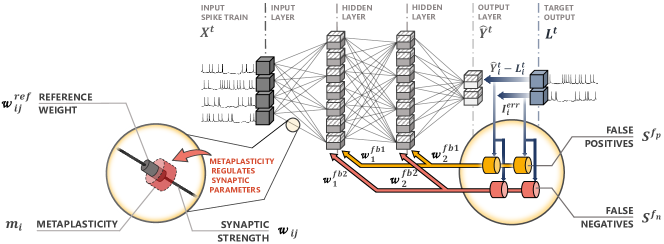
- TACOSは、事前および事後のシナプス活動に基づき、動的にシナプス強度を調整する活動依存的メタプラスティシティを有する複雑なシナプスモデルを採用する。
- 強化されたシナプスの自発的崩壊を抑制するシナプスコンsolidationを統合し、長期記憶保持を強化する。
- 不活性なシナプスを弱めるためにヘテロシナプス性崩壊を適用し、選択的可塑性を促進し、干渉を低減する。
- 誤差駆動型神経調節が、予測誤差が生じた場合にのみ学習更新をトリガーし、効率的で標的指向の可塑性を実現する。
- すべての学習ルールがシナプス局所的であり、グローバルなタスク情報や外部の監視信号を必要としない。
- モデルは学習したタスク数に依存せず、固定されたパラメータ数とメモリサイズを維持する。
実験結果
リサーチクエスチョン
- RQ1メタプラスティシティやシナプスコンsolidationといった神経科学的インスパイアされたメカニズムは、タスク境界情報なしにスパikingニューラルネットワークにおける災難的忘却を軽減できるか?
- RQ2固定されたメタプラスティシティ状態と比較して、活動依存的メタプラスティシティは、安定性と可塑性のバランスをどのように果たすか?
- RQ3限られた訓練データで、多数の順次的タスクに対してTACOSがどれほど高い性能を維持できるか?
- RQ4連続的学習における可塑性と安定性のトレードオフは、メタプラスティシティの異なるレベルによってどのように変化するか?
- RQ5TACOSは、Omniglotにおける少サンプルやドメインインクリメンタル学習といった、困難な現実世界の連続的学習シナリオにも一般化可能か?
主な発見
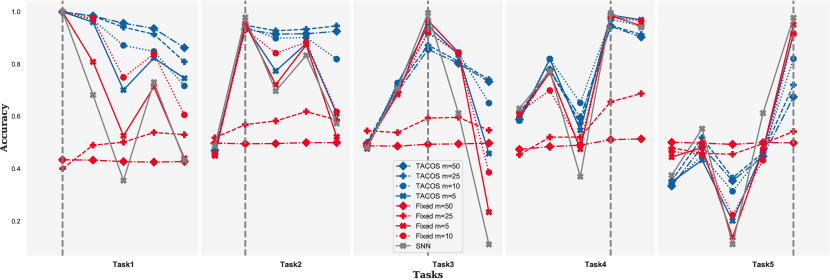
- TACOSは、split-MNISTおよびsplit-FMNISTタスクにおいて、ベースラインSNNと比較して災難的干渉を約5倍軽減した。
- ベースラインと比較して、約3倍低い可塑性を有しながらも、TACOSは全タスクで平均精度が22%高い性能を達成した。
- 50タスクのsplit-Omniglotベンチマークにおいて、低メタプラスティシティ(m=25)は、ベースラインSNNと比較して最終平均精度を6%向上させた。
- 最大メタプラスティシティ状態がm=25で性能に転換点が観察されたことから、安定性と可塑性の最適なバランスが達成されていることが示された。
- アブレーションスタディにより、メタプラスティシティとシナプスコンsolidationの両方が、忘却の軽減と記憶保持の向上に独立して寄与することが確認された。
- 訓練データの減少による性能低下は、タスクの持続時間に応じてメタプラスティシティおよびコンsolidationパラメータをスケーリングすることで緩和可能である。
より良い研究を、今すぐ始めましょう
論文の読解から最終レビューまで、研究時間を劇的に削減しましょう。
クレジットカード登録不要
このレビューはAIが作成し、人間の編集者が確認しました。