
[論文レビュー] TCAN: Text-oriented Cross Attention Network for Multimodal Sentiment Analysis
TCANは、視覚的および聴覚的モダリティの統合においてテキストモダリティを優位なガイドとして用いる、テキスト指向のクロスアテンションネットワークを提案する。テキストクエリドクロスアテンションとゲート付きメカニズム、およびユニモダルドメインの共同学習を用いることで、CMU-MOSIおよびCMU-MOSEIで最先端の性能を達成し、モダリティの寄与を効果的にバランスさせ、ノイズの影響を低減している。
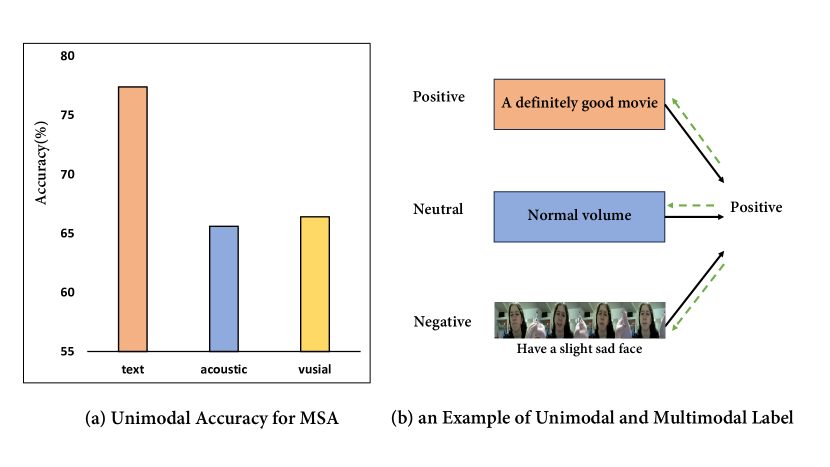
Multimodal Sentiment Analysis (MSA) endeavors to understand human sentiment by leveraging language, visual, and acoustic modalities. Despite the remarkable performance exhibited by previous MSA approaches, the presence of inherent multimodal heterogeneities poses a challenge, with the contribution of different modalities varying considerably. Past research predominantly focused on improving representation learning techniques and feature fusion strategies. However, many of these efforts overlooked the variation in semantic richness among different modalities, treating each modality uniformly. This approach may lead to underestimating the significance of strong modalities while overemphasizing the importance of weak ones. Motivated by these insights, we introduce a Text-oriented Cross-Attention Network (TCAN), emphasizing the predominant role of the text modality in MSA. Specifically, for each multimodal sample, by taking unaligned sequences of the three modalities as inputs, we initially allocate the extracted unimodal features into a visual-text and an acoustic-text pair. Subsequently, we implement self-attention on the text modality and apply text-queried cross-attention to the visual and acoustic modalities. To mitigate the influence of noise signals and redundant features, we incorporate a gated control mechanism into the framework. Additionally, we introduce unimodal joint learning to gain a deeper understanding of homogeneous emotional tendencies across diverse modalities through backpropagation. Experimental results demonstrate that TCAN consistently outperforms state-of-the-art MSA methods on two datasets (CMU-MOSI and CMU-MOSEI).
研究の動機と目的
- マルチモーダルセンチメント分析におけるモダリティ寄与の不均衡を解消すること、特に意味的豊かさが高くノイズが少ないテキストのような強力なモダリティがしばしば軽視される問題に対処すること。
- 非同期な視覚的および聴覚的シーケンスにおけるノイズおよび冗長性を軽減すること、マルチモーダル統合の過程で。
- テキストと他のモダリティ間の双方向的かつ相互作用的な学習を可能にすることで、表現学習を向上させること。
- 意味的豊かさに基づいて、異なるモダリティの寄与を動的にバランスできる柔軟なフレームワークを開発すること。
- ベンチマークとしてのマルチモーダルセンチメント分析データセットにおいて、既存の最先端手法を上回ること。
提案手法
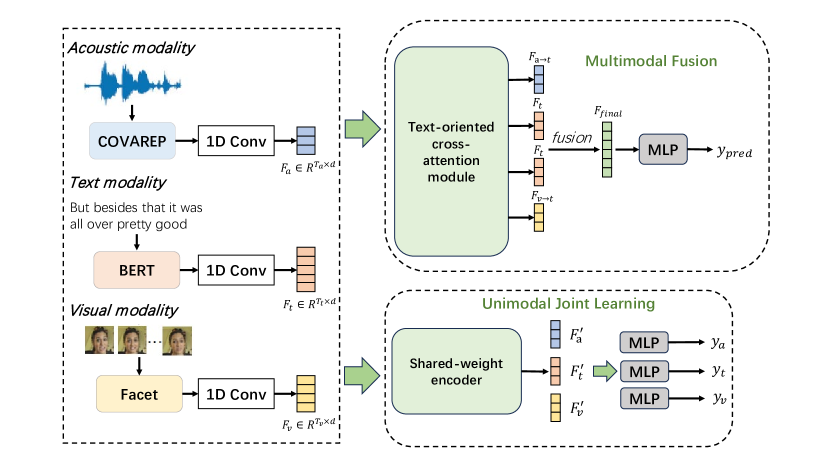
- モデルは2つのバイモダル統合モジュール(テキスト-視覚(TV)およびテキスト-聴覚(TA))を用い、テキストモダリティが他のモダリティに対するクロスアテンションのクエリとして機能する。
- テキストモダリティに対して自己アテンションを適用し、視覚的および聴覚的特徴とのクロスアテンションの前に内部表現を強化する。
- 視覚的および聴覚的モダリティにおけるノイズおよび冗長な特徴を抑制するため、ゲート制御機構を導入する。
- 共有されたセンチメント信号を逆伝播することで、モダリティ間の表現を整えるためにユニモダルドメインの共同学習を採用する。
- テキスト指向のクロスアテンションメカニズムを備えたスタックドトランスフォーマーに基づくアーキテクチャであり、マルチモーダル表現の反復的精錬を可能にする。
- テキスト指向クロスアテンションモジュールの数(N)は調整可能であり、CMU-MOSIで最適な性能がN=5で達成されている。
実験結果
リサーチクエスチョン
- RQ1意味的豊かさが高くノイズが少ないテキストモダリティを、効果的に優先するマルチモーダルセンチメント分析モデルはどのように構築できるか?
- RQ2非同期なマルチモーダルシーケンスにおいて、対称的三モダル統合と比較して、テキストクエリドクロスアテンションはどの程度統合性能を向上させ得るか?
- RQ3ゲート付きメカニズムの導入は、マルチモーダル統合におけるノイズ抑制および性能の安定性にどのような影響を及えるか?
- RQ4TCANにおける最適なクロスアテンションレイヤー数(N)は何か?これは表現の深さとモダリティのガイドランスのバランスを取るために重要である。
- RQ5ユニモダルドメインおよびマルチモーダルトレーニングの併用は、異なるモダリティ間での一貫性および一般化性能を向上させるか?
主な発見
- TCANはCMU-MOSIおよびCMU-MOSEIの両データセットで最先端の性能を達成し、F1スコアにおいて既存の最先端手法を上回っている。
- アブレーションスタディの結果、ゲート機構を削除するかユニモダルドメインの共同学習を排除すると、性能が著しく低下することが確認され、これらが有効であることを裏付けている。
- テキストモダリティが優位なモダリティとして置き換えられると、モデルの性能が著しく低下するため、テキストの意味的優位性が確認された。
- CMU-MOSIにおける最適なテキスト指向クロスアテンションモジュール数はN=5であり、Nをこの値を超えて増加させると、過学習またはガイドランスの劣化により性能が低下する。
- 可視化結果から、TCANは強力なモダリティ(例:テキスト)に高い重みを割り当てており、弱いまたは矛盾する視覚的および聴覚的モダリティの信号に対しても補正を行っていることが示された。
- 単一モダリティの予測が矛盾する曖昧なケースに対しても、モデルはマルチモーダルの正例に近い予測を効果的に生成している。
この論文を読む
Nubintのビューアで原文を開き、読みながら気になる箇所をすぐに質問できます。
Nubintでこの論文を読むこのレビューはAIが論文の原文をもとに作成しました。引用する前に原文をご確認ください。