
[論文レビュー] The 10 parsec sample in the Gaia era: first update
本稿はGaia DR3データを用いて10パーセク以内のサンプルを更新し、太陽から10パーセク圏内の336システムに属する541個の恒星、褐色矮星、系外惑星の体積完全な全数調査を実施した。高精度な位置定測、径方向速度、および新たな物理学的パラメータを統合し、特に近接連星系、褐色矮星、系外惑星分野で顕著な更新がなされた。85個の確認済み系外惑星が含まれ、ベンチマーク星の運動学的・化学的診断が向上した。
The nearest stars provide a fundamental constraint for our understanding of stellar physics and the Galaxy. The nearby sample serves as an anchor where all objects can be studied and understood with precise data. This work is an update of the 10 pc sample published by Reylé et al. (2021) that used the unprecedented high precision parallax measurements from the early third data release of the astrometric space mission Gaia. We review this census, all updates being related to close binaries, brown dwarfs and exoplanets. We provide a new catalogue of 541 stars, brown dwarfs, and exoplanets in 336 systems within 10 pc from the Sun. This list is as volume-complete as possible from current knowledge and it provides a list of benchmark stars. We also explore the new products made available in the most recent third Gaia data release.
研究の動機と目的
- 太陽から10パーセク圏内のすべての恒星、褐色矮星、系外惑星システムについて、体積完全で最新の全数調査を提供すること。
- Gaia DR3の向上した位置定測、径方向速度、物理学的パラメータを活用し、物体分類および運動学的解析の精度を向上させること。
- 改良された parallax 測定と軌道解法を用いて、誤って付与された伴星や遠方の背景天体といった、過去の誤分類を特定・是正すること。
- 将来的な高精度な近接恒星系研究のための包括的でベンチマーク品質のリストを確立すること。
- 変動性、連星性、化学成分濃度指標といった、新しいGaia DR3製品が近接恒星集団に与える影響を検討すること。
提案手法
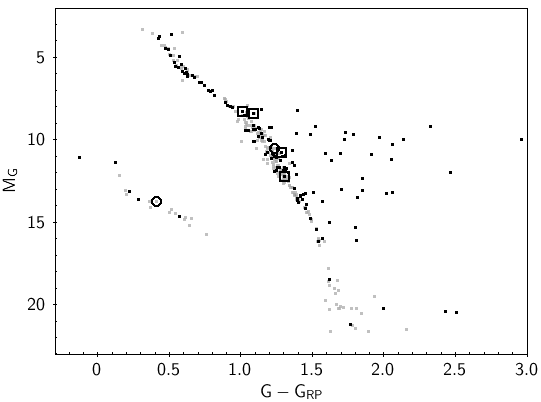
- Gaia DR3の位置定測、光度測定、径方向速度、スペクトル型を用いて、10パーセク圏内の336システムに属する541個の物体(371個の恒星、85個の褐色矮星、85個の系外惑星)の新しいカタログを編集した。
- Gaia DR3および外部ソース(例:ハッブル宇宙望遠鏡、適応光学)からの更新済み parallax 測定値を適用し、距離を再評価し、10パーセクを超える物体を除外した。
- Gaia DR3の位置定測軌道解法を用いて、誤って付与された伴星(例:GJ 666 A からの伴星を GJ 666 B に再割り当て)を是正した。
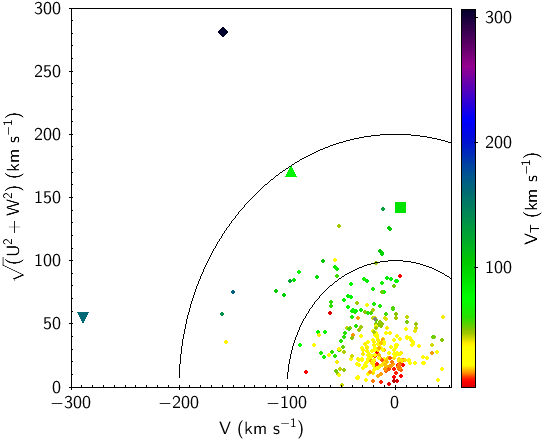
- 309個の恒星のGaia DR3径方向速度データを評価し、信頼性の低い測定値(例:EGGR 290)を除外して、銀河基準フレームにおける補正済み空間速度を算出した。
- Gaia DR3が校正した物理学的パラメータ(品質フラグ ≤1)を用いて、[α/Fe] 対 [M/H] 図を分析し、恒星集団を分類した。
- 1σの誤差範囲で10パーセクの限界に一致する可能性がある21個の恒星および褐色矮星候補、および COMMENT フィールドに記載された系外惑星候補を特定・リスト化した。
実験結果
リサーチクエスチョン
- RQ1Gaia DR3データの統合により、10パーセク恒星全数調査の完全性と正確性はどのように向上したか?
- RQ2Gaia DR3の位置定測および径方向速度を用いて、特に連星系や褐色矮星において、過去に誤分類されていた物体はどれが是正されたか?
- RQ3近接恒星の運動学的特性(例:横方向速度、全速度)の分布はどのようなものか?また、銀河構造とどのように関係しているか?
- RQ4新しいGaia DR3から得られた物理学的パラメータ(例:[α/Fe]、[M/H])は、近接恒星の化学的・動力学的分類にどのように寄与するか?
- RQ5現在、10パーセク体積内では系外惑星が恒星や褐色矮星を上回っていると見なせるか?これはサンプルの構成にどのような影響を与えるか?
主な発見
- 更新された10パーセクサンプルには、336システムに属する541個の物体が含まれ、そのうち371個の恒星(21個の白色矮星)、85個の褐色矮星、85個の確認済み系外惑星が含まれ、現在のデータで可能な限り体積完全なリストとなった。
- 8個の新しい系外惑星が追加され、その中にはハビタブルゾーンに地球質量の惑星(例:Wolf 1069 b)や、軌道通過を示す岩石惑星(例:HD 260655 b および c)が含まれる一方、2個のY型褐色矮星(CWISEP J2256+4002 および CWISEP J1810–1010)が新たに同定された。
- 改良された parallax 測定により、10パーセクを超える位置にあったり、誤って連星と分類された低質量天体が9個、サンプルから除外された(例:GJ 666 Ab、UPM J0815–2344 B、WISE J0811–8051)。
- Gaia DR3のおかげで、23個の恒星について径方向速度測定が可能になり、24個の恒星についても値が改善された。その結果、309個の恒星が完全な3次元運動学的特性を有するようになった。HD 103095は最高の全速度(312 km/s)と、著しい定常加速度(10.51 m s⁻¹ a⁻¹)を示した。
- Toomre 図は、大多数の近接恒星が薄い銀河ディスクに属することを示したが、一部(例:Kapteyn星、HD 103095)は高い速度を持つホール星であった。HD 103095は金属不足でα過剰であり、古くからある集団に属するものと一致する。
- [α/Fe] 対 [M/H] 図において、高品質な248個の恒星を分析した結果、HD 103095はα過剰で金属不足の領域に位置しており、古くからあるホール集団に属する恒星であり、極端な運動学的特性を示すことが裏付けられた。
この論文を読む
Nubintのビューアで原文を開き、読みながら気になる箇所をすぐに質問できます。
Nubintでこの論文を読むこのレビューはAIが論文の原文をもとに作成しました。引用する前に原文をご確認ください。