
[論文レビュー] The Generative AI Paradox: "What It Can Create, It May Not Understand"
要約: 本論文は Generative AI Paradox を検証する。生成能力は多言語・視覚の理解を超えることがあり、生成と理解の整合性が弱いことを示す。
The recent wave of generative AI has sparked unprecedented global attention, with both excitement and concern over potentially superhuman levels of artificial intelligence: models now take only seconds to produce outputs that would challenge or exceed the capabilities even of expert humans. At the same time, models still show basic errors in understanding that would not be expected even in non-expert humans. This presents us with an apparent paradox: how do we reconcile seemingly superhuman capabilities with the persistence of errors that few humans would make? In this work, we posit that this tension reflects a divergence in the configuration of intelligence in today's generative models relative to intelligence in humans. Specifically, we propose and test the Generative AI Paradox hypothesis: generative models, having been trained directly to reproduce expert-like outputs, acquire generative capabilities that are not contingent upon -- and can therefore exceed -- their ability to understand those same types of outputs. This contrasts with humans, for whom basic understanding almost always precedes the ability to generate expert-level outputs. We test this hypothesis through controlled experiments analyzing generation vs. understanding in generative models, across both language and image modalities. Our results show that although models can outperform humans in generation, they consistently fall short of human capabilities in measures of understanding, as well as weaker correlation between generation and understanding performance, and more brittleness to adversarial inputs. Our findings support the hypothesis that models' generative capability may not be contingent upon understanding capability, and call for caution in interpreting artificial intelligence by analogy to human intelligence.
研究の動機と目的
- Generative AI Paradox仮説を動機づけ、形式化する:生成は理解を超えることがあり得る、という仮説を人間と比較して定式化。
- 言語と視覚モデルにおける生成と理解を比較する統制実験を設計する。
- タスクおよびモダリティ全体で、識別性能(理解度)と生成性能の関係を定量化する。
- 敵対的入力やタスク難易度に対する理解の頑健性を評価する。
- 人間のような知能を超えるAI能力の解釈に対する示唆を議論する。
提案手法
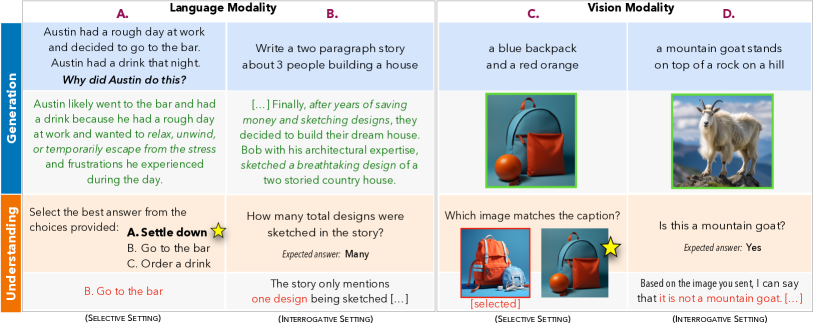
- 入力プロンプトを満たす 内容を生成することを生成と定義する;理解を選択的(識別的)および問合評価で評価する。
- 言語タスクではGPT-3.5, GPT-4、視覚タスクではMidjourney/CLIP/OpenCLIP/BLI P-2, BingChat, Bardを対象に、選択的および問合の設定で評価する。
- 理解と生成性能を同時に測るため、識別的タスク(例:多肢選択)を用いる。
- 視覚領域では、生成品質(画像プロンプト)をCLIP/OpenCLIPを用いた識別タスクと比較する。
- 自己生成内容についてモデルに質問させる問合評価(言語)や、生成画像について質問させる問合評価(視覚)を実施する。
- 敵対条件下での頑健性を probe するために難易/易しいネガティブ候補を組み込む。
実験結果
リサーチクエスチョン
- RQ1最先端モデルの生成性能は、同じタスクで人間の性能を超えるのか。
- RQ2生成能力が一致している場合、識別的理解は人間よりモデルが遅れているのか。
- RQ3自己生成出力についての質問(問合評価)に人間のような正確さで答えられるのか。
- RQ4タスク難易度とネガティブ候補の質は、モデルの理解と生成にどう影響するのか。
- RQ5言語と視覚のモダリティ間の違いは、生成と理解の関係性に影響を与えるのか。
主な発見
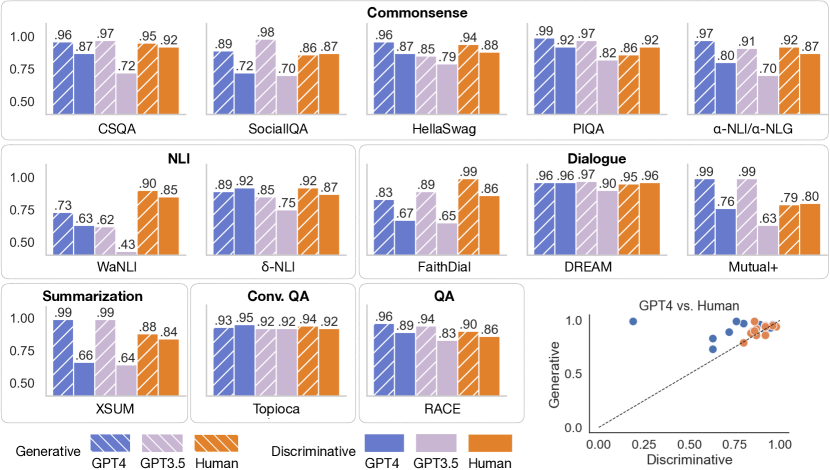
- 多くのデータセットで、生成では人間を上回るが、識別的理解では人間を下回る。
- 識別性能は、人間では生成性能とより密接に結びつく一方、GPT-4では必ずしもそうでない。
- 敵対的入力に対する識別の頑健性は人間よりモデルが劣り、タスク難易度が上がると人間とモデルの差が広がる。
- 問合評価では、自己生成内容についての質問に対してモデルは誤答することが多いが、人間は高い正確さを維持する。
- 視覚では、生成品質は人間を上回るが、生成画像に関する内容問に対する理解は遅れる。
- 言語領域では、13データセット中10件で少なくとも1モデルでサブ仮説1を支持;GPT-3.5とGPT-4の両方で7件が該当。
- 視覚領域では、CLIP/OpenCLIPによる識別精度は人間の精度を下回る一方、生成品質は高水準を維持。
この論文を読む
Nubintのビューアで原文を開き、読みながら気になる箇所をすぐに質問できます。
Nubintでこの論文を読むこのレビューはAIが論文の原文をもとに作成しました。引用する前に原文をご確認ください。