
[論文レビュー] The Star-Forming Main Sequence in JADES and CEERS at $z>1.4$: Investigating the Burstiness of Star Formation
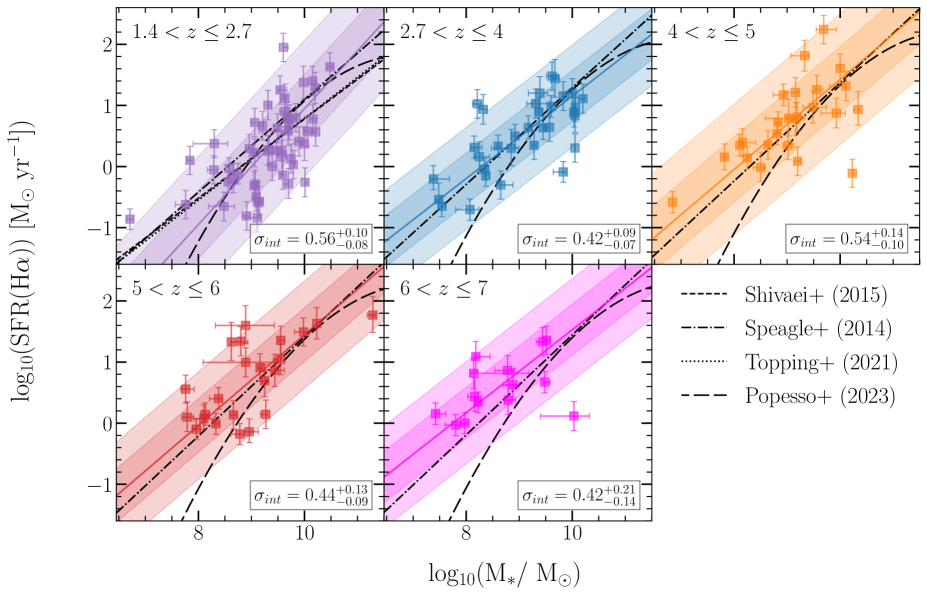
本研究では、CEERSおよびJADES調査のJWST/NIRSpecおよびNIRCamデータを用い、$z>1.4$における星形成メインシーケンス(SFMS)を分析し、H$\alpha$、UV、SEDフィッティング法による星形成率(SFR)を比較した。H$\alpha$ベースのSFMSにおける固有分散がUVベースのSFMSよりも$0.21 \pm 0.05$ dex大きいことが判明し、初期銀河におけるバースト型星形成歴の強力な証拠を提供した。
We have used public JWST/NIRSpec and JWST/NIRCam observations from the CEERS and JADES surveys in order to analyze the star-forming main sequence (SFMS) over the redshift range $1.4 \leq z < 7$. We calculate the star-formation rates (SFRs) of the galaxy sample using three approaches: Balmer line luminosity, spectral energy distribution (SED) fitting, and UV luminosity. We find a larger degree of scatter about the SFMS using the Balmer-based SFRs compared to the UV-based SFRs. Because these SFR indicators are sensitive to star formation on different time scales, the difference in scatter may be evidence of bursty star-formation histories in the early universe. We additionally compare the H$α$-to-UV luminosity ratio (L(H$α$)/$ν$L$_{ν,1600}$) for individual galaxies in the sample and find that 29\%$-$52\% of the ratios across the sample are poorly described by predictions from a smooth star-formation history. Measuring the burstiness of star formation in the early universe has multiple significant implications, such as deriving accurate physical parameters from SED fitting, explaining the evolution of the UV luminosity function, and providing constraints for sub-grid models of feedback in simulations of galaxy formation and evolution.
研究の動機と目的
- 高赤方偏移銀河($z>1.4$)における星形成のバースト性を、複数のSFR指標を用いて調査すること。
- H$\alpha$、UV、SEDフィッティングといった異なるSFR指標が星形成メインシーケンス(SFMS)を測定する際、どのように比較されるかを評価すること。
- 星形成メインシーケンスの固有分散が星質量に依存するかどうかを特定し、質量依存のバースト性を検証すること。
- バースト型SFHがSEDフィッティング、UV絶対等級関数の進化、銀河形成シミュレーションにおけるフィードバックモデルに与える影響を評価すること。
提案手法
- CEERSおよびJADES調査の公開済みJWST/NIRSpecおよびNIRCam観測データを用い、$z>1.4$銀河のスペクトロスコピック赤方偏移および線幅放射度を取得した。
- 星形成率(SFR)を3つの独立した手法で計算した:H$\alpha$光度(約5 Myrの時標識に敏感)、UV光度(約100 Myrの時標識に敏感)、SEDフィッティング(より長い時間スケールにわたる積分)。
- 各SFR指標におけるSFMSの固有分散を測定し、バースト性を定量化した。星形成が確率的である場合、H$\alpha$ベースの分散がより大きくなることが予想された。
- 個々の銀河におけるH$\alpha$光度とUV光度比(L(H$\alpha$)/$\nu$ L$_{\nu,1600}$)を計算し、100 Myrにわたる定常SFRモデルの予測と比較した。
- 誤差伝搬および分散分解の統計的手法を用い、測定ノイズから固有分散を分離した。
- ほこりの減光、IMFの変動、中性ガス放出の不完全性といった潜在的バイアスを評価し、それらが主な結果に顕著に影響を与える可能性は低いと結論した。

実験結果
リサーチクエスチョン
- RQ1高赤方偏移銀河($z>1.4$)において、短い時標識(H$\alpha$)と長い時標識(UV)のSFR指標におけるSFMSの固有分散に差があるか?
- RQ2高赤方偏移銀河のH$\alpha$対UV光度比は、100 Myrにわたる定常星形成歴モデルの予測からどの程度逸脱しているか?
- RQ3$z>1.4$の銀河におけるSFMSの固有分散に質量依存性があるか?
- RQ4バースト型星形成歴がSEDベースの星質量推定値およびUV絶対等級関数の進化に与える影響はいかなるものか?
主な発見
- H$\alpha$ベースのSFMSにおける固有分散は、UVベースのSFMSよりも$0.21 \pm 0.05$ dex大きい。これは、短い時標識SFR指標がバースト型星形成により敏感であることを示唆している。
- サンプル内の約29%~52%の銀河が、100 Myrにわたる定常SFRモデルの予測と一致しないH$\alpha$対UV光度比を示しており、それらのSFHに顕著なバースト性があることを示唆している。
- 現在のサンプル内では、SFMSの固有分散に星質量依存性は観測されなかったが、明確に確認するにはより広い星質量動的範囲が必要である。
- H$\alpha$対UV比の観測された分散は、確率的星形成の存在をさらに支持しており、その偏差は最近のまたは周期的な星形成エピソードを示している。
- これらの結果は、SEDフィッティング中に滑らかまたは定常なSFHを仮定すると、星質量推定値に系統的バイアスが生じる可能性があり、バースト型システムでは最大で0.8 dexの過小評価が生じ得ることを示唆している。
- これらの発見は、高赤方偏移UV絶対等級関数の明るい端の過剰を再現するための、銀河形成シミュレーションにおける小スケールフィードバックおよび星形成モデルに観測的制約を提供する。
この論文を読む
Nubintのビューアで原文を開き、読みながら気になる箇所をすぐに質問できます。
Nubintでこの論文を読むこのレビューはAIが論文の原文をもとに作成しました。引用する前に原文をご確認ください。