
[論文レビュー] Toward Grounded Commonsense Reasoning
この論文では、ロボットにおける接地された社会的推論のためのフレームワークを提案する。大規模言語モデル(LLM)と視覚言語モデル(VLM)を組み合わせ、ターゲットのクローズアップ観察を通じて環境を能動的に把握することで、社会的に適切な意思決定を向上させる。本手法は、アクティブなビジョンを用いないベースラインと比較して、MessySurfacesベンチマークで平均12.9%、実ロボット実験で15%の改善を達成した。
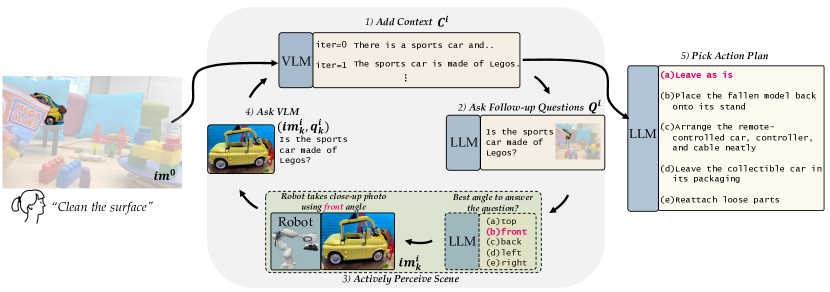
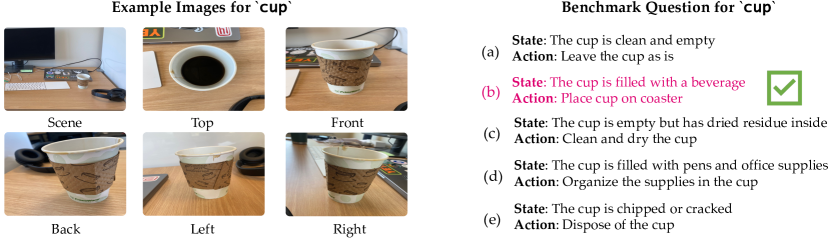
Consider a robot tasked with tidying a desk with a meticulously constructed Lego sports car. A human may recognize that it is not appropriate to disassemble the sports car and put it away as part of the "tidying." How can a robot reach that conclusion? Although large language models (LLMs) have recently been used to enable commonsense reasoning, grounding this reasoning in the real world has been challenging. To reason in the real world, robots must go beyond passively querying LLMs and actively gather information from the environment that is required to make the right decision. For instance, after detecting that there is an occluded car, the robot may need to actively perceive the car to know whether it is an advanced model car made out of Legos or a toy car built by a toddler. We propose an approach that leverages an LLM and vision language model (VLM) to help a robot actively perceive its environment to perform grounded commonsense reasoning. To evaluate our framework at scale, we release the MessySurfaces dataset which contains images of 70 real-world surfaces that need to be cleaned. We additionally illustrate our approach with a robot on 2 carefully designed surfaces. We find an average 12.9% improvement on the MessySurfaces benchmark and an average 15% improvement on the robot experiments over baselines that do not use active perception. The dataset, code, and videos of our approach can be found at https://minaek.github.io/grounded_commonsense_reasoning.
研究の動機と目的
- 人間の介入なしに、現実世界の環境で社会的に適切な清掃意思決定をとるロボットの実現。
- 被動的なLLMおよびVLM推論の限界を克服するため、欠落した知覚的文脈を収集するアクティブなビジョンの導入。
- 社会的推論に必要な情報が欠落していることを特定し、ターゲットの観察によって能動的に取得するシステムの開発。
- 新規の現実世界データセットと実ロボット実験を用いて、スケールにわたるフレームワークの評価。
- 再現可能性と今後の研究を支援するため、MessySurfacesデータセット、コード、動画の公開。
提案手法
- フレームワークは、シーン画像を分析し、社会的推論に必要な明確化が必要なオブジェクトについての追加質問を生成するLLMを使用する。
- ロボットはLLMが提案する角度から、オブジェクトのターゲットのクローズアップ画像を撮影して曇りを解消する。
- 視覚言語モデル(VLM)はクローズアップ画像を処理し、意思決定に適した詳細で文脈豊かな記述を提供する。
- LLMは、追加の観察を要請することで、繰り返し理解を精緻化し、社会的に適切な行動意思決定を下す。
- 最終的な行動(例:レゴカーをそのままで残す、食べかけのバナナを廃棄する)は、コンテキスト内学習を用いて実行可能なロボットAPIコールに変換される。
- 本システムは、新規のベンチマークデータセット(MessySurfaces)および制御されたデスク環境を備えた実世界のロボットプラットフォームの両方で評価された。
実験結果
リサーチクエスチョン
- RQ1アクティブなビジョンを用いることで、被動的なLLMおよびVLMの照会と比較して、社会的に適切なロボット意思決定の正確性が顕著に向上するか?
- RQ2LLM-VLMループは、現実世界のシーンにおける知覚的曇りを特定・解消するのにどの程度効果的か?
- RQ3LLMが生成する質問に従って、ロボットが能動的にビジョンを活用する戦略が、現実世界の清掃タスクにおける意思決定品質をどの程度向上させるか?
- RQ4多様で現実の雑然とした表面、さまざまなオブジェクトタイプおよび社会的規範を含む状況において、本フレームワークはどの程度の性能を示すか?
- RQ5本手法は、人間のフィードバックなしに、未確認のオブジェクトや状況に一般化可能か?
主な発見
- アクティブなビジョンを使用しないベースラインと比較して、本フレームワークはMessySurfacesベンチマークで平均12.9%の改善を達成した。
- 実ロボット実験では、被動なベースラインと比較して、社会的に適切な意思決定において平均15%の改善が見られた。
- LLMが生成した追加質問は、オブジェクトが貴重なモデルかおもちゃかを特定するような重要な曇りを効果的に特定した。
- LLMが提案する角度からのクローズアップ画像撮影というロボットのアクティブビジョン戦略により、VLMのレゴピースや食品の腐敗といった重要な詳細の検出能力が顕著に向上した。
- 本システムは、レゴカーのような複雑なオブジェクトを安全に保持し、不適切なアイテム(例:食べかけのバナナ)のみを廃棄することができた。
- 公開されたMessySurfacesデータセットに加え、コードと動画のおかげで、現実世界における接地された社会的推論の再現可能な評価が可能になった。
この論文を読む
Nubintのビューアで原文を開き、読みながら気になる箇所をすぐに質問できます。
Nubintでこの論文を読むこのレビューはAIが論文の原文をもとに作成しました。引用する前に原文をご確認ください。