
[論文レビュー] Towards physically consistent data-driven weather forecasting: Integrating data assimilation with equivariance-preserving deep spatial transformers
本論文は、回転およびスケーリングの対称性を保持する等長性を保つ深層空間トランスフォーマー、ノイズの多い観測値を処理するためのシグマ・ポイント集合カルマンフィルタ(SPEnKF)、および仮想観測値を用いた複数時間ステップアルゴリズムを統合することで、物理的に整合性のあるデータ駆動型気象予報フレームワークを提案する。このフレームワークは、予報精度を最大45%向上させ、安定的かつ大規模なアンサンブル(O(1000))生成を可能にし、強固なデータ同化を実現する。
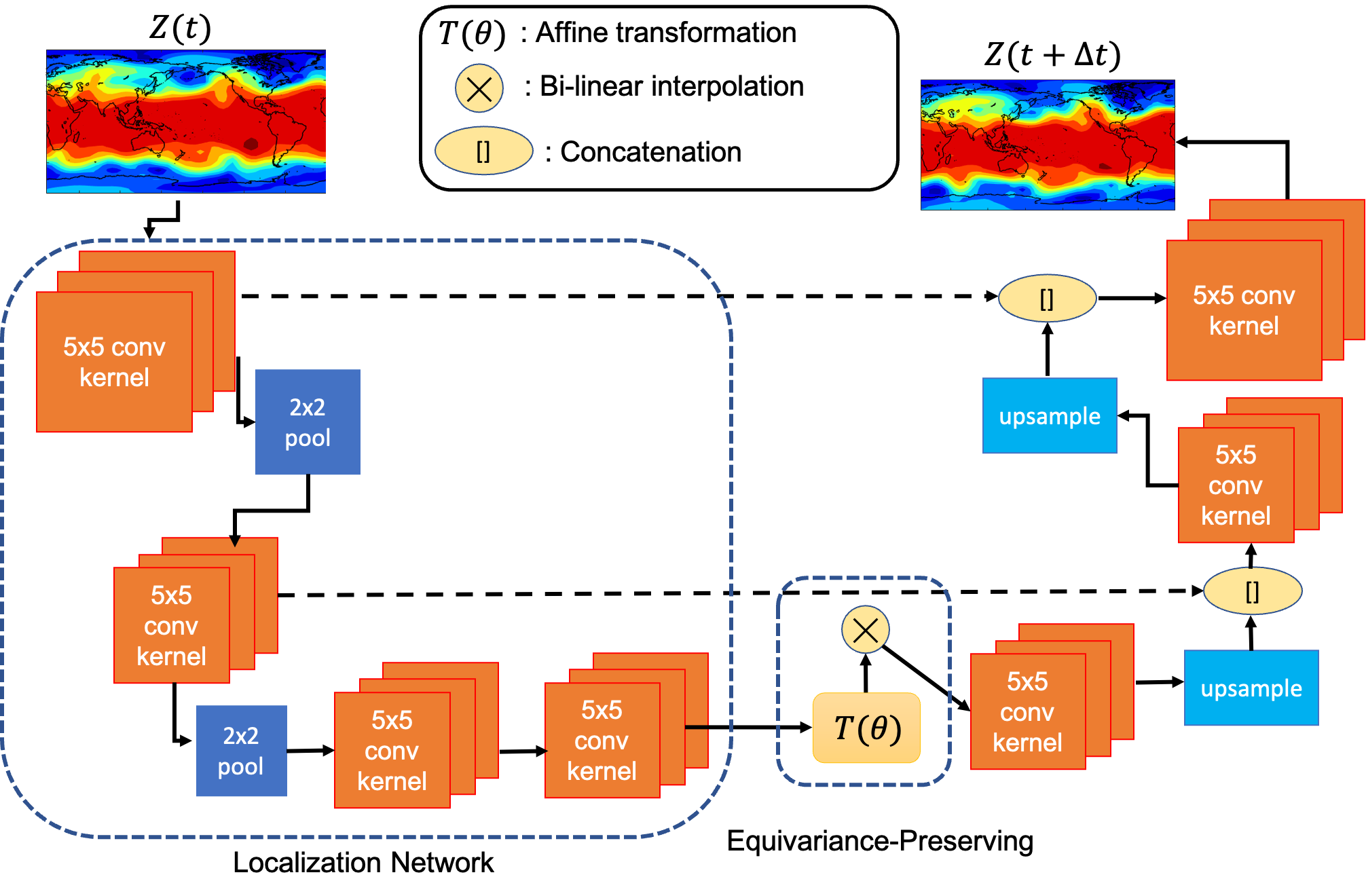
There is growing interest in data-driven weather prediction (DDWP), for example using convolutional neural networks such as U-NETs that are trained on data from models or reanalysis. Here, we propose 3 components to integrate with commonly used DDWP models in order to improve their physical consistency and forecast accuracy. These components are 1) a deep spatial transformer added to the latent space of the U-NETs to preserve a property called equivariance, which is related to correctly capturing rotations and scalings of features in spatio-temporal data, 2) a data-assimilation (DA) algorithm to ingest noisy observations and improve the initial conditions for next forecasts, and 3) a multi-time-step algorithm, which combines forecasts from DDWP models with different time steps through DA, improving the accuracy of forecasts at short intervals. To show the benefit/feasibility of each component, we use geopotential height at 500~hPa (Z500) from ERA5 reanalysis and examine the short-term forecast accuracy of specific setups of the DDWP framework. Results show that the equivariance-preserving networks (U-STNs) clearly outperform the U-NETs, for example improving the forecast skill by $45\%$. Using a sigma-point ensemble Kalman (SPEnKF) algorithm for DA and U-STN as the forward model, we show that stable, accurate DA cycles are achieved even with high observation noise. The DDWP+DA framework substantially benefits from large ($O(1000)$) ensembles that are inexpensively generated with the data-driven forward model in each DA cycle. The multi-time-step DDWP+DA framework also shows promises, e.g., it reduces the average error by factors of 2-3.
研究の動機と目的
- データ駆動型気象予報(DDWP)モデルにおける物理的整合性と予報精度の向上を目的とする。
- 大気の流れにおける回転やスケーリングの対称性を捉えることができない物理に依存しないニューラルネットワークの限界を克服することを目的とする。
- DDWPモデルから安価に大規模なアンサンブルを生成することで、ノイズの多い観測値を伴う安定的かつ正確なデータ同化を実現することを目的とする。
- 仮想観測値を用いた複数時間ステップフレームワークにより、短期予報精度を向上させることを目的とする。
- 気象にとどまらず、海洋や陸上など他の地球システム要因へも適用可能な柔軟でモジュラーなフレームワークの開発を目的とする。
提案手法
- U-NETの潜在空間に深層空間トランスフォーマー(U-STN)を導入し、回転およびスケーリングに対して不変性を保つことで、時空間的特徴量における物理的対称性を維持する。
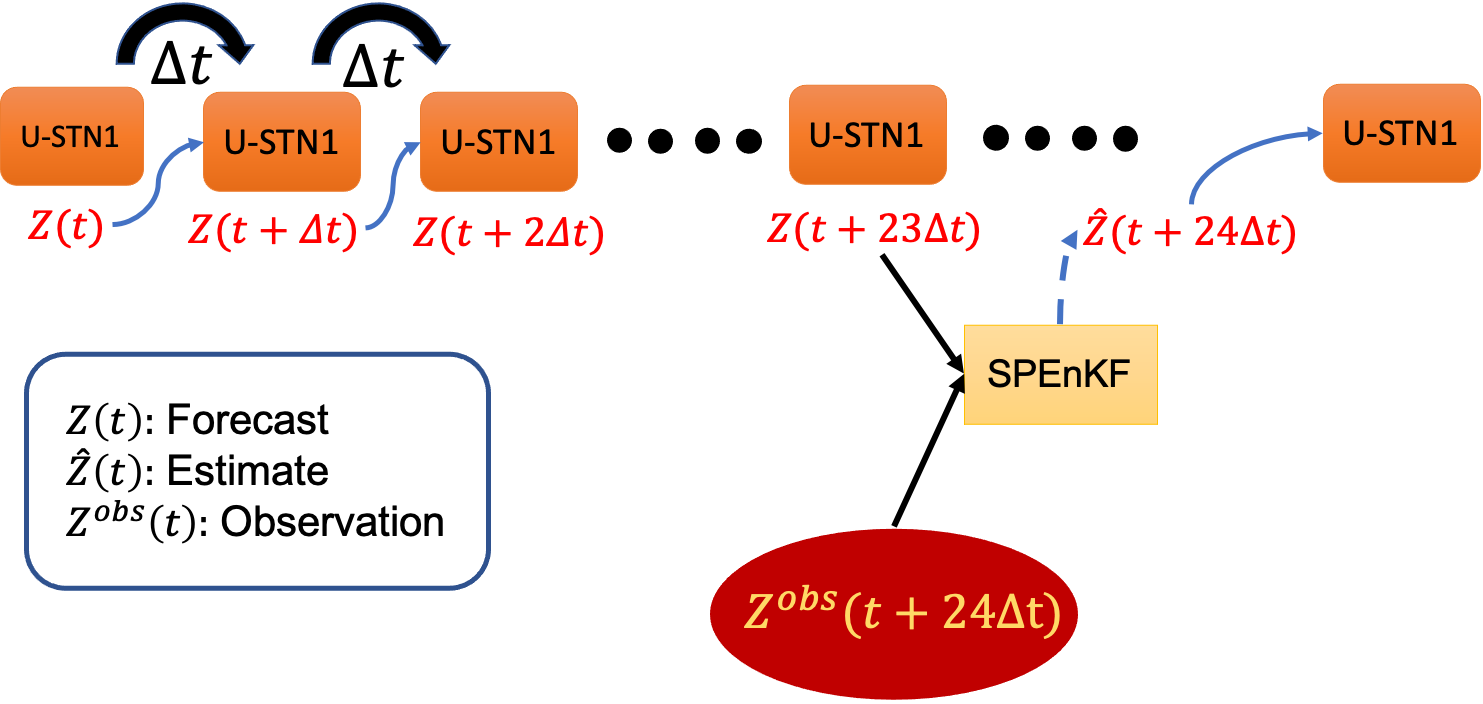
- データ同化(DA)アルゴリズムとしてシグマ・ポイント集合カルマンフィルタ(SPEnKF)を採用し、ノイズの多い観測値を処理し、初期状態を改善する。
- DDWPモデルを高速な前向きモデルとして用い、各DAサイクルでO(1000)のアンサンブルメンバーを安価に生成することで、安定性と精度を向上させる。
- 複数時間ステップモデル(例:U-STN1とU-STN12)の予報を組み合わせるための複数時間ステップアルゴリズムを提案し、中間予報を仮想観測値として同化する。
- 短期予報性能の評価のため、ERA5再解析データの500ヘクトパスカルにおけるジオポテンシャル高さ(Z500)を用いる。
- 将来の変分DAをサポートするため、自動微分を活用し、アンサンブルベースの手法にとどまらない互換性を拡張する。
実験結果
リサーチクエスチョン
- RQ1深層学習アーキテクチャに等長性を強制することで、データ駆動型気象モデルの物理的整合性と予報精度が向上するか?
- RQ2ノイズの多い観測値を効果的かつ安定的にデータ駆動型前向きモデルと結合できるか、特に安価に大規模なアンサンブルを生成できる場合に有効か?
- RQ3仮想観測値としての中間予報を同化することで、複数時間ステップモデルの予報を統合することにより、短期予報精度が向上するか?
- RQ4等長性、データ同化、複数時間ステップ予測の統合は、標準的なU-NETベースラインと比較して、スキルと安定性の面で優れているか?
- RQ5このモジュラーなフレームワークは、海洋や陸上など他の地球システム要因へどの程度拡張可能か?
主な発見
- 等長性を保つU-STNモデルは、Z500データにおいて標準的なU-NETと比較して予報スキルを45%向上させ、物理的整合性の優位性を示した。
- SPEnKFを用いたDDWP+DAフレームワークは、安価に大規模なアンサンブルを生成できるため、高い観測ノイズ下でも安定的かつ正確なデータ同化サイクルを実現した。
- 1回のDAサイクルあたりO(1000)のアンサンブルメンバーを用いることで、DAの安定性と精度が顕著に向上し、誤差の蓄積が抑制され、初期状態推定が改善された。
- 複数時間ステップDDWP+DAフレームワークは、中間予報を仮想観測値として同化することで、平均予報誤差を2〜3倍低減した。
- フレームワークはモジュラーかつ柔軟であり、さまざまなU-NETアーキテクチャ、DA頻度、アンサンブルベースまたは変分DAアルゴリズムへの統合が可能である。
- この手法は、データ成長と予報ニーズが急速に増加している海洋や陸上など、他の地球システム要因へも移植可能である。
より良い研究を、今すぐ始めましょう
論文の読解から最終レビューまで、研究時間を劇的に削減しましょう。
クレジットカード登録不要
このレビューはAIが作成し、人間の編集者が確認しました。