
[論文レビュー] Trajectory Design for Energy Minimization in UAV-enabled Wireless Communications with Latency Constraints
本稿では、ユーザーの遅延制約を満たしつつエネルギー消費を最小化するため、無人航空機(UAV)を用いた無線通信のための2段階トラジェクトリ設計を提案する。時間窓付き巡回セールスマン問題(TSPTW)に基づいて動的計画法(DP)を用い、近似的に最適な経路を特定し、ホップ間のUAV速度を同時に最適化する。DPは、著しく低い計算複雑性でほぼ全探索に近い性能を達成し、エネルギー効率およびアウトージー性能においてベンチマークを上回る。
This paper studies energy-efficient unmanned aerial vehicle (UAV)-enabled wireless communications, where the UAV acts as a flying base station (BS) to serve the ground users (GUs) within some predetermined latency constraints, e.g., requested timeout (RT). Our goal is to design the UAV trajectory to minimize the total energy consumption while satisfying the RT requirement and energy budget, which is accomplished via jointly optimizing the trajectory and UAV's velocities along subsequent hops. The corresponding optimization problem is difficult to solve due to its non-convexity and combinatorial nature. To overcome this difficulty, we solve the original problem via two consecutive steps. Firstly, we propose two algorithms, namely heuristic search, and dynamic programming (DP) to obtain a feasible set of trajectories without violating the GU's RT requirements based on the traveling salesman problem with time window (TSPTW). Then, they are compared with exhaustive search and traveling salesman problem (TSP) used as reference methods. While the exhaustive algorithm achieves the best performance at a high computation cost, the heuristic algorithm exhibits poorer performance with low complexity. As a result, the DP is proposed as a practical trade-off between the exhaustive and heuristic algorithms. Specifically, the DP algorithm results in near-optimal performance at a much lower complexity. Secondly, for given feasible trajectories, we propose an energy minimization problem via a joint optimization of the UAV's velocities along subsequent hops. Finally, numerical results are presented to demonstrate the effectiveness of our proposed algorithms. ...
研究の動機と目的
- 厳しいユーザーの遅延要件を満たしつつ、無線ネットワークにおけるUAVのエネルギー消費を最小化する課題に対処すること。
- 共同トラジェクトリおよび速度最適化問題の非凸的かつ組み合わせ的性質に起因する困難を克服すること。
- 地上ユーザーが要求するタイムアウト(RT)制約とエネルギー予算を満たす実行可能なトラジェクトリを設計すること。
- 全探索とヒューリスティック手法の間の実用的トレードオフを提案することで、性能と計算複雑性のバランスを図ること。
- 従来のインfrastrucureが不適切な動的またはスパarsなネットワーク環境において、エネルギー効率の高いUAV運用を可能にすること。
提案手法
- ユーザーの遅延制約を組み込むために、トラジェクトリ設計問題を時間窓付き巡回セールスマン問題(TSPTW)として定式化する。
- RT要件を違反しない実行可能なUAV経路を生成するため、ヒューリスティック探索と動的計画法(DP)の2つのアルゴリズムを提案する。
- 全探索の実用的代替手段としてDPを用い、計算複雑性を低減しつつほぼ最適な性能を達成する。
- 各実行可能経路に対して、式(11)のエネルギーモデルを用いて、ホップ間のUAV速度を同時に最適化し、合計エネルギー消費を最小化する。
- DPアルゴリズムから得られる最良の経路を統合し、2段階最適化(まず経路選択、次に速度最適化)を実施する。
- ブロック座標降下と逐次凸近似(SCA)を用いて、ウェイポイントへのトラジェクトリの微調整を可能とする拡張手法として検討する。
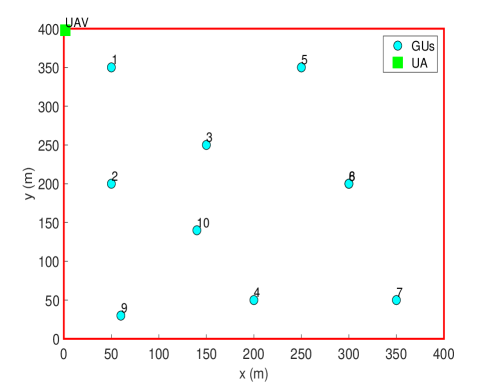
実験結果
リサーチクエスチョン
- RQ1厳しい遅延制約下で、UAVのトラジェクトリと速度を同時に最適化することで、エネルギー消費を最小化する方法は何か?
- RQ2ユーザーRT要件を満たす実行可能なUAV経路を求める際の、計算複雑性と性能のトレードオフは何か?
- RQ3動的計画法は、全探索に比べて著しく低い計算複雑性で、UAVトラジェクトリ計画においてほぼ最適な解を提供できるか?
- RQ4エネルギー効率およびアウトージー性能の観点から、本手法はTSPやヒューリスティック探索といったベースライン手法と比べてどのように優れているか?
- RQ5固定速度方式に比べて、可変速度トラジェクトリ設計はUAVのエネルギー効率をどの程度向上できるか?
主な発見
- 動的計画法(DP)アルゴリズムは、エネルギー消費においてほぼ全探索に近い性能を達成しながら、計算複雑性を顕著に低減した。
- DPに基づくトラジェクトリ設計により、平均エネルギー消費は全探索に非常に近い範囲にまで低下し、実行時間は著しく短くなった。
- ヒューリスティックアルゴリズムは、DPおよび全探索の両者よりも性能が劣り、ネットワークサイズが増大するに従いエネルギーギャップが拡大した。
- ネットワークサイズが大きくなると、移動距離が延びたり、特に$V_{ ext{max}}$が制限されている場合に速度要件が高くなるため、エネルギー消費が増加する。
- 全探索の実行時間は、地上ユーザー数の増加に伴い指数関数的に増加し、大規模な展開には現実的でない。
- 提案手法のDPベースのアプローチは、エネルギー消費およびアウトージー確率の両面でTSPベースの基準手法を上回り、優れたロバストネスと効率性を示した。
より良い研究を、今すぐ始めましょう
論文の読解から最終レビューまで、研究時間を劇的に削減しましょう。
クレジットカード登録不要
このレビューはAIが作成し、人間の編集者が確認しました。