
[論文レビュー] Ultrabroadband thin-film lithium tantalate modulator for high-speed communications
本論文は、リチウム tantalate-on-insulator (LTOI) プラットフォーム上に実装された110 GHzの超広帯域薄膜リチウム tantalate (LiTaO₃) マハチンドレ・モジュレータを提示し、176 GBd PAM8信号を用いて405 Gbit/sのネットデータレートを達成した。このデバイスは銀電極を採用することでマイクロ波損失を低減し、リチウムニオブートに比べて優れたDCバイアス安定性を示しており、高速でエネルギー効率の高い光通信のためのスケーラブルで低コストな代替手段としてLTOIを位置づけている。
The continuous growth of global data traffic over the past three decades, along with advances in disaggregated computing architectures, presents significant challenges for optical transceivers in communication networks and high-performance computing systems. Specifically, there is a growing need to significantly increase data rates while reducing energy consumption and cost. High-performance optical modulators based on materials such as InP, thin-film lithium niobate (LiNbO3), or plasmonics have been developed, with LiNbO3 excelling in high-speed and low-voltage modulation. Nonetheless, the widespread industrial adoption of thin film LiNbO3 remains compounded by the rather high cost of the underlying 'on insulator' substrates -- in sharp contrast to silicon photonics, which can benefit from strong synergies with high-volume applications in conventional microelectronics. Here, we demonstrate an integrated 110 GHz modulator using thin-film lithium tantalate (LiTaO3) -- a material platform that is already commercially used for millimeter-wave filters and that can hence build upon technological and economic synergies with existing high-volume applications to offer scalable low-cost manufacturing. We show that the LiTaO3 photonic integrated circuit based modulator can support 176 GBd PAM8 transmission at net data rates exceeding 400 Gbit/s. Moreover, we show that using silver electrodes can reduce microwave losses compared to previously employed gold electrodes. Our demonstration positions LiTaO3 modulator as a novel and highly promising integration platform for next-generation high-speed, energy-efficient, and cost-effective transceivers.
研究の動機と目的
- データセンターや通信ネットワークにおける光変調器の高データレート、低消費電力、低コスト化の需要に対応する。
- 薄膜リチウムニオブート (LNOI) モジュレータの優れた性能にもかかわらず、基板コストの高さが産業的採用を制限する障壁を克服する。
- ミリ波帯フィルターの既存の大量生産プロセスを活用し、コスト効率の高いスケーラブルな光集積回路を実現するため、リチウム tantalate (LiTaO₃) の既存製造基盤を活用する。
- 高周波信号伝送に適した電極およびデバイス設計を用いて、薄膜LiTaO₃ on insulator (LTOI) サブストレート上に高速で低損失かつ安定した電光モジュレータを実証する。
- 性能、安定性、製造可能性を統合したLTOIを、次世代光変調器におけるLNOIおよびシリコンフォトニクスの実用的代替手段として確立する。
提案手法
- CMiおよびIPHYSクリーンルーム施設を用いて、リチウム tantalate-on-insulator (LTOI) サブストレート上に薄膜リチウム tantalate (LiTaO₃) マハチンドレ・モジュレータ (MZM) をプロセスした。
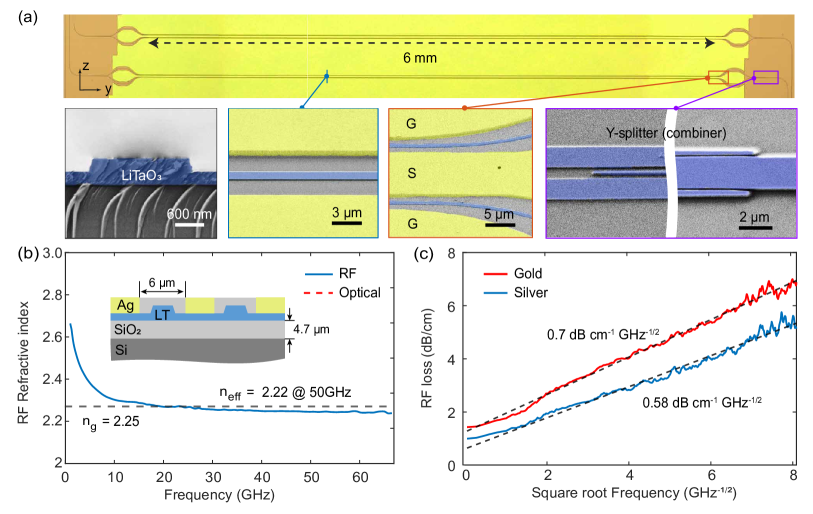
- 高周波電気信号伝送路におけるマイクロ波損失を低減するため、金に代えて銀電極を採用した。
- 高周波数帯域でのインピーダンスマッチングを向上させ、信号歪みを低減する目的で、グランド-シングル-グランド (GSG) 電極構造を設計した。
- MZMにおける効率的な光パワー分配と位相制御を実現するため、Y分岐器と波ガイド構造を採用した。
- 176 GBdまでのシンボルレートでPAM信号(PAM2、PAM4、PAM8)を用いた強度変調直接検出 (IMDD) 伝送実験を実施した。
- 対数尤度比 (LLR) および加法性白色ガウス雑音 (AWGN) チャネルモデルを用いて、誤りビット率 (BER)、達成情報レート (AIR)、ネットデータレート (NDR) を分析した。
実験結果
リサーチクエスチョン
- RQ1LTOIプラットフォーム上に実装された薄膜リチウム tantalate (LiTaO₃) モジュレータは、最先端のLNOIデバイスと同等の広帯域および低損失を達成できるか?
- RQ2リチウム tantalate モジュレータにおいて金電極を銀電極に置き換えることで、マイクロ波伝搬損失が顕著に低減するか?
- RQ3高速動作下におけるLTOIモジュレータのDCバイアス安定性は、LNOIモジュレータと比較して優れているか?
- RQ4高度な信号処理を用いたLTOIベースのMZMで、PAM信号を用いて達成可能な最大ネットデータレートは何か?
- RQ5既存の産業インfraを活用することで、LTOIプラットフォームは高速光モジュレータのスケーラブルで低コストな製造を可能にするか?
主な発見
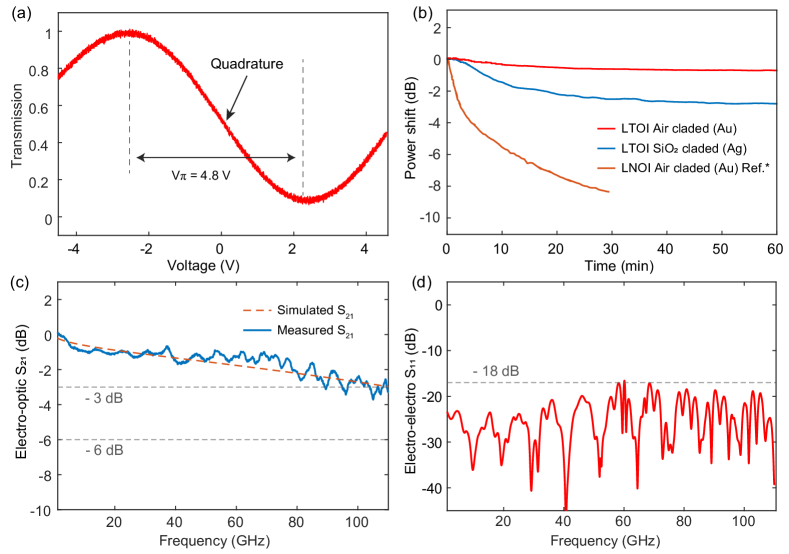
- LTOIベースのMZMは、110 GHzの電光3 dB帯域幅を達成し、次世代光リンクに適した高速動作を実現した。
- 銀電極を用いることで、金に比べてマイクロ波損失が低減され、高周波数帯での信号整合性が向上した。
- 同等のLNOIモジュレータと比較して、著しく低いDCバイアスドリフトを示し、長期的な安定性が向上した。
- 176 GBd PAM8信号を用いて405 Gbit/sのネットデータレートを達成し、BERは3.8×10⁻²に留まり、25%のソフトデシジョンFEC閾値を下回った。
- 達成された最高の情報レート (AIR) は432 Gbit/sであり、テラビットスケール伝送の可能性を示した。
- これらの結果は、LTOIがLNOIおよびシリコンフォトニクスの代替手段としてスケーラブルでコスト効率に優れた選択肢であることを示しており、LiTaO₃産業の既存製造連携による産業的採用の可能性が非常に高い。
この論文を読む
Nubintのビューアで原文を開き、読みながら気になる箇所をすぐに質問できます。
Nubintでこの論文を読むこのレビューはAIが論文の原文をもとに作成しました。引用する前に原文をご確認ください。