
[論文レビュー] UMD: Unsupervised Model Detection for X2X Backdoor Attacks
UMDは、任意の数のソースクラスが任意のターゲットクラスに誤分類されるX2Xバックドア攻撃を、敵対的(ソース, ターゲット)クラスペアを同時に推論することで、初めて非教師ありで検出する手法である。本手法は、新たな転送性統計(TR)を用いて、疑わしいバックドアペアをクラスタリングおよび選別し、集約されたトリガー統計に非教師あり異常検出を適用することで、CIFAR-10、GTSRB、ImagenetteでSOTA手法よりも17–18%高い検出精度を達成した。
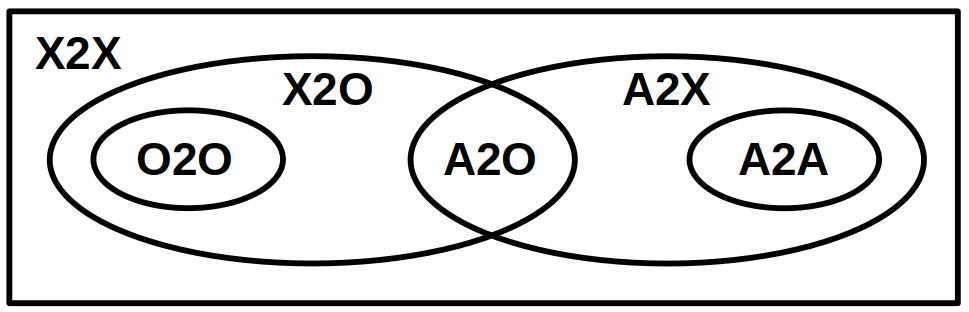
Backdoor (Trojan) attack is a common threat to deep neural networks, where samples from one or more source classes embedded with a backdoor trigger will be misclassified to adversarial target classes. Existing methods for detecting whether a classifier is backdoor attacked are mostly designed for attacks with a single adversarial target (e.g., all-to-one attack). To the best of our knowledge, without supervision, no existing methods can effectively address the more general X2X attack with an arbitrary number of source classes, each paired with an arbitrary target class. In this paper, we propose UMD, the first Unsupervised Model Detection method that effectively detects X2X backdoor attacks via a joint inference of the adversarial (source, target) class pairs. In particular, we first define a novel transferability statistic to measure and select a subset of putative backdoor class pairs based on a proposed clustering approach. Then, these selected class pairs are jointly assessed based on an aggregation of their reverse-engineered trigger size for detection inference, using a robust and unsupervised anomaly detector we proposed. We conduct comprehensive evaluations on CIFAR-10, GTSRB, and Imagenette dataset, and show that our unsupervised UMD outperforms SOTA detectors (even with supervision) by 17%, 4%, and 8%, respectively, in terms of the detection accuracy against diverse X2X attacks. We also show the strong detection performance of UMD against several strong adaptive attacks.
研究の動機と目的
- 任意の数のソースクラスとターゲットクラスペアを含むX2Xバックドア攻撃の非教師あり検出におけるギャップを埋める。
- 従来の検出器がすべて1対1や1対多攻撃に限定されているという制限を克服する。
- 訓練データ、健全なモデル、攻撃固有のシャロウ分類器へのアクセスなしに検出を可能にする。
- 従来の検出手法を回避する強力で適応的なバックドア攻撃に対しても耐性を持つ手法を開発する。
提案手法
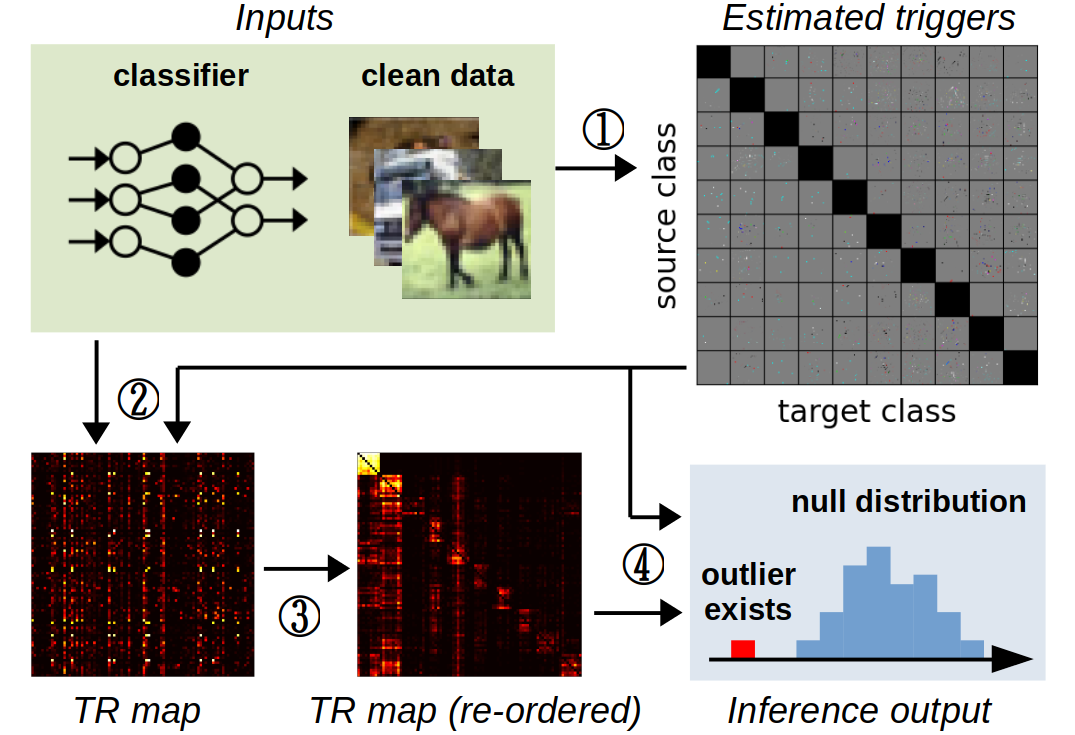
- 各順序付きクラスペア (i, j) に対して、その敵対的挙動を推定するための疑わしいトリガーを逆引きして推定する。
- 他のペアへのトリガー転送性に基づいて、あるクラスペアがバックドアである可能性を測るための新たな転送性統計(TR)を導入する。
- TR統計を用いた新しいクラスタリング問題を定式化し、疑わしいバックドアクラスペアのコアグループを同定する。
- 選別されたクラスペアのトリガー統計を集約し、非教師ありでバイアスの少ない異常検出器を適用して最終的な検出推論を実行する。
- データセットに含まれるクラス数に応じて検出信頼度のしきい値を動的に調整し、耐性を向上させる。
- 2段階の推論パイプラインを採用する:(1) TRに基づくクラスタリングによる候補選別;(2) 選別されたクラスペアの集約トリガー特徴量に対する異常検出。
実験結果
リサーチクエスチョン
- RQ1訓練データやシャロウモデルへのアクセスなしに、任意のソース・ターゲットクラス割り当てを持つX2Xバックドア攻撃を非教師ありで検出可能か?
- RQ2提案された転送性統計(TR)は、真のバックドアクラスペアと非バックドアペアをどれだけ的確に区別できるか?
- RQ3TR統計のクラスタリングは、X2X攻撃に関与する敵対的(ソース, ターゲット)クラスペアの集合を信頼性高く同定できるか?
- RQ4UMDは、従来の検出手法を回避する強力な適応型バックドア攻撃に対しても効果を発揮するか?
- RQ5非教師あり異常検出部は、多様なデータセットや攻撃タイプにわたり高い検出精度を維持できるか?
主な発見
- UMDはCIFAR-10、GTSRB、Imagenetteで100%のモデル推論精度(MIA)を達成し、それぞれSOTA検出器を17%、4%、8%上回る検出精度を示した。
- A2Ar(すべてからすべて)攻撃を伴うCIFAR-10では、UMDは1.0のMIAと0.90のPDRを達成し、教師ありベースラインを著しく上回った。
- 1,500枚の汚染画像での検出でも、UMDはPDR = 0.70を維持したが、一部のペアでASRが低いためわずかに性能が低下した。
- 同じトリガーが非標的クラスペアに対しても高いASRを示す「付随的損傷」の影響により、UMDはO2O(1対1)攻撃を効果的に検出できた。
- 適応型攻撃に対しても、多様なX2X攻撃設定において性能の著しい低下が見られず、耐性が保たれた。
- オフライン検出において計算コストは許容範囲であり、CIFAR-10では1モデルあたり約0.3時間で処理可能で、最適化手法による高速化も可能である。
この論文を読む
Nubintのビューアで原文を開き、読みながら気になる箇所をすぐに質問できます。
Nubintでこの論文を読むこのレビューはAIが論文の原文をもとに作成しました。引用する前に原文をご確認ください。