
[論文レビュー] Universal Few-shot Learning of Dense Prediction Tasks with Visual Token Matching
本論文は、画像およびラベルの埋め込みにおけるパッチレベルの非パrametricなマッチングを用いる、密度予測タスク向けの汎用的 few-shot 学習フレームワークである Visual Token Matching (VTM) を提案する。わずか10例のラベル付き例(完全教師あり学習の0.004%)でのみ競合する性能を達成しており、セマンティックセグメンテーションや深度推定を含む多様な密度予測タスクにおいて、未学習のタスクでもしばしば完全教師ありベースラインを上回る性能を示す。
Dense prediction tasks are a fundamental class of problems in computer vision. As supervised methods suffer from high pixel-wise labeling cost, a few-shot learning solution that can learn any dense task from a few labeled images is desired. Yet, current few-shot learning methods target a restricted set of tasks such as semantic segmentation, presumably due to challenges in designing a general and unified model that is able to flexibly and efficiently adapt to arbitrary tasks of unseen semantics. We propose Visual Token Matching (VTM), a universal few-shot learner for arbitrary dense prediction tasks. It employs non-parametric matching on patch-level embedded tokens of images and labels that encapsulates all tasks. Also, VTM flexibly adapts to any task with a tiny amount of task-specific parameters that modulate the matching algorithm. We implement VTM as a powerful hierarchical encoder-decoder architecture involving ViT backbones where token matching is performed at multiple feature hierarchies. We experiment VTM on a challenging variant of Taskonomy dataset and observe that it robustly few-shot learns various unseen dense prediction tasks. Surprisingly, it is competitive with fully supervised baselines using only 10 labeled examples of novel tasks (0.004% of full supervision) and sometimes outperforms using 0.1% of full supervision. Codes are available at https://github.com/GitGyun/visual_token_matching.
研究の動機と目的
- コンピュータビジョンにおける任意の密度予測タスク向けに、統一された few-shot 学習フレームワークの欠如に取り組む。
- ピクセル単位のアノテーションの高コストを克服し、最小限のラベル付きデータで多様なタスクに一般化可能な few-shot 学習を可能にする。
- 最小限のタスク固有パラメータで、統一されたアーキテクチャを維持しながら、未学習のタスクに柔軟に適応できるモデルを設計する。
- セマンティックセグメンテーション、深度推定、表面法線予測を含む、多様な密度予測タスクにおいて、強力な few-shot 一般化を実現する。
- 1つの統一モデルが、大幅に少ないラベル付き例で完全教師ありベースラインと競合する性能を達成できることを示す。
提案手法
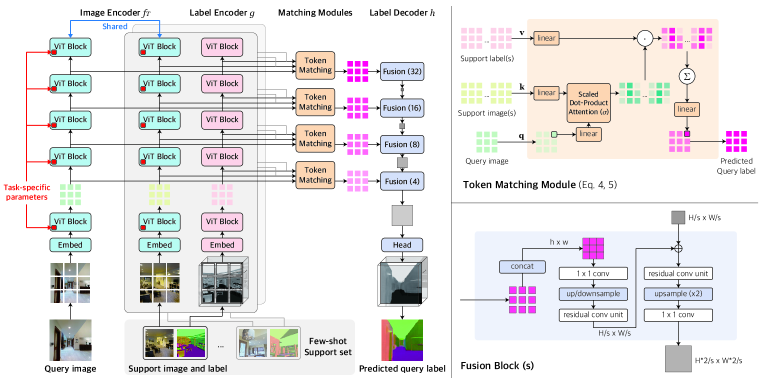
- Vision Transformer (ViT) エンコーダーを用いて、入力画像およびラベルを学習可能なパッチレベルのトークンとして表現する。
- 埋め込み表現の類似度に基づいて、画像トークンとラベルトークンの間で非パrametricなマッチングを実行する。
- マッチング機構を調整するための小さなタスク固有パラメータのセットを導入し、未学習のタスクの意味に柔軟に適応可能にする。
- 自己注意機構を用いたマルチスケール特徴マッチングを実装した階層的エンコーダデコーダアーキテクチャを採用する。
- 畳み込みデコーダーを用いて、マッチングされたトークン特徴から密度予測を再構築し、空間的構造を保持する。
- 各エピソードが、少数のラベル付きサポート画像を用いた新しいタスクを模倣するエピソードベースのメタラーニングでモデルを訓練する。
実験結果
リサーチクエスチョン
- RQ1わずか数例のラベル付き例でのみ、1つの統一モデルが任意の密度予測タスクに一般化可能か?
- RQ2完全教師ありベースラインと比較して、few-shot 密度予測における非パrametricな視覚的トークンマッチングの有効性はいかほどか?
- RQ3多様なタスクにおいて、サポートセットのサイズが few-shot 性能に与える影響は何か?
- RQ4サポートセットの画像選択にばらつきがある場合、モデルの性能はどの程度頑健か?
- RQ5メタトレーニングデータ量が、モデルの few-shot 一般化能力に与える影響は何か?
主な発見
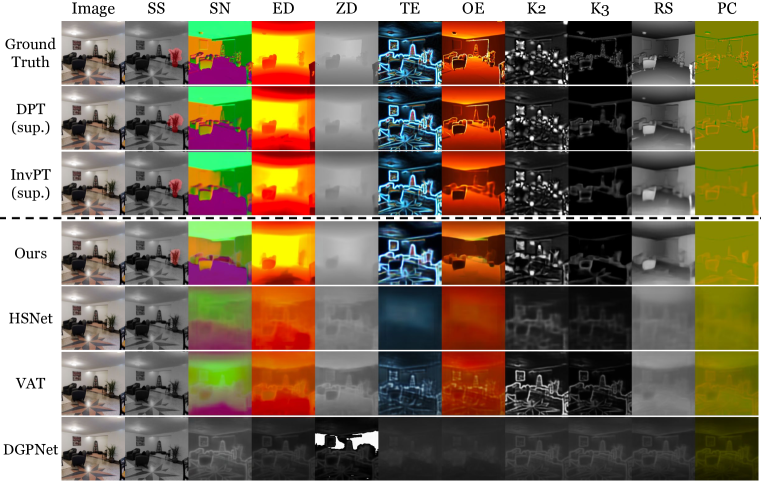
- VTM は、タスクあたりわずか10例のラベル付き例(完全教師あり学習の0.004%)でのみ、競合する性能を達成しており、しばしば完全教師ありベースラインを上回る。
- 275例のラベル付き例(完全教師あり学習の0.1%)で、複数の密度予測タスクにおいて完全教師ありモデルを上回るか、同等の性能を達成する。
- ランダムに抽出された異なるサポートセット間で、性能のばらつきがわずかであるため、サポートセットの選択に対して頑健であることが示された。
- より多くのメタトレーニングタスクが与えられるほど、性能が一貫して向上し、事前学習段階での多様なタスクの露出が有益であることが示された。
- 部分的なタスクアノテーションを伴う不完全なデータセットで学習させても、モデルは良好に一般化するため、実用的な頑健性を示した。
- 注意マップから、VTM がタスクに応じて関連のある画像領域に類似度の注目を柔軟に適応していることが明らかになった(例:セグメンテーションでは物体、表面法線では平面)。
この論文を読む
Nubintのビューアで原文を開き、読みながら気になる箇所をすぐに質問できます。
Nubintでこの論文を読むこのレビューはAIが論文の原文をもとに作成しました。引用する前に原文をご確認ください。