
[論文レビュー] Updated Planetary Mass Constraints of the Young V1298 Tau System Using MAROON-X
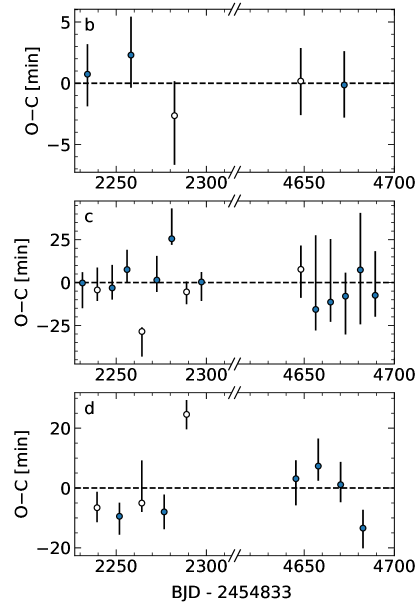
本研究では、新しいTESS光度計測データと高精度MAROON-X径速度測定値を用いて、若年で多重惑星系であるV1298 Tauの質量制約を更新した。惑星eについては2.6σの検出が得られ、質量は0.66±0.26 M<sub>Jup</sub>であった。惑星b、c、dについては2σの上限が得られ、惑星eの公軌道周期が55.4 dより長いことは確認されたが、46.77日の予想時系列解と整合的であった。
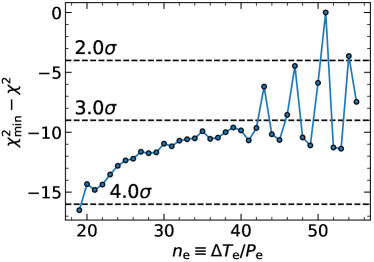
The early K-type T-Tauri star, V1298 Tau ($V=10\,{ m mag}$, ${ m age}\approx20-30\,{ m Myr}$) hosts four transiting planets with radii ranging from $4.9-9.6\,R_\oplus$. The three inner planets have orbital periods of $\approx8-24\,{ m d}$ while the outer planet's period is poorly constrained by single transits observed with \emph{K2} and \emph{TESS}. Planets b, c, and d are proto-sub-Neptunes that may be undergoing significant mass loss. Depending on the stellar activity and planet masses, they are expected to evolve into super-Earths/sub-Neptunes that bound the radius valley. Here we present results of a joint transit and radial velocity (RV) modelling analysis, which includes recently obtained \emph{TESS} photometry and MAROON-X RV measurements. Assuming circular orbits, we obtain a low-significance ($\approx2σ$) RV detection of planet c implying a mass of $19.8_{-8.9}^{+9.3}\,M_\oplus$ and a conservative $2σ$ upper limit of $<39\,M_\oplus$. For planets b and d, we derive $2σ$ upper limits of $M_{ m b}<159\,M_\oplus$ and $M_{ m d}<41\,M_\oplus$. For planet e, plausible discrete periods of $P_{ m e}>55.4\,{ m d}$ are ruled out at a $3σ$ level while seven solutions with $43.3
研究の動機と目的
- MAROON-Xから得られた高精度径速度測定値を用いて、若年であるV1298 Tau系の4つの Transit する惑星の質量制約を改善すること。
- K2およびTESSによる単一転位からの制約が弱かった外側の惑星eの公軌道周期推定値を精緻化すること。
- 更新された質量および半径測定値と惑星進化モデルを組み合わせることで、惑星の動的安定性と内部構造を評価すること。
- 強い星面活動が存在する中で低振幅の径速度信号の検出可能性を、注入・回収シミュレーションを用いて検証すること。
- 惑星が原始的なガス豊富な組成であるか、顕著な大気質量損失を経験したかを評価すること。
提案手法
- 星面活動をモデル化するためのガウス過程回帰を用いた階層ベイズフレームワークを用いて、TESS転位光曲線とMAROON-X径速度データを同時にモデリングした。
- 円軌道および非円軌道モデルを組み込み、非円軌道の場合には離心率分布をサンプリングした。
- SPOCKコードを用いて各事後分布サンプルの動的安定性確率を推定し、安定性を満たすサンプルのみを残すためのリジェクションサンプリングを実施した。
- 活動性モデルにシミュレートされた惑星の径速度信号を注入し、検出感度と測定バイアスを評価するための注入・回収テストを実施した。
- 効率的なガウス過程回帰とPyMC3を用いたネストドサンプリングの実行のために、exoplanetおよびcelerite2パッケージを用いた。
- Davidら(2019b)およびFeinsteinら(2022)の予想時系列に基づいた、0.05 dの不確実性を伴う情報的事前分布を転送時間に採用した。
実験結果
リサーチクエスチョン
- RQ1新しいMAROON-X径速度データを用いて、V1298 Tau系の4つの転位惑星の更新された質量制約は何か?
- RQ2外側の惑星eは46.77日付近の安定した公軌道周期と整合的か?それとも高信頼度で長い周期は除外されるか?
- RQ3惑星b、c、d、eの測定された質量は、惑星内部構造および進化モデルの予測とどのように一致するか?
- RQ4若年でK型の星であるV1298 Tauの星面活動は、低振幅の惑星径速度信号の検出可能性にどの程度影響を及えるか?
- RQ5更新された軌道および質量制約のもとで、この系の動的安定性状態はいかなるものか?
主な発見
- 最も確実な46.768131±0.000076 dの予想時系列のもとで、惑星eの径速度検出が2.6σで得られ、質量は0.66±0.26 M<sub>Jup</sub>であった。
- 惑星cについては2σの径速度検出が得られ、質量は19.8<sub>-8.9</sub><sup>+9.3</sup> M<sub>⊕</sub>であった。保守的な2σ上限は<39 M<sub>⊕</sub>であった。
- 惑星bについては2σ上限が<159 M<sub>⊕</sub>、惑星dについては<41 M<sub>⊕</sub>が得られ、低質量または検出不能である可能性を示した。
- 惑星eの公軌道周期が55.4 d以上である可能性は3σレベルで除外されたが、43.3〜55.4 dの範囲の周期は46.77 dの解と整合的であった。
- 注入・回収テストの結果、惑星cの信号回収精度が最も高く、0.5σ以内で回収された。一方、惑星dは回収質量に約10–15%の系統的バイアスが見られた。
- 惑星進化モデルとの比較から、惑星b、d、eは原始的なガス豊富な組成と整合的であるのに対し、惑星cは水を主体とするコアと質量比約5%のH<sub>2</sub>エンVELOPEを有すると考えられる。
この論文を読む
Nubintのビューアで原文を開き、読みながら気になる箇所をすぐに質問できます。
Nubintでこの論文を読むこのレビューはAIが論文の原文をもとに作成しました。引用する前に原文をご確認ください。