
[論文レビュー] User-defined Event Sampling and Uncertainty Quantification in Diffusion Models for Physical Dynamical Systems
本稿では、カオス的物理的力学系における拡散モデルのための、ユーザー定義イベントのサンプリングと不確実性の定量化の手法を提案する。ノイズが減少するにつれて真の分布に収束する条件付きスコア関数の確率的近似を導出することで、再訓練を要せず非線形イベント、特に分布の末尾部においても正確な条件付きサンプリングが可能となり、極端なイベントの補正された尤度推定が得られる。
Diffusion models are a class of probabilistic generative models that have been widely used as a prior for image processing tasks like text conditional generation and inpainting. We demonstrate that these models can be adapted to make predictions and provide uncertainty quantification for chaotic dynamical systems. In these applications, diffusion models can implicitly represent knowledge about outliers and extreme events; however, querying that knowledge through conditional sampling or measuring probabilities is surprisingly difficult. Existing methods for conditional sampling at inference time seek mainly to enforce the constraints, which is insufficient to match the statistics of the distribution or compute the probability of the chosen events. To achieve these ends, optimally one would use the conditional score function, but its computation is typically intractable. In this work, we develop a probabilistic approximation scheme for the conditional score function which provably converges to the true distribution as the noise level decreases. With this scheme we are able to sample conditionally on nonlinear userdefined events at inference time, and matches data statistics even when sampling from the tails of the distribution.
研究の動機と目的
- ローレンツアトラクタ、二重振り子、フィッツハブ・ナグumoニューロンなどのカオス的物理系を代替モデルとして拡散モデルが利用可能となるようにすること。
- 分布の末尾部におけるまれなまたは極端なイベントのサンプリングを拡散モデルで実現することの挑戦に取り組むこと。
- 再訓練を必要としない推論時条件付け機構を、非線形なユーザー定義イベント(例:軌道の交差やニューロンのスパイク)に適用可能にする。
- このようなイベントにおける補正された不確実性の定量化と周辺尤度推定を提供すること。
- まれなまたは複雑な力学的挙動に対する効率的かつアモアタイズド( amortized )なモデルクエリを可能にすること。
提案手法
- ノイズのある観測値が与えられたときのデノイズドサンプル分布のモーメントマッチングを用いて、計算不能な条件付きスコア関数の確率的近似を導出する。
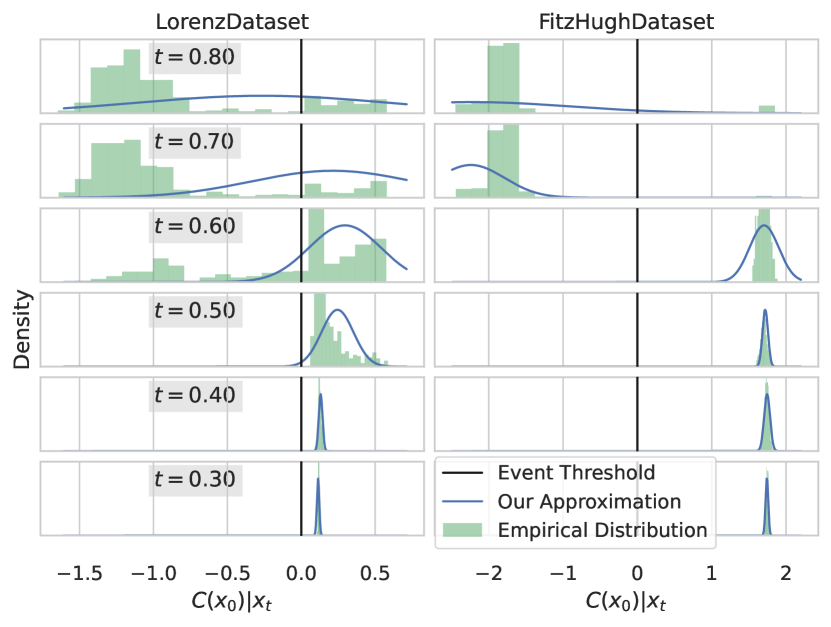
- 制約関数 $ C $ をデノイズド分布のモードの周囲で線形化することで、$ p(C(x_0) \mid x_t) $ を近似する。
- 近似式 $ p(C(x_0) \mid x_t) \approx \mathcal{N}(C(\hat{x}_0), \nabla C^\top \hat{\Sigma} \nabla C) $ を用いる。ここで $ \hat{x}_0 $ はデノイズドサンプル、$ \hat{\Sigma} $ はその共分散行列である。
- ノイズレベル $ \sigma_t \to 0 $ のとき、近似が漸近的に正確になり、分布が標準正規分布に収束することを証明する。
- 拡散モデルとニューラルODEの関係を活用し、正確な尤度計算と条件付きサンプリングを可能にする。
- 重要度サンプリングと直接サンプリングを用いて、極端なイベントの周辺尤度推定値を検証する。
実験結果
リサーチクエスチョン
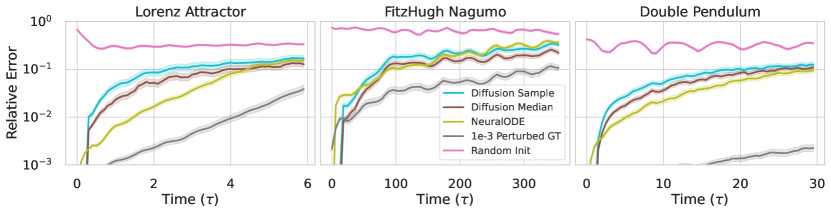
- RQ1微分方程式の内部構造が不明な状態でも、拡散モデルをカオス的力学系の代替モデルとして効果的に使用できるか?
- RQ2再訓練なしに、任意の非線形なユーザー定義イベント(例:軌道の交差やニューロンスパイク)に条件づけた拡散モデルのサンプリングが可能か?
- RQ3モデルは、まれなまたは極端なイベントに対して補正された不確実性推定と正確な周辺尤度を提供できるか?
- RQ4特に低ノイズ領域において、提案された条件付きスコア近似が真の分布をどれほど正確に捉えられるか?
- RQ5データ統計を保持したまま、分布の末尾部からの効率的サンプリングが可能か?
主な発見
- 提案された条件付きスコア近似は、ノイズレベルが低下するにつれて真の条件付き分布に分布収束し、理論的保証を有する。
- 再訓練なしに、極端なイベント(例:ニューロンスパイクや軌道交差)を含む非線形イベントの正確なサンプリングが推論時に行える。
- 非常に非線形な制約に対しても、分布の末尾部からのサンプリングが、実測データの統計と一致する。
- フィッツハブ・ナグumoモデルにおけるニューロン発火の周辺尤度は、直接サンプリングにより正確に推定され、条件付き尤度と照合される。
- 非線形制約がある中でも、低ノイズ領域(例:$ t < 0.5 $)において近似が次第に高精度になる。
- 再訓練なしに、標準的な再試行サンプリングに比べて、まれなイベントのサンプリングにおいて計算効率が優れている。これにより、禁止的なシミュレーションコストを回避できる。
この論文を読む
Nubintのビューアで原文を開き、読みながら気になる箇所をすぐに質問できます。
Nubintでこの論文を読むこのレビューはAIが論文の原文をもとに作成しました。引用する前に原文をご確認ください。