
[論文レビュー] Variational Quantum Linear Solver
論文は、近端量子デバイス上で線形系を解くためのハイブリッド量子古典変分アルゴリズム(VQLS)を導入し、運用上の終了条件とスケーラブルな性能の証拠を示す。
Previously proposed quantum algorithms for solving linear systems of equations cannot be implemented in the near term due to the required circuit depth. Here, we propose a hybrid quantum-classical algorithm, called Variational Quantum Linear Solver (VQLS), for solving linear systems on near-term quantum computers. VQLS seeks to variationally prepare $|x\rangle$ such that $A|x\rangle\propto|b\rangle$. We derive an operationally meaningful termination condition for VQLS that allows one to guarantee that a desired solution precision $ε$ is achieved. Specifically, we prove that $C \geq ε^2 / κ^2$, where $C$ is the VQLS cost function and $κ$ is the condition number of $A$. We present efficient quantum circuits to estimate $C$, while providing evidence for the classical hardness of its estimation. Using Rigetti's quantum computer, we successfully implement VQLS up to a problem size of $1024\times1024$. Finally, we numerically solve non-trivial problems of size up to $2^{50}\times2^{50}$. For the specific examples that we consider, we heuristically find that the time complexity of VQLS scales efficiently in $ε$, $κ$, and the system size $N$.
研究の動機と目的
- 限られた回路深さを前提としたNISQデバイスで線形系を解く動機付け。
- A x = b の解近似のためのハイブリッド量子古典の変分フレームワークを提案。
- 真の解への近接を保証し終了を導くコスト関数を定義。
- コストを推定する効率的な量子回路を提供し、実用的なスケーリング洞察を示す。
提案手法
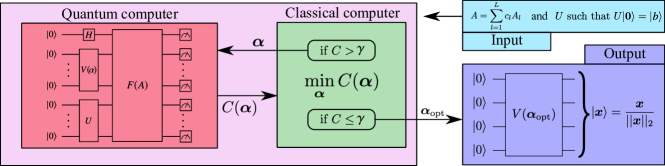
- A をユニタリの線形結合 A = sum_l c_l A_l として表現し、A_l の実装を効率的に行えるようにする。
- 訓練可能な変分回路 V(alpha) を用いて x(alpha) = V(alpha)|0> を準備。
- A|x> が |b> からどれだけ離れているかを定量化するコスト関数 C_G と C_L(およびその未正規化版)を定義し、C <= gamma のとき終了を可能にする。
- Hadamard テストと Hadamard-Overlap Test 回路を用いてコスト関数の値を推定し、コストの高価な部分回路の制御を回避する。
- 固定構造(層状)ハードウェア効率的アンサatz と、QAOA風や可変構造アンサatz などの代替案を提供。
- 確率的誤差キャンセル(PEC)緩和手法を議論し、ノイズ下での終了を認証する。
実験結果
リサーチクエスチョン
- RQ1VQLS は近端量子ハードウェア上で解 AX = b の解に比例する状態を準備できるか。
- RQ2コスト関数は κ と C の用語で解の誤差 ε を定量的にどのように下支えするか。
- RQ3コスト推定タスクは古典的には困難で、VQLS に対する量子優位性を正当化できるか。
- RQ4異なるアンサatz 構造は訓練性と系サイズ n に対するスケーリングにどのような影響を与えるか。
- RQ5実用的なテストにおける κ、ε、N の時間解決の観察スケーリングはどうなるか。
主な発見
- 終了条件: C ≥ ε^2 / κ^2 により所望の精度 ε を保証。
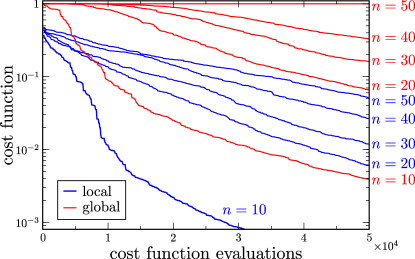
- 局所コスト関数(C_L)は大規模 n の場合グローバルより訓練が良く、2^50次元へのスケーリングを可能にする。
- Rigetti ハードウェアで 1024×1024 問題を解く実験;シミュレーションは κ, ε, N によるスケーリングを示し、最大で κ に線形、1/ε に対して対数的、N に対して多項式対数的であることが示唆。
- コスト関数の評価は古典的には DQC1-困難であることが示され、VQLS における量子優位性を強調。
- 正規化コストに対してグローバル偏光ノイズに対する最適パラメータ耐性(OPR)を示し、PEC はノイズ下で終了を多項式オーバーヘッドで認証できる。
より良い研究を、今すぐ始めましょう
論文設計から論文執筆まで、研究時間を劇的に削減しましょう。
クレジットカード登録不要
このレビューはAIが作成し、人間の編集者が確認しました。