
[論文レビュー] VisoGender: A dataset for benchmarking gender bias in image-text pronoun resolution
VisoGenderは、視覚言語モデルにおける性別バイアスを評価するベンチマークデータセットを導入し、ステレオタイプ的な性別表現を示す職業従事者の画像を用いた照準語の解決と画像検索を焦点としている。研究では、最先端モデルにおいて顕著な解決および検索バイアスが確認され、女性的と見なされる被験者に対しては正確性が低く、中立的なクエリにおいても男性的と見なされる専門職従事者に好まれる傾向が見られた。
We introduce VisoGender, a novel dataset for benchmarking gender bias in vision-language models. We focus on occupation-related biases within a hegemonic system of binary gender, inspired by Winograd and Winogender schemas, where each image is associated with a caption containing a pronoun relationship of subjects and objects in the scene. VisoGender is balanced by gender representation in professional roles, supporting bias evaluation in two ways: i) resolution bias, where we evaluate the difference between pronoun resolution accuracies for image subjects with gender presentations perceived as masculine versus feminine by human annotators and ii) retrieval bias, where we compare ratios of professionals perceived to have masculine and feminine gender presentations retrieved for a gender-neutral search query. We benchmark several state-of-the-art vision-language models and find that they demonstrate bias in resolving binary gender in complex scenes. While the direction and magnitude of gender bias depends on the task and the model being evaluated, captioning models are generally less biased than Vision-Language Encoders. Dataset and code are available at https://github.com/oxai/visogender
研究の動機と目的
- 視覚言語モデルにおける性別バイアスを評価するための専用ベンチマークデータセットの不足に対処すること。
- 男性的および女性的と見なされる被験者の照準語解決精度におけるバイアスを測定すること。
- 性別中立的なクエリを用いて、男性的と女性的と見なされる専門職従事者の間での検索比を比較し、検索バイアスを評価すること。
- 最先端の視覚言語モデルのこれらのバイアス指標におけるパフォーマンスを評価すること。
- 米国労働市場における実世界の職業の性別分布とモデルバイアスの相関関係を調査すること。
提案手法
- データセットは、職業的役割(例:医師)を演じる人物の画像と、所有代名詞('his' や 'her')を含むキャプションをペアにし、共参照解決をテストする。
- 人間のアノテーターが各画像内の被験者の性別的表現をラベル付けし、男性的および女性的表現の両方においてバランスの取れた表現を確保する。
- 2つの評価タスクを定義する:(1) 照準語の解決、ここでモデルは与えられた画像とキャプションに対して正しい照準語を予測する。 (2) 画像検索、ここでモデルは性別中立的なキャプションに対して関連する画像を検索する。
- 解決バイアスは、男性的と女性的と見なされる被験者間での照準語解決の正確性の差として測定される。
- 検索バイアスは、Bias@K、MaxSkew、NDKL といった標準的な指標を用いて、表現の公平性を評価する。
- データセットはGitHubに公開され、ライセンスおよびURLの整合性を確認するためのコードを併記しており、訓練を目的としたものではなく、評価専用を目的としている。

実験結果
リサーチクエスチョン
- RQ1視覚言語モデルは、被験者の性別的表現に基づいて照準語を割り当てる際に、どの程度解決バイアスを示すのか?
- RQ2性別中立的なキャプションで職業的役割をクエリした際、検索バイアスはどのように現れるのか?
- RQ3最先端の視覚言語モデルは、照準語の解決と画像検索の両タスクにおいて、性別バイアスの観点からどのように比較されるのか?
- RQ4モデルバイアスと米国労働市場における実世界の職業の性別分布の間に相関関係があるか?
- RQ5VisoGenderベンチマークは、視覚言語モデルにおける能力的および表現的不平等を検出し、定量的に測定できるか?
主な発見
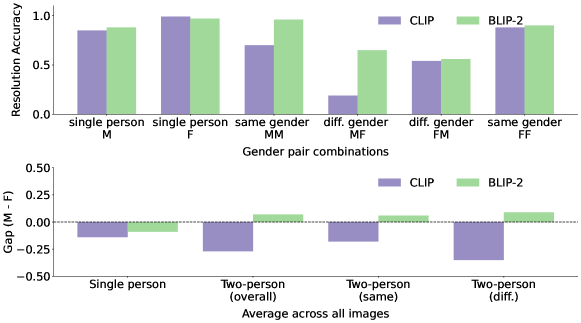
- 視覚言語モデルは顕著な解決バイアスを示しており、女性的と見なされる被験者に対しては、男性的と見なされる被験者よりも照準語解決の正確性が低い。
- 性別表現が異なる2人いるシーンでは、モデルの照準語解決のパフォーマンスはほぼランダムに近く、複雑なシーンにおける性別の区別が困難であることを示している。
- 検索モデルは、中立的なクエリに対して、女性的と見なされる専門職従事者の画像よりも、男性的と見なされる専門職従事者の画像を常に高い順位にランク付けしている。これは強い検索バイアスを示している。
- キャプション生成モデルは、視覚言語エンコーダーよりも全体的なバイアスが低く、アーキテクチャの違いがバイアスの伝播に影響している可能性を示している。
- モデルのバイアスの大きさと方向性は、米国労働市場における実世界の職業の性別分布と相関しており、社会的バイアスの再現が行われていることを示している。
- このデータセットは、能力的および表現的不平等の両方を特定するのに効果的であり、視覚言語推論におけるより良いシーンの区別と公平性の向上の必要性を浮き彫りにしている。
この論文を読む
Nubintのビューアで原文を開き、読みながら気になる箇所をすぐに質問できます。
Nubintでこの論文を読むこのレビューはAIが論文の原文をもとに作成しました。引用する前に原文をご確認ください。