
[論文レビュー] VSSD: Vision Mamba with Non-Causal State Space Duality
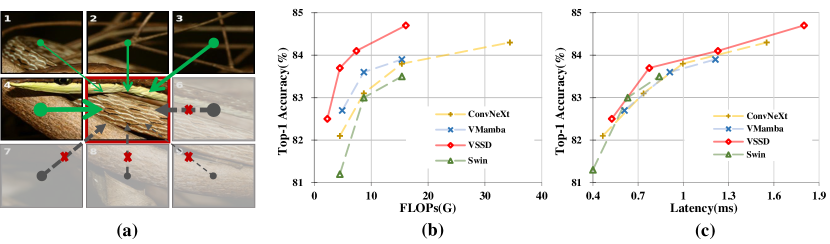
本稿では、非因果的ビジョン・ミンバモデルであるVSSDを提案する。VSSDは、状態空間双対性(SSD)を再定義し、状態遷移行列𝐀の役割を隠れ状態の保持からトークン寄与度の制御に再配分することで、マルチスキャン戦略を用いずに完全な非因果的モデリングを可能にする。VSSDは、81.8%のトップ-1精度を達成し、ImageNet-1Kで先行するSSMベースのモデル(VMamba)を1%上回る性能を発揮するとともに、トレーニングスループットを最大50%向上させる。
Vision transformers have significantly advanced the field of computer vision, offering robust modeling capabilities and global receptive field. However, their high computational demands limit their applicability in processing long sequences. To tackle this issue, State Space Models (SSMs) have gained prominence in vision tasks as they offer linear computational complexity. Recently, State Space Duality (SSD), an improved variant of SSMs, was introduced in Mamba2 to enhance model performance and efficiency. However, the inherent causal nature of SSD/SSMs restricts their applications in non-causal vision tasks. To address this limitation, we introduce Visual State Space Duality (VSSD) model, which has a non-causal format of SSD. Specifically, we propose to discard the magnitude of interactions between the hidden state and tokens while preserving their relative weights, which relieves the dependencies of token contribution on previous tokens. Together with the involvement of multi-scan strategies, we show that the scanning results can be integrated to achieve non-causality, which not only improves the performance of SSD in vision tasks but also enhances its efficiency. We conduct extensive experiments on various benchmarks including image classification, detection, and segmentation, where VSSD surpasses existing state-of-the-art SSM-based models. Code and weights are available at \url{https://github.com/YuHengsss/VSSD}.
研究の動機と目的
- 状態空間モデル(SSMs)の固有の因果的制限が、画像分類、検出、セグメンテーションなどの非因果的ビジョンタスクに与える影響を是正すること。
- SSM処理中に2次元特徴マップを1次元シーケンスに平坦化することによる空間的連続性の破壊を是正すること。
- 非因果的モデリングにための双方向スキャンに依存するマルチスキャンSSMアプローチの代替として、より効率的で正確な代替手法を開発すること。
- 因果マスクを排除し、一括で全トークンを同時に処理するグローバル隠れ状態の計算を可能にすることで、トレーニング速度とモデル安定性を向上させること。
提案手法
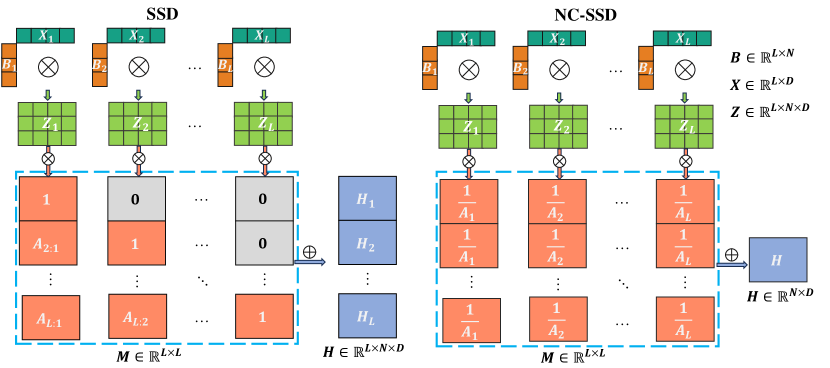
- 状態遷移行列𝐀を、隠れ状態の保持ではなく、各トークンが隠れ状態に与える寄与度を制御するものに再定式化することで、SSDを再考する。
- 各トークンの寄与度を自己参照的(self-referential)にすることで、因果マスクを排除し、1回の順方向伝搬で非因果的モデリングを実現する。
- 学習可能な重みベクトル𝐦を導入し、勾配爆発を防ぐために正規化機構として機能させることで、トレーニングの安定性を向上させる。
- 非因果的設計により、マルチスキャン戦略を暗黙的に統合し、明示的な双方向スキャンの必要性を排除する。
- 最終段階でNC-SSDとハイブリッドアテンションを統合し、重複するダウンサンプリングを組み合わせることで、性能と空間的インダクティブバイアスを向上させる。
- 各トークンを同時に処理する1つのグローバル隠れ状態を導入し、トークンごとの隠れ状態を置き換えることで、効率性とモデリング能力を向上させる。
実験結果
リサーチクエスチョン
- RQ1SSMの因果的インダクティブバイアスを排除することで、マルチスキャン戦略に依存せずに非因果的ビジョンデータをよりよくモデル化できるか?
- RQ2状態遷移行列𝐀の役割を隠れ状態の保持からトークン寄与度の制御に再定義することで、ビジョンタスクにおける安定的かつ効率的な非因果的モデリングが可能になるか?
- RQ3提案された非因果的SSD(NC-SSD)は、通常のSSDおよびBi-SSDのようなマルチスキャン変種と比較して、精度、遅延、トレーニング速度の面でどのように差をつけるか?
- RQ4正規化が線形アテンションに類似したメカニズムに欠如する状況下で、学習可能な重みベクトル𝐦の影響はトレーニング安定性とモデル性能にどのような影響を与えるか?
- RQ5標準アテンションと重複ダウンサンプリングの統合により、NC-SSDのビジョンベンチマークにおける性能がさらに向上するか?
主な発見
- VSSDは、ImageNet-1Kで81.8%のトップ-1精度を達成し、FLOPsとパラメータ数がほぼ同等の状態で、先行モデルVMambaを1%上回る性能を発揮した。
- 提案されたNC-SSDは、Bi-SSDと比較して50%、vanilla SSDと比較して20%のトレーニングスループット向上を達成し、顕著な効率性の向上を示した。
- 学習可能な重みベクトル𝐦の導入は、トレーニング安定性にとって不可欠である。これがないと、特に大規模なアーキテクチャではトレーニング中にモデルが崩壊する。
- パッチベースのダウンサンプラーを重複する畳み込みダウンサンプラーに置き換えることで、FLOPsが0.2G増加するのみで精度が0.7%向上した。
- 最終段階に標準的な自己アテンションをハイブリッド化することで、パラメータ数を増やさずに精度が0.2%向上した。これは、深層部におけるアテンションの有効性を示している。
- アブレーションスタディの結果、NC-SSDは通常のSSDと比べてトップ-1精度で0.6%、Bi-SSDと比べて0.2%高い性能を示し、スループットも上回った。
この論文を読む
Nubintのビューアで原文を開き、読みながら気になる箇所をすぐに質問できます。
Nubintでこの論文を読むこのレビューはAIが論文の原文をもとに作成しました。引用する前に原文をご確認ください。