
[論文レビュー] Weak baselines and reporting biases lead to overoptimism in machine learning for fluid-related partial differential equations
本論文は、流体関連の偏微分方程式(PDE)に対する機械学習(ML)研究における過剰な楽観主義を調査し、MLによる高速化を主張する79%の研究が弱いベースラインを使用しており、報告バイアスの影響を受けていると明らかにした。著者らは、研究者の自由度と肯定的結果の優先が原因で、性能の誇大評価が生じ、ML-for-PDE分野における再現可能性を向上させるために、文化的・構造的改革の必要性を指摘している。
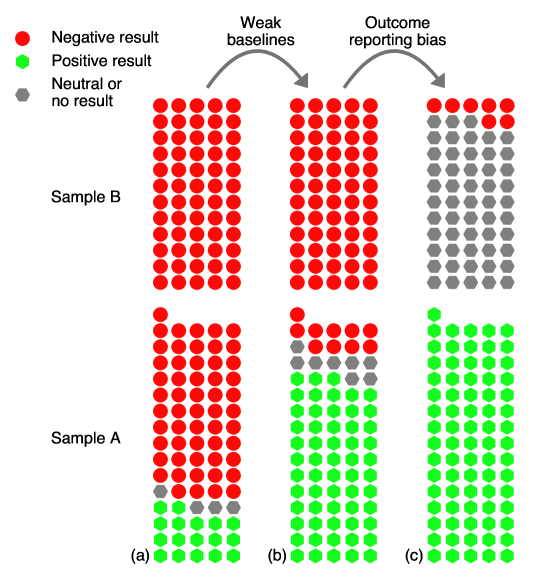
One of the most promising applications of machine learning (ML) in computational physics is to accelerate the solution of partial differential equations (PDEs). The key objective of ML-based PDE solvers is to output a sufficiently accurate solution faster than standard numerical methods, which are used as a baseline comparison. We first perform a systematic review of the ML-for-PDE solving literature. Of articles that use ML to solve a fluid-related PDE and claim to outperform a standard numerical method, we determine that 79% (60/76) compare to a weak baseline. Second, we find evidence that reporting biases, especially outcome reporting bias and publication bias, are widespread. We conclude that ML-for-PDE solving research is overoptimistic: weak baselines lead to overly positive results, while reporting biases lead to underreporting of negative results. To a large extent, these issues appear to be caused by factors similar to those of past reproducibility crises: researcher degrees of freedom and a bias towards positive results. We call for bottom-up cultural changes to minimize biased reporting as well as top-down structural reforms intended to reduce perverse incentives for doing so.
研究の動機と目的
- 流体関連の偏微分方程式(PDE)に対する機械学習研究における楽観主義の程度を調査すること。
- 標準数値スolverを凌駕すると主張するML-for-PDE研究において、弱いベースラインがどれほど広がっているかを評価すること。
- 報告バイアス(特に成果物および出版バイアス)が、PDE解法におけるML性能の認識を歪める役割を検討すること。
- 研究者の自由度や肯定的結果のインcentiveといった、再現性の問題を引き起こすシステム的要因を同定すること。
- 偏った報告を低減し、分野全体の科学的厳密性を高めるために、下からの文化的変化と上からの構造的改革を提言すること。
提案手法
- 流体関連PDEにおける標準数値手法を凌駆すると主張する76件のML-for-PDE論文を体系的レビューした。
- 各研究のベースラインを、2つの基準に基づいて評価した:(1) 同じ自由度または反復回数(実行時間の代理指標)での比較、(2) 効率的で最新の数値手法の使用。
- 両方の基準を満たした場合を「フェア」と分類し、それ以外は「弱い」または「フェアでない」とラベル付けした。
- 報告実践を分析し、成果物および出版バイアスを特定した。特に、否定的結果の報告不足に注目した。
- 物理学的制約を組み込んだニューラルネットワーク(PINNs)が、標準スolverよりも遅くなることがあるという文献からの証拠を特定・引用した。
- Poisson、Helmholtz、Burgers’、Navier-Stokes方程式を含む多様なPDEタイプに対して、ベースラインの強さと手法的厳密性を体系的な評価フレームワークで評価した。
実験結果
リサーチクエスチョン
- RQ1ML-for-PDE研究において、標準数値スolverを凌駆すると主張する際、どれほど多くの研究が弱いベースラインを使用しているのか?
- RQ2流体関連PDE向けML研究において、成果物および出版バイアスがどれほど広がっているのか?
- RQ3ML-for-PDE研究における楽観主義を生み出すシステム的要因は何か?また、それらは過去の再現性危機とどのように類似しているか?
- RQ4なぜ多くのMLベースのPDEスolver(PINNsを含む)は、高速化を主張しているにもかかわらず、標準スolverに劣っているのか?
- RQ5ML-for-PDE研究分野における再現性を高め、偏った報告を低減するために、どのような文化的・構造的改革が必要か?
主な発見
- 標準スolverを凌駆すると主張するML-for-PDE研究の79%(76件中60件)が、弱いベースラインを使用しており、性能主張の妥当性が損なわれている。
- 多くの研究が、有限要素法や共役勾配法といった非効率的または古くなった数値手法とMLモデルを比較しており、最新のマルチグリッド法やスペクトル法といった代替手法と比較していない。
- 物理学的制約を組み込んだニューラルネットワーク(PINNs)は、前方PDE問題において標準スolverよりも桁違いに遅く、高速化を主張する主張とは矛盾している。
- いくつかの研究では否定的結果が得られたり、スループットの向上が達成されなかったが、それらの報告は文献において不十分に記載されたり、欠落していた。これは成果物報告バイアスの兆候である。
- 弱いベースラインと報告バイアスは、研究者の自由度と肯定的結果のインセンティブに起因しており、他の科学分野における過去の再現性危機と類似している。
- 本研究は、分野全体が方法論的欠陥とシステム的インcentiveの影響を受けて楽観的であると結論づけ、科学的整合性と再現性を高めるために文化的・構造的改革の必要性を訴えている。
この論文を読む
Nubintのビューアで原文を開き、読みながら気になる箇所をすぐに質問できます。
Nubintでこの論文を読むこのレビューはAIが論文の原文をもとに作成しました。引用する前に原文をご確認ください。