
[論文レビュー] What to do when things get crowded? Scalable joint analysis of overlapping gravitational wave signals
The paper demonstrates that sequential simulation-based inference using TMNRE (via peregrine and swyft) can jointly infer 30 parameters for two overlapping spinning, precessing binary black hole signals with high precision, using only about 7×10^6 waveform evaluations, far fewer than traditional methods.
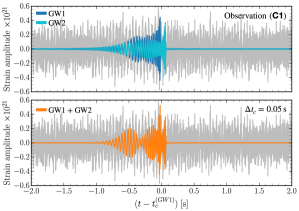
The gravitational wave sky is starting to become very crowded, with the fourth science run (O4) at LIGO expected to detect $\mathcal{O}(100)$ compact object coalescence signals. Data analysis issues start to arise as we look further forwards, however. In particular, as the event rate increases in e.g. next generation detectors, it will become increasingly likely that signals arrive in the detector coincidentally, eventually becoming the dominant source class. It is known that current analysis pipelines will struggle to deal with this scenario, predominantly due to the scaling of traditional methods such as Monte Carlo Markov Chains and nested sampling, where the time difference between analysing a single signal and multiple can be as significant as days to months. In this work, we argue that sequential simulation-based inference methods can solve this problem by breaking the scaling behaviour. Specifically, we apply an algorithm known as (truncated marginal) neural ratio estimation (TMNRE), implemented in the code peregrine and based on swyft. To demonstrate its applicability, we consider three case studies comprising two overlapping, spinning, and precessing binary black hole systems with merger times separated by 0.05 s, 0.2 s, and 0.5 s. We show for the first time that we can recover, with full precision (as quantified by a comparison to the analysis of each signal independently), the posterior distributions of all 30 model parameters in a full joint analysis. Crucially, we achieve this with only $\sim 15\%$ of the waveform evaluations that would be needed to analyse even a single signal with traditional methods.
研究の動機と目的
- Motivate the need for joint analysis of overlapping gravitational wave signals in current and future detectors.
- Develop and apply a sequential simulation-based inference approach to extract full posterior distributions for multiple overlapping signals.
- Demonstrate that TMNRE can recover full 30-parameter posteriors with substantially fewer waveform evaluations than traditional methods.
- Validate accuracy against independent single-signal analyses and assess calibration/coverage.
- Discuss scalability and prospects for next-generation detectors and more complex overlaps.
提案手法
- Apply truncated marginal neural ratio estimation (TMNRE) to overlapping GW signals using the peregrine implementation (built on swyft).
- Forward-model data with two overlapping spinning, precessing BBH waveforms (IMRPhenomXPHM) in a three-detector O4 network (Hanford, Livingston, Virgo).
- Perform sequential inference rounds with prior truncation to focus on low-dimensional marginal posteriors, enabling efficient marginalization over parameters.
- Achieve joint 30-parameter posterior recovery (15 per signal) and compare to independent single-signal analyses for validation.
- Quantify computational cost: ~7×10^6 waveform evaluations, ~2–3 hours per round on 18-core node, ~8–12 hours training per round, total ~48 hours.
- Discuss potential improvements and scalability to 3G detectors and more than two overlapping signals.
実験結果
リサーチクエスチョン
- RQ1Can TMNRE-based SBI recover full 30-dimensional posteriors for two overlapping BBH signals with high precision and proper calibration?
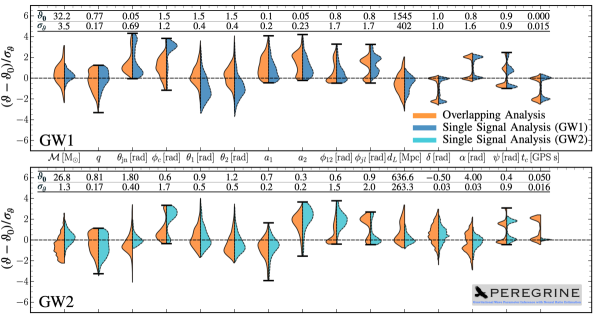
- RQ2How does the joint overlapping analysis perform in comparison to analyzing each signal independently?
- RQ3What are the computational requirements and scalability benefits of TMNRE for joint analyses of overlapping GW signals?
- RQ4How do overlap degree and merger-time separation affect parameter constraints and degeneracies?
- RQ5What are the implications for future detectors and larger numbers of overlapping signals?
主な発見
- TMNRE can recover full 30-parameter posteriors for two overlapping spinning, precessing BBHs with high accuracy, approaching the precision of individual-signal analyses.
- The overlapping analysis shows only modest broadening of posteriors and achieves near-identical coverage of the injected values in all parameters.
- 1D and 2D marginal posteriors show that chirp masses improve slightly as signals separate, while most parameters remain largely uncorrelated between signals.
- The method yields extremely well-calibrated posteriors (coverage nearly on the diagonal in coverage plots) across all case studies.
- Computational efficiency is dramatically improved: ~7×10^6 waveform evaluations (about an order of magnitude fewer than traditional joint analyses) and total wall time around 2–3 days for running rounds on available hardware.
- Demonstrates scalability potential for next-generation detectors where overlapping signals will be prevalent.
この論文を読む
Nubintのビューアで原文を開き、読みながら気になる箇所をすぐに質問できます。
Nubintでこの論文を読むこのレビューはAIが論文の原文をもとに作成しました。引用する前に原文をご確認ください。