
[論文レビュー] Wise-SrNet: A Novel Architecture for Enhancing Image Classification by Learning Spatial Resolution of Feature Maps
この論文では、畳み込みニューラルネットワークにおけるグローバル平均プーリング(GAP)を置き換えることで、計算コストを増加させずに特徴マップの空間分解能を保持する、新しい深層学習アーキテクチャであるWise-SrNetを提案する。深度分離畳み込みにインspiredされ、チャネルごとに学習可能な空間的アテンションを適用することで、224×224の画像では複数のモデルとデータセットでTop-1精度が2–8%向上し、512×512の画像では3–26%向上した。
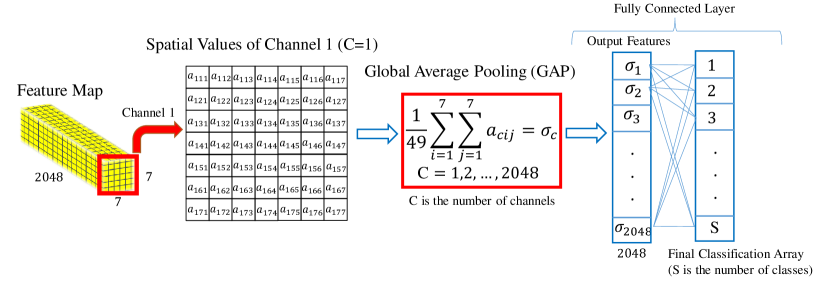
One of the main challenges since the advancement of convolutional neural networks is how to connect the extracted feature map to the final classification layer. VGG models used two sets of fully connected layers for the classification part of their architectures, which significantly increased the number of models' weights. ResNet and the next deep convolutional models used the Global Average Pooling (GAP) layer to compress the feature map and feed it to the classification layer. Although using the GAP layer reduces the computational cost, but also causes losing spatial resolution of the feature map, which results in decreasing learning efficiency. In this paper, we aim to tackle this problem by replacing the GAP layer with a new architecture called Wise-SrNet. It is inspired by the depthwise convolutional idea and is designed for processing spatial resolution while not increasing computational cost. We have evaluated our method using three different datasets: Intel Image Classification Challenge, MIT Indoors Scenes, and a part of the ImageNet dataset. We investigated the implementation of our architecture on several models of the Inception, ResNet, and DenseNet families. Applying our architecture has revealed a significant effect on increasing convergence speed and accuracy. Our Experiments on images with 224*224 resolution increased the Top-1 accuracy between 2% to 8% on different datasets and models. Running our models on 512*512 resolution images of the MIT Indoors Scenes dataset showed a notable result of improving the Top-1 accuracy within 3% to 26%. We will also demonstrate the GAP layer's disadvantage when the input images are large and the number of classes is not few. In this circumstance, our proposed architecture can do a great help in enhancing classification results. The code is shared at https://github.com/mr7495/image-classification-spatial.
研究の動機と目的
- 現代のCNNにおけるグローバル平均プーリング(GAP)による空間分解能の損失が学習効率に与える影響を是正すること。
- 高解像度入力および多数のクラスを含む大規模画像分類タスクにおいて、GAPの限界を克服すること。
- 空間情報を維持しながらモデルパラメータを削減できる、軽量で計算効率の良いGAPの代替手法を設計すること。
- ResNet、DenseNet、Inceptionなどの多様なアーキテクチャにおいて、収束速度と分類精度の向上を実現すること。
- EfficientNetのようにGAPに最適化されたモデルが、Wise-SrNetのような代替特徴圧縮手法と互換性がない理由を調査すること。
提案手法
- GAP層を置き換える学習可能な空間分解能処理モジュールを備えた、新しいアーキテクチャであるWise-SrNetを導入する。
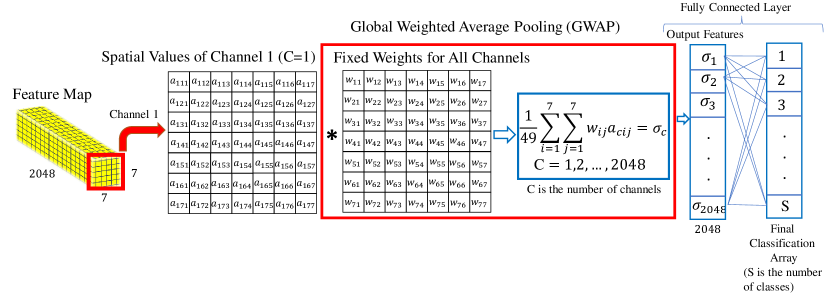
- チャネルごとに独立して空間次元を処理するため、チャネル固有のトレーニング可能な重みを用いて、深度分離畳み込みの原則を活用する。
- チャネル間で共有された空間的重みを有するが、チャネルごとに学習可能な変換を備えた、深さ分離に類似したレイヤーを設計する。
- 過学習を防ぎつつ計算効率を維持するため、正則化および正規化レイヤーを統合する。
- 完全結合層やフル接続層を避けることで、GAPと同等のFLOPsを維持する。
- ResNet、DenseNet、Inception、Xceptionなどのバックボーンモデルの最終GAP層として、このアーキテクチャを置き換える。
実験結果
リサーチクエスチョン
- RQ1計算コストを維持したまま、標準的なGAPと比較して空間的に注意を向けた学習可能な圧縮レイヤーが、画像分類精度を向上させられるか?
- RQ2特徴マップにおける空間分解能の保持が、異なるデータセットおよび画像解像度において収束速度とモデル一般化性能に与える影響はいかほどか?
- RQ3Wise-SrNetは他のアーキテクチャで顕著な向上を示すが、EfficientNetモデルでは限られた改善にとどまるのはなぜか?
- RQ4GAPの使用が高解像度画像および大規模クラスデータセットにおいてどれほど性能を低下させるか、またWise-SrNetはその影響を緩和できるか?
- RQ5提案されたアーキテクチャは、アーキテクチャの再トレーニングなしに、さまざまなCNNファミリーに普遍的に適用可能か?
主な発見
- ResNet50、DenseNet121、Inceptionなどの複数のモデルとデータセットにおいて、224×224解像度の画像でTop-1精度が2%から8%向上した。
- MIT Indoor Scenesデータセットの512×512解像度画像では、Top-1精度が3%から26%向上し、高解像度入力において顕著な向上が確認された。
- Wise-SrNetがEfficientNetモデルで性能向上が限定的であるのは、NAS最適化されたアーキテクチャがGAPに特化して調整されているためであり、他の圧縮レイヤーへの適応性が低いことが原因である。
- Grad-CAMの可視化結果から、Wise-SrNetはGAPよりもより特徴的で空間的に整合性のある特徴マップを生成していることが確認され、関連画像領域の局在化が向上していることが示された。
- 計算コストをGAPと同等に維持しながら、より豊富な空間的特徴表現を可能にするため、多くのクラスと大規模な入力画像を含むシナリオで効果的であることが証明された。
- Wise-SrNetは、EfficientNetを除くすべての評価対象モデルでGAPを上回った。これは、GAPに最適化されたアーキテクチャが、代替手法の移行性を制限していることを確認した。
より良い研究を、今すぐ始めましょう
論文の読解から最終レビューまで、研究時間を劇的に削減しましょう。
クレジットカード登録不要
このレビューはAIが作成し、人間の編集者が確認しました。