
[論文レビュー] Zenseact Open Dataset: A large-scale and diverse multimodal dataset for autonomous driving
Zenseact Open Dataset (ZOD) は Europe’s large-scale multimodal autonomous driving dataset with high-resolution sensors, rich annotations for long-range perception, and a permissive CC BY-SA 4.0 license, including Frames, Sequences, and Drives to support diverse tasks.
Existing datasets for autonomous driving (AD) often lack diversity and long-range capabilities, focusing instead on 360° perception and temporal reasoning. To address this gap, we introduce Zenseact Open Dataset (ZOD), a large-scale and diverse multimodal dataset collected over two years in various European countries, covering an area 9x that of existing datasets. ZOD boasts the highest range and resolution sensors among comparable datasets, coupled with detailed keyframe annotations for 2D and 3D objects (up to 245m), road instance/semantic segmentation, traffic sign recognition, and road classification. We believe that this unique combination will facilitate breakthroughs in long-range perception and multi-task learning. The dataset is composed of Frames, Sequences, and Drives, designed to encompass both data diversity and support for spatio-temporal learning, sensor fusion, localization, and mapping. Frames consist of 100k curated camera images with two seconds of other supporting sensor data, while the 1473 Sequences and 29 Drives include the entire sensor suite for 20 seconds and a few minutes, respectively. ZOD is the only large-scale AD dataset released under a permissive license, allowing for both research and commercial use. More information, and an extensive devkit, can be found at https://zod.zenseact.com
研究の動機と目的
- Address the need for diverse, long-range autonomous driving data beyond 360-degree perception datasets.
- Provide high-quality, multimodal sensor data with extensive annotations for multiple perception tasks.
- Enable multi-task learning and domain adaptation in AD through Frames, Sequences, and Drives subdivisions.
提案手法
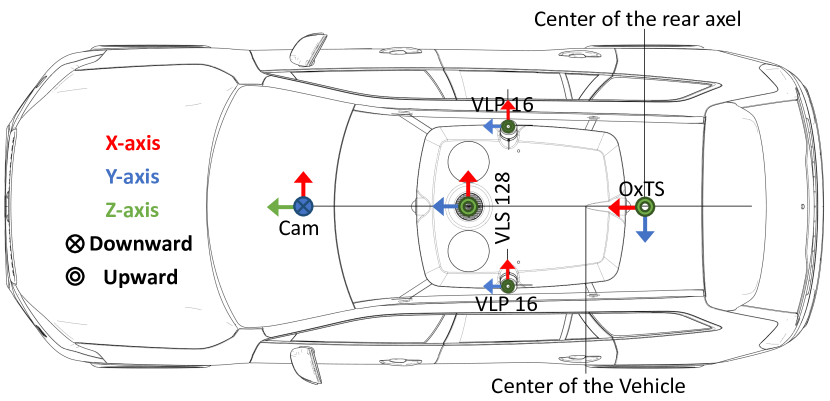
- Describe the sensor suite and data collection setup across Europe over two years.
- Define three data categories (Frames, Sequences, Drives) with distinct intended tasks.
- Provide manual, hierarchical annotations for semantic/instance segmentation, 2D/3D bounding boxes, and road/tSign labels.
- Anonymize faces and license plates with two methods (blurring and DNAT) and publish both versions to study anonymization impact.
- Release the dataset under CC BY-SA 4.0 with an extensive devkit to facilitate rapid experimentation.
実験結果
リサーチクエスチョン
- RQ1How diverse and geographically expansive is ZOD compared to existing AD datasets?
- RQ2Can high-resolution sensors and long-range annotations enable robust long-range perception and multi-task learning?
- RQ3What is the impact of anonymization techniques on downstream vision models trained on ZOD?
- RQ4How do Frame, Sequence, and Drive subsets support different AD tasks such as perception, localization, mapping, and planning?
主な発見
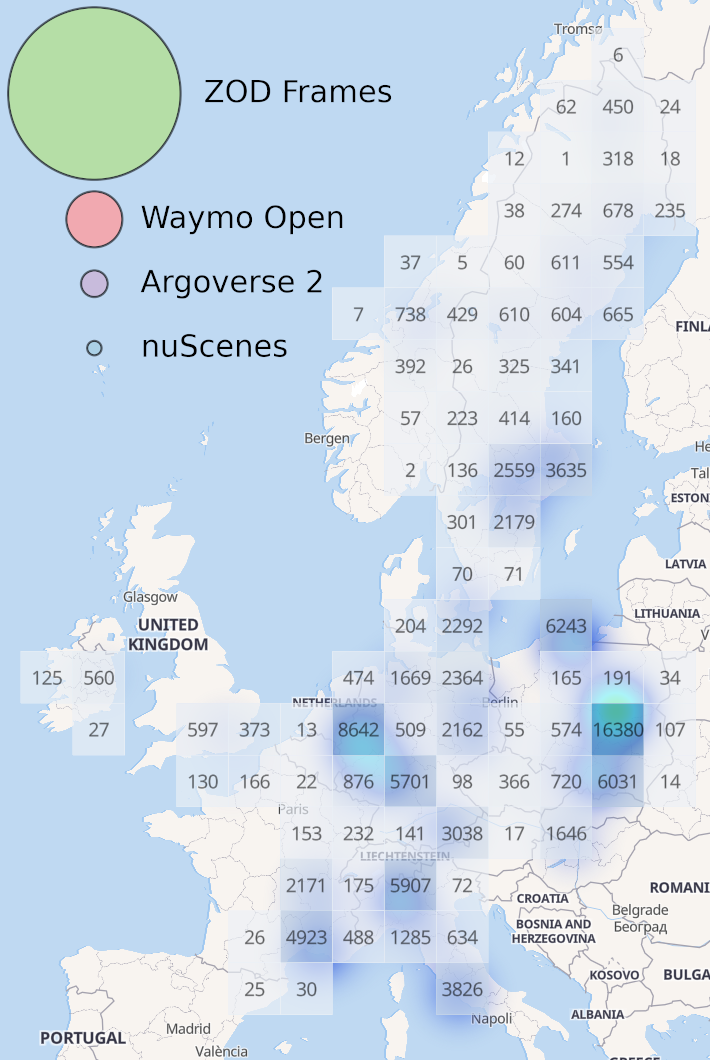
- ZOD Frames cover 14 European countries with a diversity area of 705,000 m^2 (7.05e5 km^2) when using the 75 m ego-pose metric, indicating strong geographical diversity.
- Objects are annotated up to 245 meters, with an 8MP front camera and rooftop LiDARs yielding high-range perception not common in similarly sized datasets.
- The traffic sign taxonomy includes 156 classes with 446k labeled instances, making it the largest in terms of sign instances among comparable datasets.
- Anonymization experiments show no statistically significant performance degradation for Faster-RCNN and YOLOv7 detectors when trained on anonymized data, evaluated on original images.
- 3D object detection shows distance-dependent performance, with CenterPoint achieving mAP of 0.25 in 0–150 m, dropping to 0.01 at 150–250 m, highlighting long-range perception challenges (Table 4).
- Traffic sign recognition exhibits strong performance on common signs but notable long-tail challenges for rare signs (macro F1 lower than micro F1).
この論文を読む
Nubintのビューアで原文を開き、読みながら気になる箇所をすぐに質問できます。
Nubintでこの論文を読むこのレビューはAIが論文の原文をもとに作成しました。引用する前に原文をご確認ください。