
[논문 리뷰] A Dual-Augmentor Framework for Domain Generalization in 3D Human Pose Estimation
이 논문은 3D 인간 자세 추정에서 도메인 일반화를 위한 이중 보완기 프레임워크를 제안한다. 약한 보완기는 원본 도메인 지식을 유지하고, 강한 보완기는 분포 외 자세를 탐색하며, 메타 최적화는 훈련 중 도메인 이동을 시뮬레이션한다. 이 방법은 최신 기술 수준의 성능을 달성하여 3DHP에서 MPJPE를 2.4mm 향상시키고 AUC를 0.8% 향상시키며, 여러 벤치마크에서 이전 방법을 능가한다.
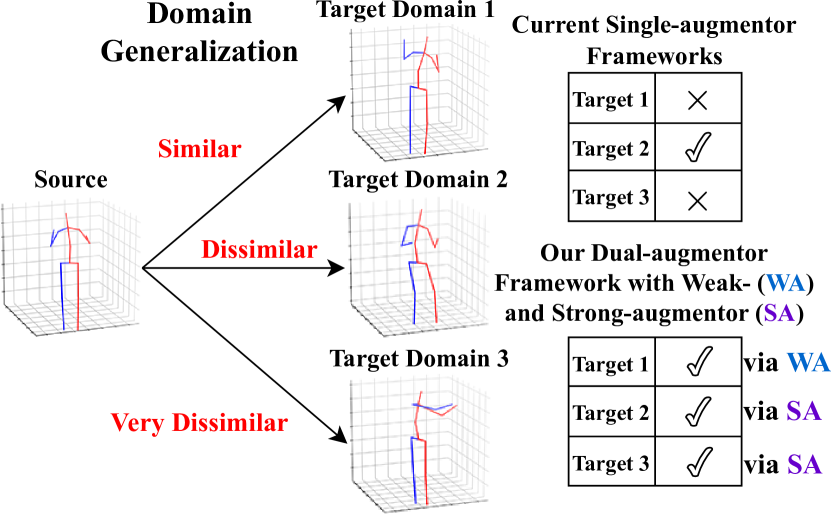
3D human pose data collected in controlled laboratory settings present challenges for pose estimators that generalize across diverse scenarios. To address this, domain generalization is employed. Current methodologies in domain generalization for 3D human pose estimation typically utilize adversarial training to generate synthetic poses for training. Nonetheless, these approaches exhibit several limitations. First, the lack of prior information about the target domain complicates the application of suitable augmentation through a single pose augmentor, affecting generalization on target domains. Moreover, adversarial training's discriminator tends to enforce similarity between source and synthesized poses, impeding the exploration of out-of-source distributions. Furthermore, the pose estimator's optimization is not exposed to domain shifts, limiting its overall generalization ability. To address these limitations, we propose a novel framework featuring two pose augmentors: the weak and the strong augmentors. Our framework employs differential strategies for generation and discrimination processes, facilitating the preservation of knowledge related to source poses and the exploration of out-of-source distributions without prior information about target poses. Besides, we leverage meta-optimization to simulate domain shifts in the optimization process of the pose estimator, thereby improving its generalization ability. Our proposed approach significantly outperforms existing methods, as demonstrated through comprehensive experiments on various benchmark datasets.Our code will be released at \url{https://github.com/davidpengucf/DAF-DG}.
연구 동기 및 목표
- 제어된 실험실 설정에 국한된 레이블이 있는 데이터에서 3D 인간 자세 추정의 도메인 일반화 문제를 해결하기 위해.
- 원본 지식을 유지하고 분포 외 자세를 탐색하는 데 실패하는 단일 보완기 방법의 한계를 극복하기 위해.
- 원본 자세와 합성 자세 간 유사성을 강제로 부여하는 적대적 훈련에 대한 의존도를 줄이기 위해, 다양성을 제한한다.
- 메타 최적화를 통해 최적화 중 도메인 이동을 시뮬레이션하여 자세 추정기의 일반화 성능을 향상시키기 위해.
- 대상 도메인 데이터 없이도 원본 데이터에만 의존하여 효과적인 훈련을 가능하게 하기 위해.
제안 방법
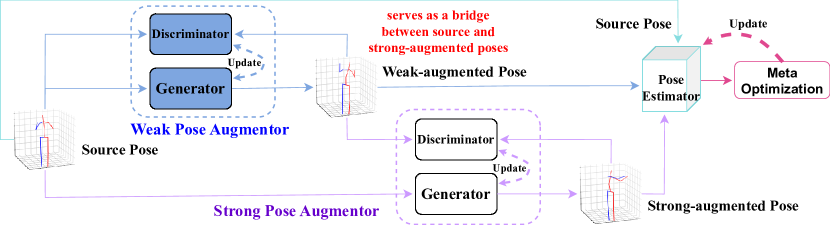
- 약한 보완기(원본 유사 자세 유지)와 강한 보완기(원본 외 분포 탐색)를 갖는 두 가지 별도의 자세 보완기를 도입한다.
- 생성과 판별에 서로 다른 전략을 적용: 약한 보완 자세는 판별기가 강한 보완 자세와 약한 보완 자세를 구별할 수 있도록 다리를 형성한다.
- 근접한 쌍(W-PP, S-PP)을 사용해 국소 자세 일관성을 유지하고, 한 상태 간격 쌍(W-OG, S-OG)을 사용해 약한 및 강한 생성기 간의 구조적 차이를 강제한다.
- 원본, 약한 보완 자세, 강한 보완 자세 간의 메타 최적화를 적용하여 훈련 중 도메인 이동을 시뮬레이션하고 도메인 불변 특징 학습을 향상시킨다.
- 원본과 모든 보완 자세 간의 유사성을 강제하지 않는 수정된 판별기 설정을 사용해 적대적 훈련을 구현한다.
- VPose를 백본 네트워크로 사용하고, PCK, AUC, MPJPE와 같은 표준 지표를 사용해 3DHP 및 3DPW 데이터셋에서 평가한다.
실험 결과
연구 질문
- RQ1이중 보완기 프레임워크는 단일 보완기 방법보다 원본 도메인 지식 유지를 유지하면서 분포 외 자세를 탐색하는 데 더 잘 균형을 이룰 수 있는가?
- RQ2약한 보완기와 강한 보완기 간의 판별 과정을 분리함으로써 적대적 유사성 강제 없이도 일반화 성능을 향상시킬 수 있는가?
- RQ3원본, 약한 보완 자세, 강한 보완 자세 간의 메타 최적화가 자세 추정기의 도메인 이동에 대한 저항성 향상에 얼마나 기여하는가?
- RQ4근접 쌍과 한 상태 간격 쌍 구성 요소가 합성 자세의 품질과 다양성에 어떻게 기여하는가?
- RQ5이중 보완기 프레임워크는 최신 기술 수준의 도메인 일반화 방법보다 표준 3D HPE 벤치마크에서 뛰어난 성능을 달성하는가?
주요 결과
- 제안된 이중 보완기 프레임워크는 이전 최신 기술 수준 방법 대비 3DHP에서 PCK 1.2% 향상, AUC 0.8% 향상, MPJPE 2.4mm 감소를 달성한다.
- 3DPW에서는 PA-MPJPE 1.3mm 향상, MPJPE 1.8mm 향상으로, 다양한 데이터셋에서 일관된 성능 향상을 보였다.
- 제거 실험에서 약한 보완 근접 쌍(W-PP)을 제거하면 3DHP에서 PCK가 4.6% 감소하고 MPJPE가 9.5mm 증가하여 자세 일관성 유지에 핵심적인 역할을 함을 입증한다.
- 강한 보완기에서 한 상태 간격 쌍(S-OG)을 제거하면 PCK가 1.5% 감소하고 MPJPE가 3.4mm 증가하여 생성기 출력 간의 차별화에 중요함을 확인한다.
- 이중 보완기 프레임워크는 단일 보완기 기반 모델(WA 및 SA)을 모두 능가하며, WA는 3DHP에서 PCK 87.3%에 그치고 SA는 89.8%에 머무르지만, 전체 방법은 92.9% PCK를 달성한다.
- 제거 실험을 통해 차별화된 생성, 차별화된 판별, 메타 최적화가 모두 필수적임을 확인하였으며, 어느 하나라도 제거하면 성능이 크게 저하된다.
이 논문 읽기
누빈트 뷰어에서 원문을 열고, 읽으면서 궁금한 곳을 바로 물어보세요.
누빈트에서 이 논문 읽기이 리뷰는 AI가 논문 원문을 바탕으로 만들었습니다. 인용하기 전에 원문을 확인해 주세요.