
[논문 리뷰] A General-Purpose Self-Supervised Model for Computational Pathology
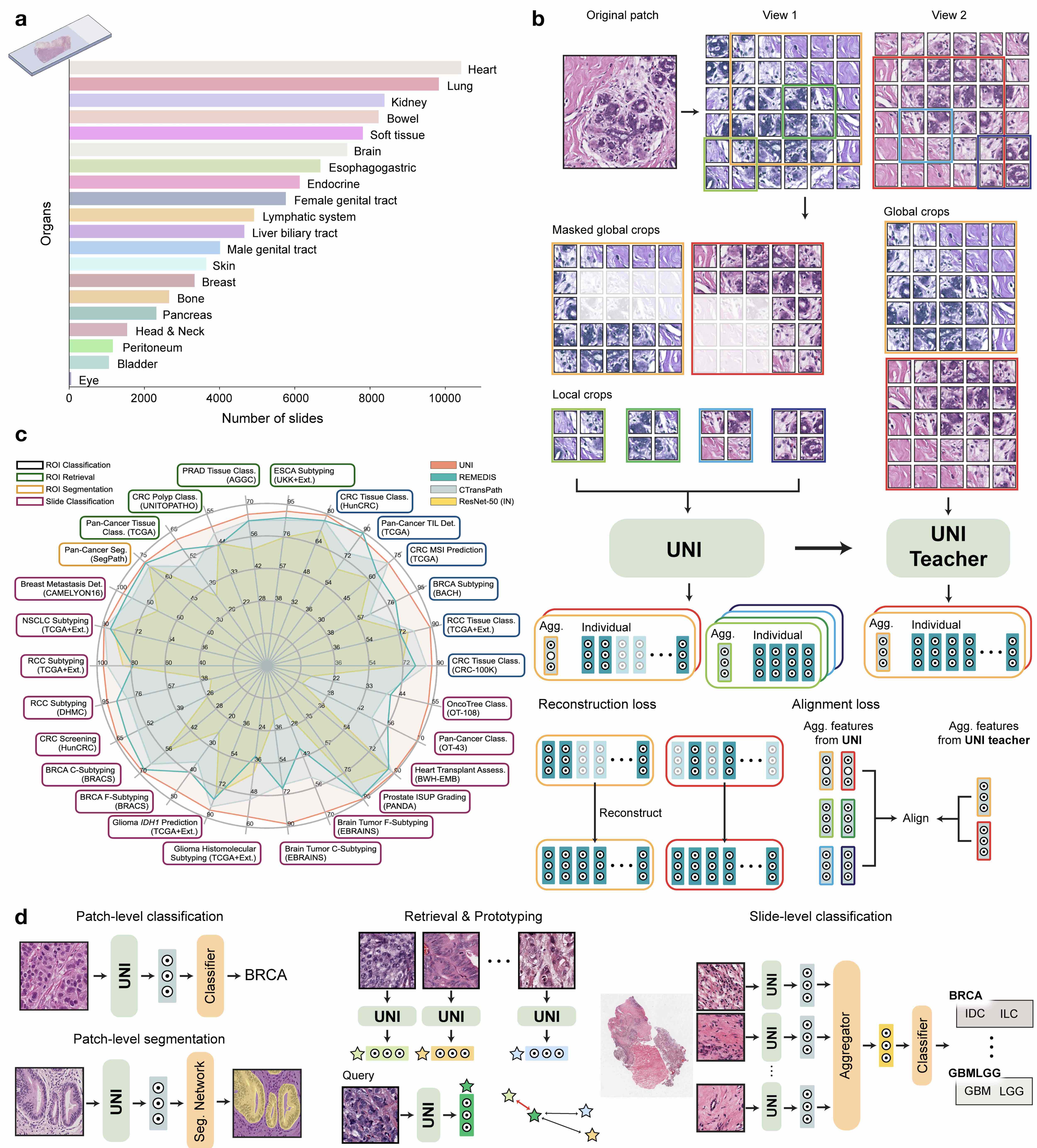
UNI는 100백만 개가 넘는 조직 패치(Mass-100K)에서 사전 학습된 범용 자기지도 학습 비전 트랜스포머 모델로, 33개의 다양한 계산 병리학(CPath) 작업에서 최첨단 성능을 달성하며 해상도에 구애받지 않는 분류, 적은 샷 슬라이드 분류, 그리고 108개의 OncoTree 코드에 걸친 광범위한 일반화를 가능하게 한다.
Tissue phenotyping is a fundamental computational pathology (CPath) task in learning objective characterizations of histopathologic biomarkers in anatomic pathology. However, whole-slide imaging (WSI) poses a complex computer vision problem in which the large-scale image resolutions of WSIs and the enormous diversity of morphological phenotypes preclude large-scale data annotation. Current efforts have proposed using pretrained image encoders with either transfer learning from natural image datasets or self-supervised pretraining on publicly-available histopathology datasets, but have not been extensively developed and evaluated across diverse tissue types at scale. We introduce UNI, a general-purpose self-supervised model for pathology, pretrained using over 100 million tissue patches from over 100,000 diagnostic haematoxylin and eosin-stained WSIs across 20 major tissue types, and evaluated on 33 representative CPath clinical tasks in CPath of varying diagnostic difficulties. In addition to outperforming previous state-of-the-art models, we demonstrate new modeling capabilities in CPath such as resolution-agnostic tissue classification, slide classification using few-shot class prototypes, and disease subtyping generalization in classifying up to 108 cancer types in the OncoTree code classification system. UNI advances unsupervised representation learning at scale in CPath in terms of both pretraining data and downstream evaluation, enabling data-efficient AI models that can generalize and transfer to a gamut of diagnostically-challenging tasks and clinical workflows in anatomic pathology.
연구 동기 및 목표
- 계산 병리학(CPath)에서 확장 가능하고 일반화 가능한 자기지도 표현의 필요성을 제고한다.
- 대규모의 다양항 히스토로지 데이터로 학습된 기초 모델(UNI)을 개발하여 조직 유형과 작업 전반에 걸쳐 일반화한다.
- ROI-, patch-, slide 수준의 CPath 작업에서 UNI의 성능을 시연하며, 적은 샷 학습 및 해상도 구애 없는 분류를 포함한다.
- CPath를 위한 자기지도 사전 학습의 확장성 효과와 데이터 효율성을 보여준다.
제안 방법
- Mass-100K에서 UNI(ViT-Large)를 사전 학습한다. 이 데이터셋은 20개 조직 유형에 걸친 100,426개의 WSIs에서 100백만 개가 넘는 조직 패치를 포함한다.
- 마스크 이미지 모델링 및 자기 증류 구성요소를 포함하는 DINOv2 자기지도 학습 목표를 사용한다.
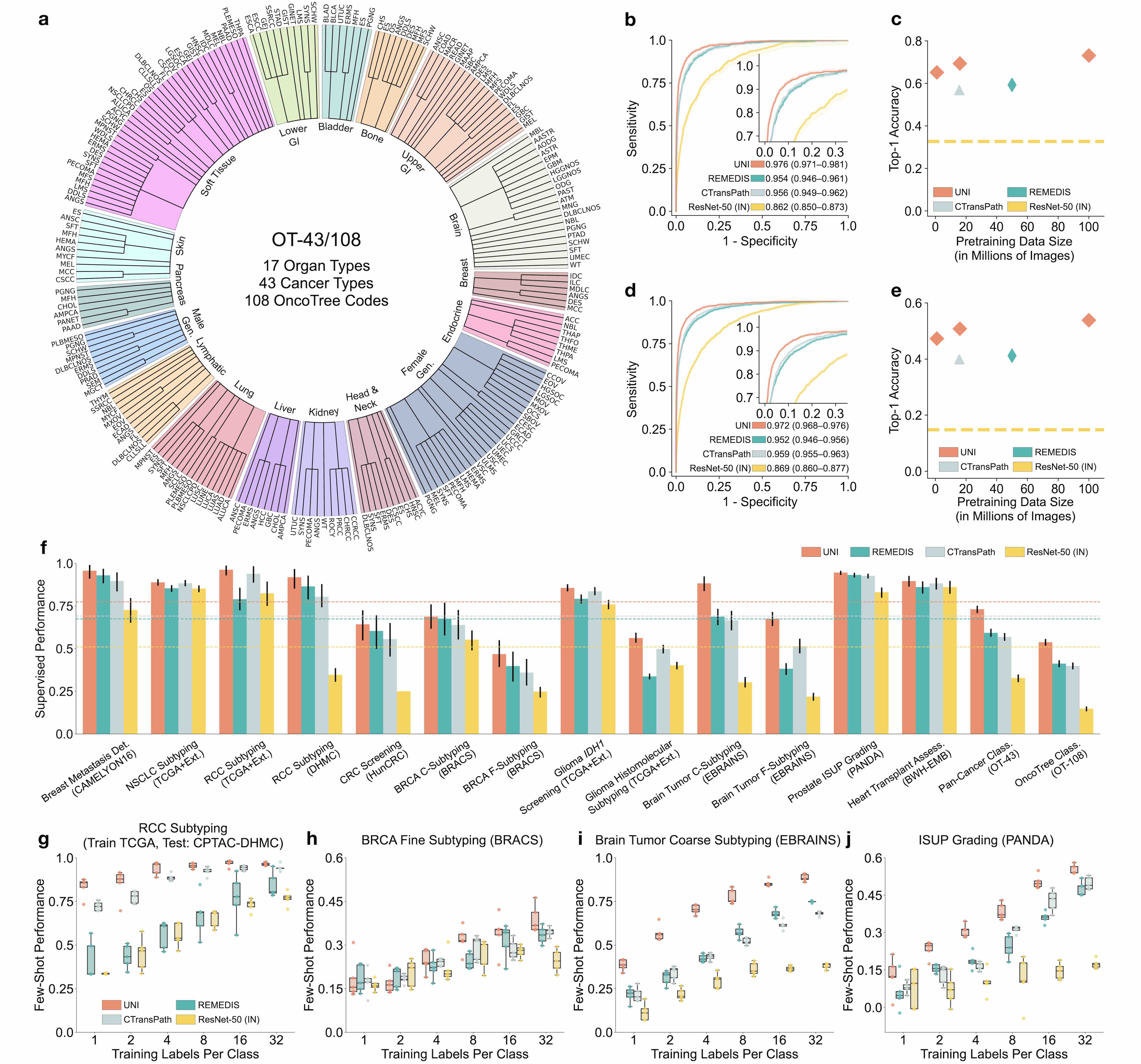
- ROI 분류, 분할, 이미지 검색, 슬라이드 수준 분류를 아우르는 33개의 다운스트림 CPath 작업에서 UNI를 평가한다( OncoTree OT-43 및 OT-108 포함 ).
- ResNet-50(IN-1K), CTransPath, REMEDIS 대비를 비교하고 데이터 규모 효과(Mass-1K, Mass-22K, Mass-100K)를 평가한다.
- 대표 표현 품질과 표본 효율성을 평가하기 위해 슬라이드 수준의 적은 샷 학습(C×K 구성) 및 ROI 수준 선형 및 KNN probing을 조사한다.
- 해상도에 구애받지 않는 표현과 고해상도 특징의 강건성을 탐구하며, MHSA 주의 시각화를 포함한다.
실험 결과
연구 질문
- RQ1대규모의 다양항 히스토로지 코퍼스에서 사전 학습된 자기지도 비전 트랜스포머가 학습된 장기 유형을 넘어 다양한 CPath 작업에 일반화할 수 있는가?
- RQ2데이터 규모(Mass-1K, Mass-22K, Mass-100K)가 OncoTree OT-43/OT-108 및 다른 다운스트림 작업의 성능에 어떤 영향을 미치는가?
- RQ3적은 샷 슬라이드 분류와 ROI 수준 탐색에 대해 UNI가 효과적인가, 그리고 다양한 이미지 해상도에서도 성능을 유지하는가?
- RQ4히스토로지 데이터로의 사전 학습이 주석 데이터 필요를 줄이면서 이전 기준(ResNet-50, CTransPath, REMEDIS) 대비 작업 간 전이 성능을 향상시키는가?
- RQ5해상도에 걸친 UNI 표현의 정성적 특성(예: 주의 맵)은 어떤가?
주요 결과
- UNI가 33개의 다운스트림 작업에서 기준선을 상회하며 OT-43 및 OT-108에서 REMEDIS 및 CTransPath보다 큰 격차로 top-1 및 top-5 이득을 달성한다.
- 데이터 규모의 이점: Mass-1K에서 Mass-22K로는 OT-43에서 +4.2%(top-1), +3.6%(top-5); Mass-22K에서 Mass-100K로는 +3.7%(top-1), +0.7%(top-5); Mass-1K에서 Mass-100K로는 OT-108에서 +6.5%(top-1), +8.6%(top-5) 달성.
- UNI는 약지도 학습된 슬라이드 분류 및 15 ROI 수준 작업에서 강한 성능을 달성하며 일관된 우위를 보이고 난이도가 높은 작업에서 주목할 만한 이점을 보인다.
- 외부 TCGA 평가 데이터에서도 UNI는 ResNet-50을 능가하고 여러 작업에서 CTransPath/REMEDIS와의 경쟁력이나 우위를 보이며 외부 코호트 전반에서 더 나은 일반화를 보인다.
- 적은 샷 학습: UNI는 일반적으로 클래스당 더 적은 예제가 필요하여 여러 작업에서 강한 성능에 도달하며 라벨 효율성이 우수하다.
- 해상도 구애 없는 능력: UNI는 크게 다른 이미지 해상도에서도 강한 표현을 유지하고 주의 맵은 여러 스케일에서 의미 있는 조직 위치화를 보여준다.
이 논문 읽기
누빈트 뷰어에서 원문을 열고, 읽으면서 궁금한 곳을 바로 물어보세요.
누빈트에서 이 논문 읽기이 리뷰는 AI가 논문 원문을 바탕으로 만들었습니다. 인용하기 전에 원문을 확인해 주세요.