
[논문 리뷰] A Hybrid Self-Supervised Learning Framework for Vertical Federated Learning
이 논문은 수평적 연합 학습에서의 데이터 부족 문제를 해결하기 위해, 정렬된 샘플의 양사 간 시각과 비정렬된 샘플의 국지적 증강을 활용하는 하이브리드 자기지도 학습 프레임워크인 FedHSSL을 제안한다. 이는 표현 학습을 향상시키며, 우수한 프라이버시-유용성 트레이드오프를 달성하여 기준 모델들을 크게 능가하며, 불변 특징 집합을 통해 레이블 유추 공격에 대한 강건성을 보여준다.
Vertical federated learning (VFL), a variant of Federated Learning (FL), has recently drawn increasing attention as the VFL matches the enterprises' demands of leveraging more valuable features to achieve better model performance. However, conventional VFL methods may run into data deficiency as they exploit only aligned and labeled samples (belonging to different parties), leaving often the majority of unaligned and unlabeled samples unused. The data deficiency hampers the effort of the federation. In this work, we propose a Federated Hybrid Self-Supervised Learning framework, named FedHSSL, that utilizes cross-party views (i.e., dispersed features) of samples aligned among parties and local views (i.e., augmentation) of unaligned samples within each party to improve the representation learning capability of the VFL joint model. FedHSSL further exploits invariant features across parties to boost the performance of the joint model through partial model aggregation. FedHSSL, as a framework, can work with various representative SSL methods. We empirically demonstrate that FedHSSL methods outperform baselines by large margins. We provide an in-depth analysis of FedHSSL regarding label leakage, which is rarely investigated in existing self-supervised VFL works. The experimental results show that, with proper protection, FedHSSL achieves the best privacy-utility trade-off against the state-of-the-art label inference attack compared with baselines. Code is available at \url{https://github.com/jorghyq2016/FedHSSL}.
연구 동기 및 목표
- 제한된 레이블이 부여되고 정렬된 샘플이 부족한 수평적 연합 학습(VFL) 환경에서의 데이터 부족 문제를 해결하기 위해.
- 정렬된 샘플의 양사 간 시각과 비정렬된 샘플의 국지적 증강을 활용하여 VFL에서의 표현 학습을 향상시키기 위해.
- 각 당사자 간의 불변 특징을 부분적으로 집계하여 모델 일반화 능력을 향상시키기 위해.
- 기존 연구에서 거의 다루지 않은 문제인 자기지도 학습 기반 VFL에서의 레이블 泄露 분석 및 완화를 위해.
- 레이블 유추 공격 상황에서 최신 기술 대비 더 나은 프라이버시-유용성 트레이드오프를 달성하기 위해.
제안 방법
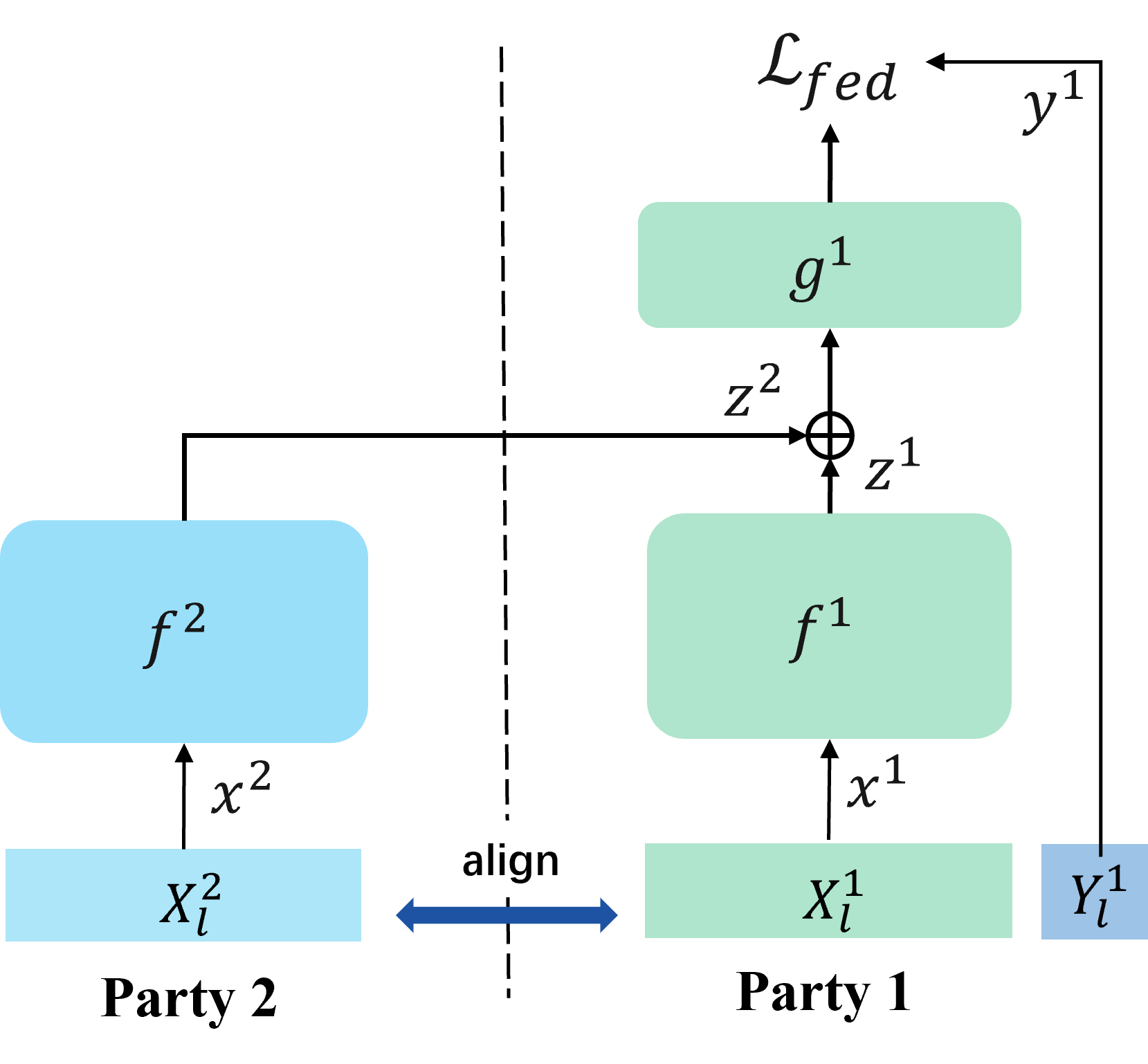
- FedHSSL은 정렬된 샘플을 기반으로 각 당사자 간 공유되는 특징(즉, 양사 간 시각)을 활용하여 대비 자기지도 학습의 양성 쌍으로 사용한다.
- 각 당사자 내에서 국지적 데이터 증강을 적용하여 비정렬된 샘플에 대한 추가적인 시각을 생성함으로써 국지적 표현 학습을 강화한다.
- 프레임워크는 부분적 모델 집계를 수행하여 당사자 간에 불변 특징을 추출하고 공유함으로써 공동 모델의 일반화 능력을 향상시킨다.
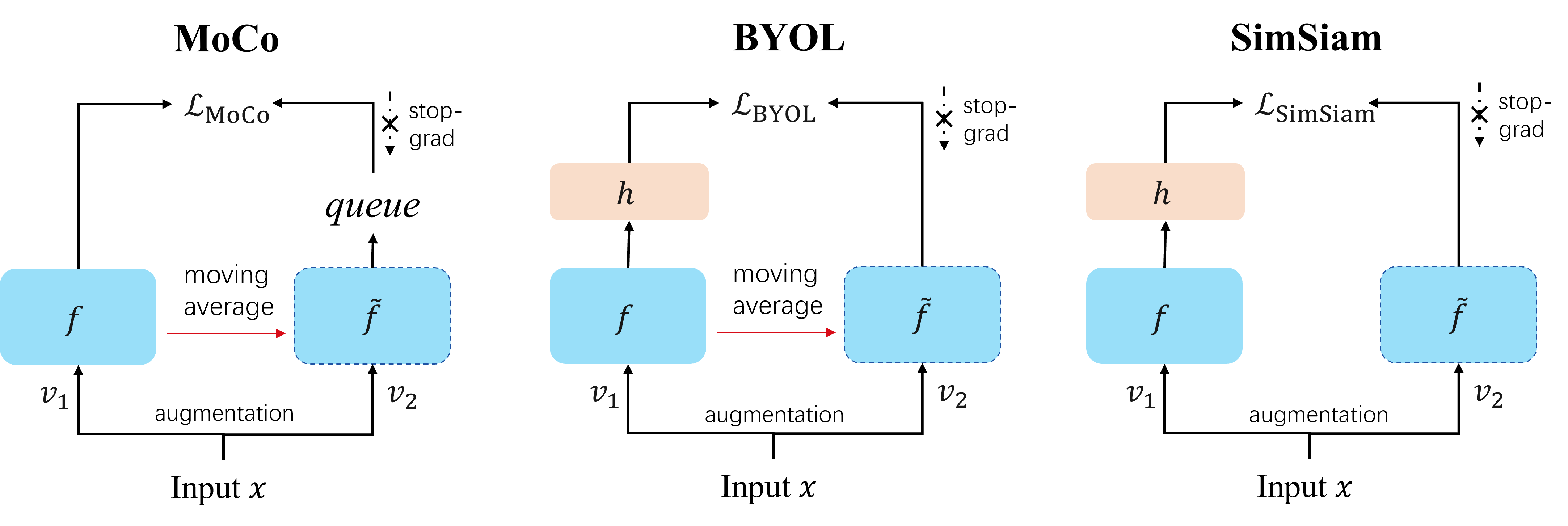
- SimSiam, BYOL, MoCo 등의 다양한 자기지도 학습 방법을 플러그인 구성 요소로 통합하여 유연성과 호환성을 확보한다.
- 사전학습 및 미세조정 단계에서 레이블 泄露 분석을 수행하며, ISO 기반 보호 메커니즘을 적용하여 프라이버시-유용성 트레이드오프를 평가한다.
- 네 가지 실세계 데이터셋(NUSWIDE, Avazu, BHI, Modelnet)을 사용하여 프레임워크를 평가하였으며, 제거 분석을 통해 각 구성 요소의 기여도를 확인하였다.
실험 결과
연구 질문
- RQ1수평적 연합 학습에서 정렬된 샘플과 비정렬된 샘플을 모두 효과적으로 활용할 수 있는 하이브리드 자기지도 학습 프레임워크는 모델 성능 향상에 기여하는가?
- RQ2정렬된 샘플의 양사 간 시각을 활용하는 것과 국지적 증강에만 의존하는 것 간의 표현 품질은 어떻게 비교되는가?
- RQ3레이블 유추 공격 상황에서 기존 자기지도 학습 기반 VFL 방법 대비 FedHSSL은 레이블 泄露를 얼마나 줄이는가?
- RQ4정렬된 샘플의 비율 변화가 FedHSSL의 프라이버시-유용성 트레이드오프에 미치는 영향은 어떠한가?
- RQ5당사자 간 불변 특징의 부분 집계가 공동 VFL 모델의 성능 향상에 상당한 기여를 하는가?
주요 결과
- FedHSSL은 네 가지 데이터셋에서 모든 기준 모델을 크게 능가하며, 주요 작업 정확도에서 0.03에서 0.05의 개선을 기록하였다.
- NUSWIDE 데이터셋에서 FedHSSL-SimSiam는 40%의 정렬된 샘플 조건에서 주요 작업 정확도 0.833을 달성하였으며, 동일 조건에서 FedLocalSimSiam(0.533)보다 뚜렷한 성능 우월성을 보였다.
- 교정된 평균 성능(CAP) 지표에 따르면, FedHSSL-SimSiam는 NUSWIDE에서 0.284, Modelnet에서 0.349의 CAP를 기록하여 FedSplitNN 및 FedLocalSimSiam를 모두 능가하였다.
- BHI 데이터셋에서 40%의 정렬된 샘플 조건에서 FedHSSL-SimSiam는 주요 작업 정확도 0.788을 달성하였으며, FedLocalSimSiam의 0.756보다 높은 성능을 기록하여 양사 간 시각 활용의 이점을 입증하였다.
- 프라이버시 분석 결과, FedHSSL은 기준 모델 대비 더 나은 프라이버시-유용성 트레이드오프를 달성하였으며, 40%의 정렬된 샘플과 강력한 보호 조치를 적용한 상황에서 NUSWIDE에서 레이블 복구 정확도(MC 공격)가 0.443으로 떨어졌다.
- 제거 분석 결과, 양사 간 시각 학습과 국지적 증강 모두 성능 향상에 상당한 기여를 하며, 두 요소의 조합이 가장 높은 성능 향상을 이끌었다.
더 나은 연구,지금 바로 시작하세요
논문 읽기부터 검토까지, 연구 시간을 획기적으로 줄여보세요.
카드 등록 없음 · 무료 플랜 제공
이 리뷰는 AI가 만들고, 인간 에디터가 검토했습니다.