
[논문 리뷰] A Novel Approach to Industrial Defect Generation through Blended Latent Diffusion Model with Online Adaptation
The paper introduces AdaBLDM, a diffusion-model-based defect generator that uses a defect trimap, cross-modal prompts, and online decoder adaptation to synthesize diverse, high-quality industrial defects for improved anomaly detection.
Effectively addressing the challenge of industrial Anomaly Detection (AD) necessitates an ample supply of defective samples, a constraint often hindered by their scarcity in industrial contexts. This paper introduces a novel algorithm designed to augment defective samples, thereby enhancing AD performance. The proposed method tailors the blended latent diffusion model for defect sample generation, employing a diffusion model to generate defective samples in the latent space. A feature editing process, controlled by a ``trimap" mask and text prompts, refines the generated samples. The image generation inference process is structured into three stages: a free diffusion stage, an editing diffusion stage, and an online decoder adaptation stage. This sophisticated inference strategy yields high-quality synthetic defective samples with diverse pattern variations, leading to significantly improved AD accuracies based on the augmented training set. Specifically, on the widely recognized MVTec AD dataset, the proposed method elevates the state-of-the-art (SOTA) performance of AD with augmented data by 1.5%, 1.9%, and 3.1% for AD metrics AP, IAP, and IAP90, respectively. The implementation code of this work can be found at the GitHub repository https://github.com/GrandpaXun242/AdaBLDM.git
연구 동기 및 목표
- 산업 현장에서의 defective 샘플 부족으로 효과적인 이상 탐지(AD) 달성의 어려움 해결.
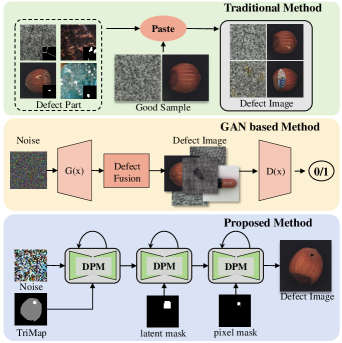
- 결함 합성을 위해 BLDM( blended latent diffusion model )에 기반한 결함 생성 프레임워크를 제안.
- 결함 위치와 외관 제어를 위한 결함 트림맵과 교차 모달 프롬프트를 도입.
- 샘플 현실성과 다양성 향상을 위한 3단계 추론 및 온라인 디코더 적응 도입.
- 생성 데이터로 다수 벤치마드에서의 AD 성능 향상 입증.
제안 방법
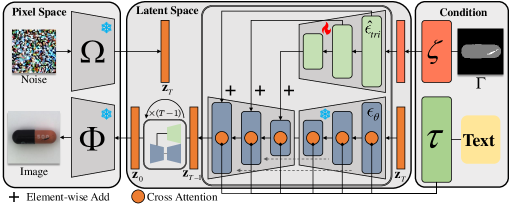
- 백본으로 Latent Diffusion Model(LDM)을 활용하고, 결함 영역 제어를 위한 교차 모달 프롬프트와 결함 트림맵으로 확장.
- 생성에 영향을 주는 오브젝트 및 결함 유형을 설명하는 CLIP/BLIP 기반의 언어 프롬프트를 사용.
- 임베딩을 통한 대상 영역 내 결함을 제한하고 트림맵 특징용으로 설계된 인코더를 도입하는 결함 트림맵 구성.
- 콘텐츠 편집을 통한 다단계 디노이징: 자유 확산 단계, 잠재 공간 편집, 픽셀 공간 혼합으로 결함 제작.
- 생성된 샘플마다 디코더를 미세 조정하는 온라인 디코더 적응을 제안하여 결함의 현실감과 정상 영역 보존의 균형을 달성.
- 도메인 데이터에서의 사전 학습 후 실제 결함 데이터로 트림맵 인코더와 컨볼루션 블록을 미세 튜닝하는 2단계 학습 스킴으로 모델 학습.
실험 결과
연구 질문
- RQ1확산 기반의 결함 생성이 기존 SOTA 방법을 넘어서는 다양하고 고품질의 합성 결함을 만들어 AD 성능을 향상시킬 수 있는가?
- RQ2교차 모달 프롬프트와 결함 트림맵이 생성된 결함의 현실감과 로컬라이제이션 정확도에 어떤 영향을 미치는가?
- RQ3온라인 디코더 적응이 합성 결함의 품질과 다운스트림 AD 지표를 더욱 향상시키는가?
- RQ4AdaBLDM가 GAN 기반 및 다른 확산 기반 결함 생성 방법과 비교하여 여러 산업 데이터셋에서 어떻게 성능을 보이는가?
주요 결과
- AdaBLDM은 데이터 증가를 통해 MVTec AD에서 새로운 SOTA AD 성능을 달성하며, DeSTseg를 AP에서 1.5%, IAP에서 1.9%, IAP90에서 3.1% 앞섰다.
- SOTA 결함 생성기(DFM, DCDGANc 변형들)와 비교할 때 AdaBLDM은 AD 메트릭으로 더 높은 품질의 더 다양한 결함 샘플을 제공한다.
- 3단계 추론과 온라인 디코더 적응은 더 높은 샘플 충실도와 더 나은 결함 패턴 변화를 가져온다.
- 여러 서브카테고리에서 AdaBLDM 생성 데이터를 활용한 SVM 기반 AD가 강력한 이상 탐지율을 보이며, DeSTseg 기반 AD도 AdaBLDM 데이터의 이점을 얻는다.
- 이 방법은 MVTEC AD, BTAD, KSDD2의 텍스처 및 객체 카테고리에서 견고함을 보여준다.
이 논문 읽기
누빈트 뷰어에서 원문을 열고, 읽으면서 궁금한 곳을 바로 물어보세요.
누빈트에서 이 논문 읽기이 리뷰는 AI가 논문 원문을 바탕으로 만들었습니다. 인용하기 전에 원문을 확인해 주세요.