
[논문 리뷰] A random-key GRASP for combinatorial optimization
이 논문은 연속 단위 초입방체에서 해를 매핑하는 디코더를 사용하는 문제 독립형 GRASP 메타휴리스틱인 Random-Key GRASP(RK-GRASP)를 제안한다. 이는 다섯 개인 NP-난해 문제에서 뛰어난 성능을 보이며, RK-GRASP가 Random Variable Neighborhood Descent(RVND)를 사용할 경우 THLP의 97%, SSP의 100%, NCGPP의 75%에서 BRKGA 및 Multi-Start 방법보다 뛰어난 성능을 발휘한다.
This paper proposes a problem-independent GRASP metaheuristic using the random-key optimizer (RKO) paradigm. GRASP (greedy randomized adaptive search procedure) is a metaheuristic for combinatorial optimization that repeatedly applies a semi-greedy construction procedure followed by a local search procedure. The best solution found over all iterations is returned as the solution of the GRASP. Continuous GRASP (C-GRASP) is an extension of GRASP for continuous optimization in the unit hypercube. A random-key optimizer (RKO) uses a vector of random keys to encode a solution to a combinatorial optimization problem. It uses a decoder to evaluate a solution encoded by the vector of random keys. A random-key GRASP is a C-GRASP where points in the unit hypercube are evaluated employing a decoder. We describe random key GRASP consisting of a problem-independent component and a problem-dependent decoder. As a proof of concept, the random-key GRASP is tested on five NP-hard combinatorial optimization problems: traveling salesman problem, tree of hubs location problem, Steiner triple covering problem, node capacitated graph partitioning problem, and job sequencing and tool switching problem.
연구 동기 및 목표
- 랜덤 키 파рад룸을 사용하여 문제 독립형 GRASP 메타휴리스틱을 개발하는 것.
- 해를 문제에 특화된 논리에서 분리함으로써 단일 솔버 프레임워크를 다양한 조합 최적화 문제에 재사용할 수 있도록 하는 것.
- 다양한 국소 탐색 전략을 사용하여 RK-GRASP의 성능을 다양한 NP-난해 조합 최적화 문제에 대해 평가하는 것.
- CPU 시간과 해 품질 지표를 사용하여 RK-GRASP의 성능을 BRKGA 및 Multi-Start 방법과 비교하는 것.
- 기본 테스트를 통해 랜덤 키 GRASP 프레임워크의 실현 가능성과 우수성을 입증하는 것.
제안 방법
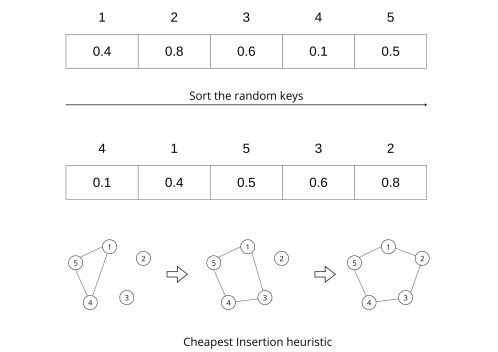
- RK-GRASP는 해를 [0,1) 범위의 랜덤 키 벡터로 표현하는 연속 단위 초입방체에서 작동한다.
- 문제에 특화된 디코더는 각 랜덤 키 벡터를 이산 문제 공간 내 타당한 해로 매핑하고, 그 비용을 평가한다.
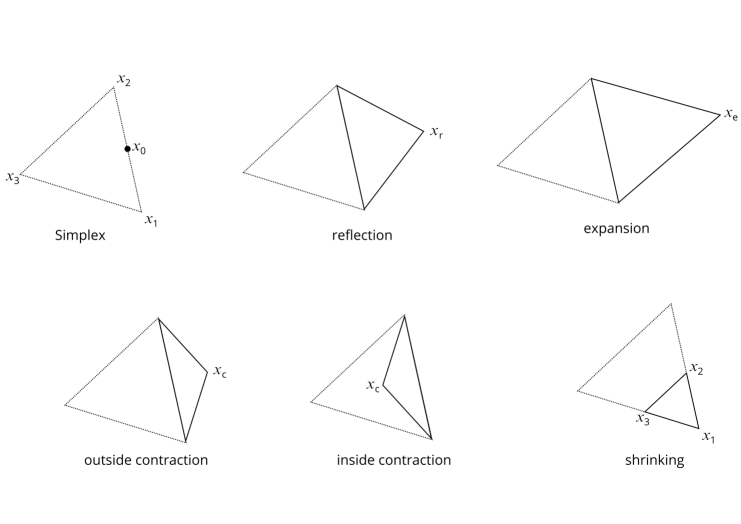
- 알고리즘은 근사적 랜덤 구성 단계와 국소 탐색 절차(예: 그리드 검색, 넬더-미드 검색, 무작위 변수 이웃 근접 탐색(RVND))를 결합한다.
- 다양한 반복 동안 발견된 최고의 해가 반환되며, 국소 탐색을 통해 해 품질을 향상시킨다.
- 메타휴리스틱(솔버)과 문제에 특화된 논리(디코더)를 분리함으로써, 다양한 최적화 문제에 걸쳐 재사용이 가능하다.
- 성능는 CPU 시간과 해 갭 기반의 성능 프로필을 사용하여 평가되며, 수렴 임계값은 1%로 설정된다.
실험 결과
연구 질문
- RQ1랜덤 키 최적화자(RKO) 파라다임을 사용하여 문제 독립형 GRASP 메타휴리스틱을 효과적으로 설계할 수 있는가?
- RQ2다양한 NP-난해 조합 최적화 문제에서 RK-GRASP는 BRKGA 및 Multi-Start 방법과 비교해 성능와 해 품질 면에서 어떻게 다른가?
- RQ3그리드 검색, 넬더-미드, 또는 RVND 중 어떤 국소 탐색 전략이 RK-GRASP 프레임워크에서 가장 뛰어난 성능을 내는가?
- RQ4RK-GRASP는 NP-난해 문제의 기준 인스턴스에서 얼마나 많은 신규 최고 기록 해를 달성할 수 있는가?
- RQ5랜덤 키 인코딩과 디코더 기반 매핑은 다양한 문제 영역에서 효율적이고 확장 가능한 최적화를 가능하게 하는가?
주요 결과
- CPU 시간 측면에서, RK-GRASP에 RVND를 적용한 결과, Tree of Hubs Location Problem(THLP)의 97% 인스턴스, Job Sequencing and Tool Switching Problem(SSP)의 100% 인스턴스, Node Capacitated Graph Partitioning Problem(NCGPP)의 75% 인스턴스에서 BRKGA 및 Multi-Start 방법보다 뛰어난 성능를 보였다.
- TSP의 경우, BRKGA와 RK-GRASP에 RVND를 적용한 결과 모두 성능 비율 4 이내로 95%의 인스턴스를 해결했지만, 누적 성능 프로필에서 RK-GRASP에 RVND를 적용한 결과가 더 뛰어난 우월성을 보였다.
- RK-GRASP에 RVND를 적용한 결과, THLP, SSP, NCGPP에서 새로운 최고 기록 해를 달성하여 고품질 해를 찾는 데서의 효과성을 입증했다.
- Steiner Triple Covering Problem(STCP)의 경우, BRKGA와 RK-GRASP에 RVND를 적용한 결과 모두 성능 비율 4 이내로 40%의 인스턴스를 해결했으며, 명백한 우월성은 관찰되지 않았다.
- 성능 프로필 분석 결과, RK-GRASP에 RVND를 적용한 결과는 TSP, THLP, SSP에서 성능 비율 4 이내의 해의 누적 분포가 가장 높았다.
- 프레임워크의 문제 독립적 설계 덕분에, 다른 디코더를 단지 삽입하기만 하면 동일한 솔버를 다양한 문제에 재사용할 수 있어, 새로운 조합 최적화 문제에 효율적으로 적응할 수 있다.
이 논문 읽기
누빈트 뷰어에서 원문을 열고, 읽으면서 궁금한 곳을 바로 물어보세요.
누빈트에서 이 논문 읽기이 리뷰는 AI가 논문 원문을 바탕으로 만들었습니다. 인용하기 전에 원문을 확인해 주세요.