
[논문 리뷰] A red giant orbiting a black hole
이 논문은 1277일, 중간 정도로 타원도가 높은 궤도를 도는 1 M☉의 적색거성과 공전하는 8.9±0.3 M☉의 수면 상태인 블랙홀인 가이아 BH2를 규명한다. 가이아 DR3에서의 천체운동학적 해법을 지지하는 분광학적 및 광도학적 후속 관측 결과가 나왔으며, X선 및 라디오 비검출 결과는 저효율적 적축 모델을 지지한다. 이는 가이아 BH2가 알려진 블랙홀 중 두 번째로 가까운 곳에 위치해 있으며, X선 조사로는 탐지되지 않는 넓은 궤도를 도는 수면 상태 블랙홀 이진계의 집단을 드러낸다.
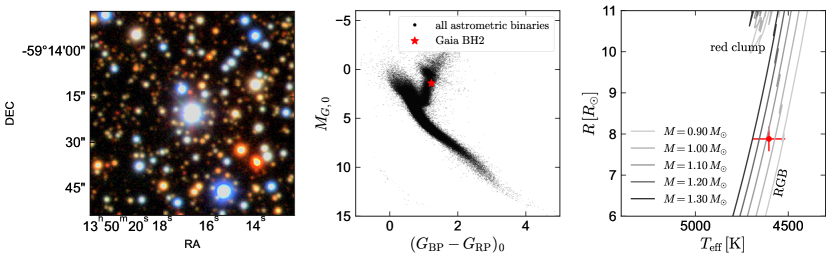
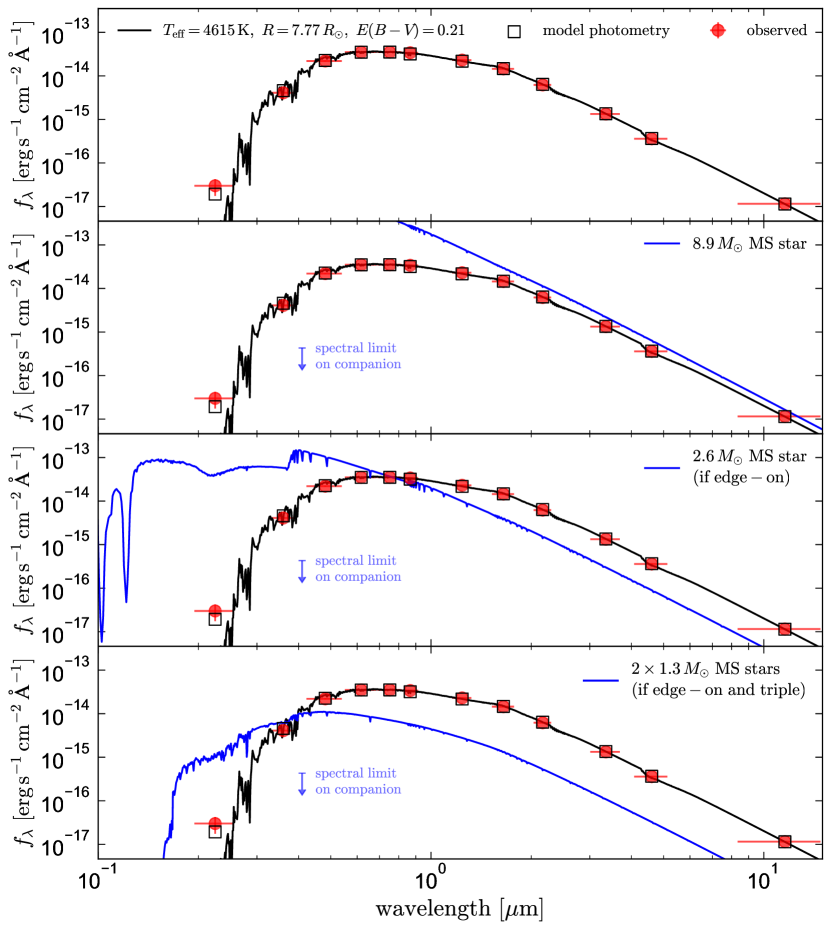
We report spectroscopic and photometric follow-up of a dormant black hole (BH) candidate from Gaia DR3. The system, which we call Gaia BH2, contains a $\sim 1M_{\odot}$ red giant and a dark companion with mass $M_2 = 8.9\pm 0.3\,M_{\odot}$ that is very likely a BH. The orbital period, $P_{ m orb} = 1277$ days, is much longer than that of any previously studied BH binary. Our radial velocity (RV) follow-up over a 7-month period spans more than 90% of the orbit's dynamic range in RV and is in excellent agreement with predictions of the Gaia solution. UV imaging and high-resolution optical spectra rule out all plausible luminous companions that could explain the orbit. The star is a bright ($G=12.3$), slightly metal-poor ($ m [Fe/H]=-0.22$) low-luminosity giant ($T_{ m eff}=4600\, m K$; $R = 7.8\,R_{\odot}$; $\log\left[g/\left({ m cm\,s^{-2}} ight) ight] = 2.6$). The binary's orbit is moderately eccentric ($e=0.52$). The giant is strongly enhanced in $α-$elements, with $ m [α/Fe] = +0.26$, but the system's Galactocentric orbit is typical of the thin disk. We obtained X-ray and radio nondetections of the source near periastron, which support BH accretion models in which the net accretion rate at the horizon is much lower than the Bondi-Hoyle-Lyttleton rate. At a distance of 1.16 kpc, Gaia BH2 is the second-nearest known BH, after Gaia BH1. Its orbit -- like that of Gaia BH1 -- seems too wide to have formed through common envelope evolution. Gaia BH1 and BH2 have orbital periods at opposite edges of the Gaia DR3 sensitivity curve, perhaps hinting at a bimodal intrinsic period distribution for wide BH binaries. Dormant BH binaries like Gaia BH1 and Gaia BH2 likely significantly outnumber their close, X-ray bright cousins, but their formation pathways remain uncertain.
연구 동기 및 목표
- 다양한 파장대에서의 후속 관측을 통해 가이아 DR3 천체운동학적 이진후보(가이아 BH2)가 블랙홀 이진계임을 확인하기 위해.
- 보이지 않는 형성물의 궤도 파rameters와 역학적 질량을 특정하여, 별 또는 밀도 높은 천체의 가능성은 배제하기 위해.
- X선 및 라디오 비검출을 통해 블랙홀의 적축 상태를 조사하고, 복사 효율을 평가하기 위해.
- 가이아 BH2를 은하수 블랙홀 이진계 형성 이론과 연관지어, 은하수 내 수면 상태 블랙홀의 전체 집단적 특성에 놓고 고려하기 위해.
제안 방법
- 7개월간의 분광학적 라디얼 속도 모니터링을 통해 궤도 운동을 측정하고, 가이아 DR3의 천체운동학적 해법을 확인하기 위해.
- 관측된 라디얼 속도 곡선을 모방할 수 있는 밝은 동반성체가 존재하는지 배제하기 위해 고해상도 광학 및 자외선 분광학을 수행하기 위해.
- 가이아 DR3 데이터를 이용한 천체운동학 분석을 통해 궤도 요소를 유도하기 위해, 주기, 이심률, 기울기 등을 포함한다.
- 찰라 및 메르카트를 이용한 X선 및 라디오 관측을 통해 적축 신호를 탐색하고, 복사 효율을 제약하기 위해.
- 적색거성의 대기층 모델링을 통해 유효 온도, 표면 중력, 금속성도를 유도하기 위해.
- 이중성계의 궤도 파arameters를 이중성계 진화 모델과 비교하여 형성 경로를 평가하기 위해.
실험 결과
연구 질문
- RQ1가이아 BH2의 어두운 형성물이 블랙홀과 일치하는가? 그 질량은 얼마인가?
- RQ2X선 및 라디오 비검출 결과로부터 유추되는 블랙홀의 적축 상태는 무엇인가?
- RQ3가이아 BH2의 궤도 구조는 블랙홀 이진계 형성에 대한 이론적 기대와 어떻게 비교되는가?
- RQ4가이아 BH2의 존재는 은하수 내 넓은 궤도를 도는 수면 상태 블랙홀 이진계 집단에 대해 어떤 시사점을 갖는가?
- RQ5왜 가이아 BH1과 가이아 BH2의 궤도 주기는 가이아 DR3의 감도 곡선의 양 끝에 위치해 있는가?
주요 결과
- 가이아 BH2 시스템은 라디얼 속도 모니터링과 가이아 DR3의 천체운동학적 일致성으로 확인된 8.9±0.3 M☉의 블랙홀을 포함한다.
- 적색거성의 질량은 약 1 M☉이며, 유효 온도는 4600 K, 반지름은 7.8 R☉, 표면 중력은 log(g) = 2.6 cm s⁻²이다.
- 궤도 주기는 1277일이며, 이심률은 0.52이며, 페리아스트론 거리는 2.4 au로, 적색 초거성의 기원으로 기대되는 반지름을 초과한다.
- X선 및 라디오 관측에서 검출 결과가 없었으며, 이는 복사 효율이 10⁻⁴ 이하임을 시사하며, 복사 효율이 낮은 적축 모델과 일치한다.
- 이 시스템은 거리가 1.16 kpc에 위치해 있어, 가이아 BH1에 이어 알려진 블랙홀 중 두 번째로 가까운 곳이다.
- 궤도 파arameters는 고질량 주계열에서의 바람에 의한 진화 또는 천체역학적 과정을 통해 형성되었을 가능성이 있으며, 표준 공동-envelope 진화 과정은 아님을 시사한다.
이 논문 읽기
누빈트 뷰어에서 원문을 열고, 읽으면서 궁금한 곳을 바로 물어보세요.
누빈트에서 이 논문 읽기이 리뷰는 AI가 논문 원문을 바탕으로 만들었습니다. 인용하기 전에 원문을 확인해 주세요.