
[논문 리뷰] A Review of Deep Learning Techniques for Speech Processing
깊은 학습 아키텍처(RNNs, CNNs, transformers, conformers, diffusion models, GNNs)와 이들의 음성 태스크 전반에 걸친 응용, 데이터셋 및 향후 방향에 대한 포괄적 고찰.
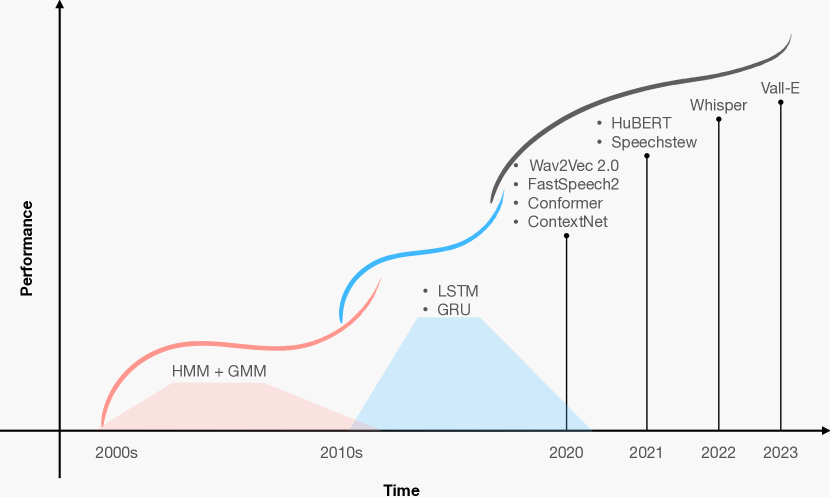
The field of speech processing has undergone a transformative shift with the advent of deep learning. The use of multiple processing layers has enabled the creation of models capable of extracting intricate features from speech data. This development has paved the way for unparalleled advancements in speech recognition, text-to-speech synthesis, automatic speech recognition, and emotion recognition, propelling the performance of these tasks to unprecedented heights. The power of deep learning techniques has opened up new avenues for research and innovation in the field of speech processing, with far-reaching implications for a range of industries and applications. This review paper provides a comprehensive overview of the key deep learning models and their applications in speech-processing tasks. We begin by tracing the evolution of speech processing research, from early approaches, such as MFCC and HMM, to more recent advances in deep learning architectures, such as CNNs, RNNs, transformers, conformers, and diffusion models. We categorize the approaches and compare their strengths and weaknesses for solving speech-processing tasks. Furthermore, we extensively cover various speech-processing tasks, datasets, and benchmarks used in the literature and describe how different deep-learning networks have been utilized to tackle these tasks. Additionally, we discuss the challenges and future directions of deep learning in speech processing, including the need for more parameter-efficient, interpretable models and the potential of deep learning for multimodal speech processing. By examining the field's evolution, comparing and contrasting different approaches, and highlighting future directions and challenges, we hope to inspire further research in this exciting and rapidly advancing field.
연구 동기 및 목표
- 전통적(MFCC, HMM) 접근 방식에서 현대의 딥러닝 모델까지 음성 처리의 진화를 추적한다.
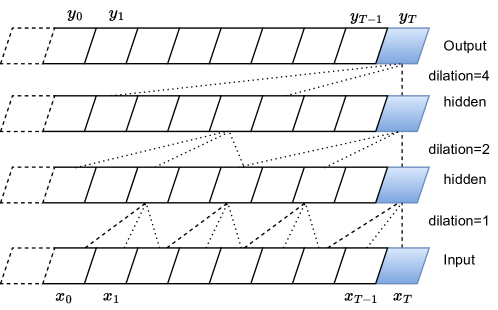
- 음성 태스크를 위한 딥러닝 아키텍처(RNNs, CNNs, Transformers, Conformers, diffusion models, GNNs)를 분류하고 비교한다.
- 표현 학습(감독 학습, 비감독 학습, 준감독 학습, 자기지도 학습)과 음성 처리에서의 역할을 조사한다.
- 광범위한 음성 처리 작업(ASR, 합성, 화자 인식, 다이어라이제이션, 번역, 향상, 멀티모달 처리) 및 관련 데이터셋/벤치마크를 검토한다.
- 도메인 적응, 메타학습, 매개변수 효율적 방법 등 전이 학습 기술을 논의하고 향후 연구 방향을 제시한다.
제안 방법
- 음성 처리에 사용되는 딥러닝 아키텍처의 광범위한 분류 체계(RNNs, CNNs, Transformers, Conformers, sequence-to-sequence 모델, 강화학습, 그래프 신경망, 확산 모델)를 제시한다.
- 표현 학습 패러다임(감독 학습, 비감독 학습, 준감독 학습, 자기지도 학습)과 성능에 대한 함의를 설명한다.
- 주요 음성 처리 작업과 이를 다루는 딥러닝 접근법(ASR, 합성, 화자 인식, 다이어라이제이션, 번역, 향상, VAD, 품질 평가, 분리, SLU, 시청각 처리)을 조사한다.
- 음성 처리와 관련된 고급 전이 학습 기법(도메인 적응, 메타학습, 매개변수 효율적 전이 학습)을 논의한다.
- 성능과 계산 효율성 및 해석 가능성 간의 균형을 이루는 아키텍처를 탐구하고, 멀티모달 음성 처리, 효율성, 일반화 등 향후 방향을 제시한다.
실험 결과
연구 질문
- RQ1주요 딥러닝 아키텍처의 핵심 음성 태스크에 대한 상대적 강점과 한계는 무엇인가?
- RQ2데이터셋과 벤치마크가 음성 처리 태스크의 진전에 어떤 영향을 미쳤는가?
- RQ3표현 학습(감독 vs 자기지도)의 음성 태스크 성능 향상에 어떤 역할을 하는가?
- RQ4데이터 효율성, 해석 가능성, 강건성 등의 어떤 문제가 배치를 제한하며, 가장 유망한 미래 방향은 무엇인가?
- RQ5도메인과 모달리티 전반에서 전이 학습 기법이 음성 처리를 어떻게 향상시킬 수 있는가?
주요 결과
- 딥러닝은 인식, 합성, 화자 분석 등 음성 태스크 전반에서 전통적 방법에 비해 상당한 진전을 이끌었다.
- End-to-end RNN, CNN, and transformer-based models have become central to modern speech systems, often outperforming HMM-based pipelines.
- Self-supervised and semi-supervised representations are increasingly leveraged to reduce labeled data requirements and improve robustness.
- Multimodal approaches (audio-visual) show promise in challenging environments, particularly for speech activity detection and recognition.
- Transfer learning, including domain adaptation and parameter-efficient methods, is valuable for cross-domain speech processing tasks.
- The field continues to explore architectures that balance performance with computational efficiency and interpretability.
이 논문 읽기
누빈트 뷰어에서 원문을 열고, 읽으면서 궁금한 곳을 바로 물어보세요.
누빈트에서 이 논문 읽기이 리뷰는 AI가 논문 원문을 바탕으로 만들었습니다. 인용하기 전에 원문을 확인해 주세요.