
[논문 리뷰] A Survey on Automated Program Repair Techniques
이 설문은 자동화된 프로그램 수리(APR) 기술을 네 세대로 분류한다—탐색 기반, 제약 기반, 템플릿 기반, 학습 기반—그리고 그 개발, 평가 기준, 미래 방향을 분석하며 데이터 중심 및 딥러닝 접근에 중점을 둔다.
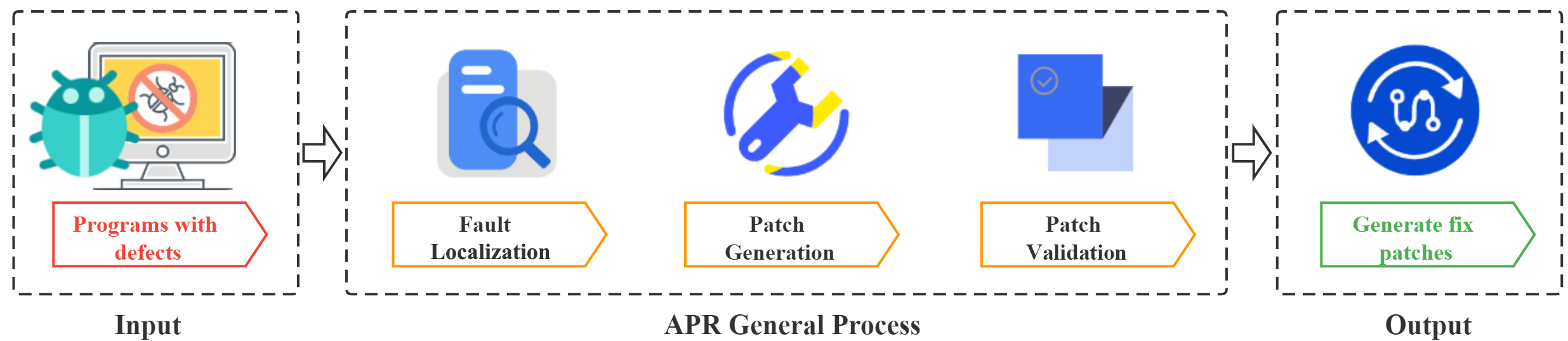
With the rapid development and large-scale popularity of program software, modern society increasingly relies on software systems. However, the problems exposed by software have also come to the fore. Software defect has become an important factor troubling developers. In this context, Automated Program Repair (APR) techniques have emerged, aiming to automatically fix software defect problems and reduce manual debugging work. In particular, benefiting from the advances in deep learning, numerous learning-based APR techniques have emerged in recent years, which also bring new opportunities for APR research. To give researchers a quick overview of APR techniques' complete development and future opportunities, we revisit the evolution of APR techniques and discuss in depth the latest advances in APR research. In this paper, the development of APR techniques is introduced in terms of four different patch generation schemes: search-based, constraint-based, template-based, and learning-based. Moreover, we propose a uniform set of criteria to review and compare each APR tool, summarize the advantages and disadvantages of APR techniques, and discuss the current state of APR development. Furthermore, we introduce the research on the related technical areas of APR that have also provided a strong motivation to advance APR development. Finally, we analyze current challenges and future directions, especially highlighting the critical opportunities that large language models bring to APR research.
연구 동기 및 목표
- APR 기법에 대한 체계적인 분류 체계를 제공하고 역사적 변천을 추적한다.
- 접근 방식, 수리 능력, 품질, 효율성의 차원에서 APR 도구를 비교하기 위한 일관된 평가 프레임워크를 제안한다.
- 최근 데이터 기반 및 학습 기반 APR 진보와 이들의 수리 품질 및 확장성에 대한 영향을 강조한다.
- 실험적 평가의 도전과제, 데이터셋 품질, APR 연구에서 대형 언어 모델의 역할을 논의한다.
제안 방법
- APR 기법을 네 가지 범주로 분류한다: 탐색 기반, 제약 기반, 템플릿 기반, 학습 기반.
- 접근 설계, 수리 능력, 수리 품질, 수리 효율성의 다차원 평가 기준을 포함하는 일관된 평가 기준을 제안한다.
- 시계열 순으로 APR 기법을 검토하고 각 범주의 강점과 한계를 요약한다.
- 데이터셋 겹침 및 비교의 공정성 등 실증 평가의 문제를 강조한다.
- APR 연구에서 대형 언어 모델(LLMs) 및 데이터 기반 접근법의 영향과 가능성을 논의한다.
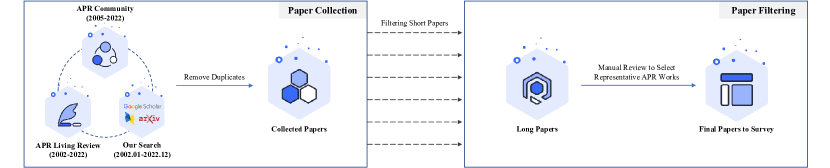
실험 결과
연구 질문
- RQ1소프트웨어 결함에 대응하여 네 가지 패치 생성 체계에서 APR 기법이 어떻게 진화해 왔는가?
- RQ2디자인, 능력, 품질, 효율성 측면에서 APR 도구를 비교하기에 가장 적합한 평가 기준은 무엇인가?
- RQ3특히 데이터 기반 및 학습 기반 방법에서 각 APR 범주의 핵심 장점과 단점은 무엇인가?
- RQ4향후 APR 연구의 주요 도전 과제와 기회는 무엇이며 산업적 배포 및 LLM 통합을 포함한다?
주요 결과
- APR 기법은 네 가지 세대 계열로 구성되며: 탐색 기반, 제약 기반, 템플릿 기반, 학습 기반이며 학습 기반 메소드는 점점 두드러지고 있다.
- 네 차원에 걸친 12개 지표의 일관된 평가 프레임워크를 제시하여 APR 도구를 구조화된 방식으로 비교한다.
- 학습 기반 APR 접근 방식은 수리 데이터로부터 경험적 지식을 획득하게 하여 시간이 지남에 따라 수리 범위와 품질을 개선할 가능성이 있다.
- 실증 연구의 문제점으로 불공정한 비교와 데이터셋 품질 등을 지적하고 표준화된 벤치마크의 필요성을 강조한다.
- 저자들은 APR 개발의 향후 방향으로 대형 언어 모델과 데이터 기반 방법의 중요한 역할을 논의한다.
이 논문 읽기
누빈트 뷰어에서 원문을 열고, 읽으면서 궁금한 곳을 바로 물어보세요.
누빈트에서 이 논문 읽기이 리뷰는 AI가 논문 원문을 바탕으로 만들었습니다. 인용하기 전에 원문을 확인해 주세요.