
[논문 리뷰] A Survey on LLM-Generated Text Detection: Necessity, Methods, and Future Directions
본 조사는 대형 언어 모델이 생성한 텍스트를 탐지하는 진보를 종합하여 탐지기, 데이터셋, 평가, 도전 과제 및 향후 방향을 다룬다.
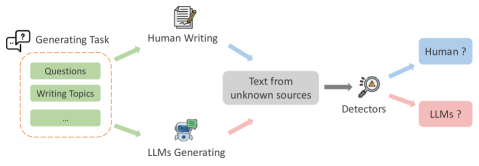
The powerful ability to understand, follow, and generate complex language emerging from large language models (LLMs) makes LLM-generated text flood many areas of our daily lives at an incredible speed and is widely accepted by humans. As LLMs continue to expand, there is an imperative need to develop detectors that can detect LLM-generated text. This is crucial to mitigate potential misuse of LLMs and safeguard realms like artistic expression and social networks from harmful influence of LLM-generated content. The LLM-generated text detection aims to discern if a piece of text was produced by an LLM, which is essentially a binary classification task. The detector techniques have witnessed notable advancements recently, propelled by innovations in watermarking techniques, statistics-based detectors, neural-base detectors, and human-assisted methods. In this survey, we collate recent research breakthroughs in this area and underscore the pressing need to bolster detector research. We also delve into prevalent datasets, elucidating their limitations and developmental requirements. Furthermore, we analyze various LLM-generated text detection paradigms, shedding light on challenges like out-of-distribution problems, potential attacks, real-world data issues and the lack of effective evaluation framework. Conclusively, we highlight interesting directions for future research in LLM-generated text detection to advance the implementation of responsible artificial intelligence (AI). Our aim with this survey is to provide a clear and comprehensive introduction for newcomers while also offering seasoned researchers a valuable update in the field of LLM-generated text detection. The useful resources are publicly available at: https://github.com/NLP2CT/LLM-generated-Text-Detection.
연구 동기 및 목표
- AI 기능으로 텍스트의 오용 완화와 무결성 보장을 위해 LLM-생성 텍스트 탐지기의 필요성 동기화.
- 최근 탐지기 접근법, 데이터셋 및 평가 관행 수집 및 분석.
- 현재의 한계를 식별하고 탐지를 강화하기 위한 미래 연구 방향을 제시.
- 신참자에게 명확한 최신 소개와 연구자들을 위한 간결한 업데이트 제공.
제안 방법
- Kitchenham 지침에 따라 LLM-생성 텍스트 탐지 문헌을 체계적 문헌고찰(SLR)로 수행.
- 대상 검색어 사용: “LLM-generated text detection” OR “machine-generated text detection” OR “AI-written text detection” OR “deepfake text detection” .
- Google Scholar, ArXiv, Scopus, Web of Science, IEEE Xplore, Springer Link, ACL Anthology, ACM DL 등에서 소싱.
- 포함 기준 적용: (i) 탐지 방법에 초점을 둔 검토, (ii) 탐지 방법론을 제시, (iii) 도전과제 및 향후 방향 논의, (iv) 필요성과 응용을 명시.
- 관련 논문 82편을 선별하고 데이터, 탐지기, 지표, 문제점 및 향후 방향 분석.
실험 결과
연구 질문
- RQ1LLM생성 텍스트를 탐지하는 지배적인 방법과 그에 따른 도전은 무엇인가?
- RQ2LLM생성 텍스트 탐지를 위한 데이터세트와 벤치마크는 무엇이며, 어떤 한계가 있는가?
- RQ3어떤 평가 지표가 사용되며, 탐지기가 다양한 조건에서 얼마나 잘 수행하는가?
- RQ4강건한 탐지를 위한 주요 도전과제(예: 분포 외, 공격, 데이터 모호성)와 향후 방향은 무엇인가?
주요 결과
- 2023년에 LLM생성 텍스트 탐지에 대한 연구가 급증했다.
- 이 조사는 워터마킹, 제로샷, 미세조정 LM 방법, 적대적 학습, 탐지자로서의 LLM, 인간 보조 접근법에 이르는 탐지기를 포괄하는 연구를 분류한다.
- 광범위한 데이터셋과 벤치마크가 존재하나(HC3, CHEAT, GROVER 기반 데이터셋, TweepFake, GPT-2 출력 데이터셋 등), 한계와 개선의 필요가 지적된다.
- 평가 지표로 정확도, AUROC, 리콜, F1-점수 등이 포함되며, 분포 외 및 데이터 모호성 이슈에 대한 논의가 있다.
- 논문은 탐지기에 대한 공격 및 저자원 환경에서의 강건한 탐지기의 필요성, 데이터 모호성 하에서의 문제를 다룬다.
- 향후 방향으로는 공격에 강한 탐지기 구축, 제로샷 탐지기의 강화, 다중 에이전트 시스템 등이 강조된다.

이 논문 읽기
누빈트 뷰어에서 원문을 열고, 읽으면서 궁금한 곳을 바로 물어보세요.
누빈트에서 이 논문 읽기이 리뷰는 AI가 논문 원문을 바탕으로 만들었습니다. 인용하기 전에 원문을 확인해 주세요.