
[논문 리뷰] accelerating wrf i/o performance with adios2 and network-based streaming
이 논문은 기상예보모델(WRF)에서 지속적인 I/O 병목 현상을 해결하기 위해 고성능 I/O 백엔드로 ADIOS2를 통합하는 것을 제안한다. UCX 데이터 전송 방식과 함께 ADIOS2의 지속 가능한 스테이징 전송(SST) 기능, 노드 로컬 버스트 버퍼, 그리고 인라인 압축 기능을 활용하여, I/O 시간을 10배 이상 감소시키고 전체 솔루션 도달 시간을 50% 향상시켰다. 이는 현대적인 I/O 프레임워크가 최소한의 코드 수정으로도 레거시 HPC 애플리케이션의 성능을 극적으로 향상시킬 수 있음을 보여준다.
With the approach of Exascale computing power for large-scale High Performance Computing (HPC) clusters, the gap between compute capabilities and storage systems is growing larger. This is particularly problematic for the Weather Research and Forecasting Model (WRF), a widely-used HPC application for high-resolution forecasting and research that produces sizable datasets, especially when analyzing transient weather phenomena. Despite this issue, the I/O modules within WRF have not been updated in the past ten years, resulting in subpar parallel I/O performance. This research paper demonstrates the positive impact of integrating ADIOS2, a next-generation parallel I/O framework, as a new I/O backend option in WRF. It goes into detail about the challenges encountered during the integration process and how they were addressed. The resulting I/O times show an over tenfold improvement when using ADIOS2 compared to traditional MPI-I/O based solutions. Furthermore, the study highlights the new features available to WRF users worldwide, such as the Sustainable Staging Transport (SST) enabling Unified Communication X (UCX) DataTransport, the node-local burst buffer write capabilities and in-line lossless compression capabilities of ADIOS2. Additionally, the research shows how ADIOS2's in-situ analysis capabilities can be smoothly integrated with a simple WRF forecasting pipeline, resulting in a significant improvement in overall time to solution. This study serves as a reminder to legacy HPC applications that incorporating modern libraries and tools can lead to considerable performance enhancements with minimal changes to the core application.
연구 동기 및 목표
- WRF에서 지속적인 I/O 성능 병목 현상은 10년 이상 개선되지 않았음에도 불구하고, 컴퓨팅 성능 격차가 점점 커지는 상황를 해결하기 위해.
- WRF의 차세대 I/O 백엔드로 ADIOS2 통합을 평가하여 고속도, 확장 가능한 데이터 I/O를 가능하게 하기 위해.
- 버스트 버퍼 지원 및 인라인 분석 기능을 포함한 ADIOS2의 고급 기능을 활용하여 I/O 쓰기 시간과 전체 솔루션 도달 시간 향상을 입증하기 위해.
- WRF 생태계 내에서 손실 없음/손실 압축 및 양방향 데이터 커플링과 같은 현대적인 데이터 관리 기능을 가능하게 하기 위해.
제안 방법
- 기존의 MPI-I/O 및 PnetCDF 백엔드를 대체하여 WRF에 ADIOS2를 새로운 I/O 백엔드로 통합하기 위해.
- 고성능·저지연 전송을 위해 Unified Communication X(UCX)를 사용하는 ADIOS2의 지속 가능한 스테이징 전송(SST) 엔진을 활용하기 위해.
- 주 메모리에서 빠른 로컬 스토리지로 데이터를 오프로드하여 쓰기 작업을 가속화하기 위해 노드 로컬 버스트 버퍼를 활용하기 위해.
- ADIOS2 내부에서 인라인 손실 없음 및 손실 압축을 적용하여 효과적인 I/O 대역폭을 증가시키기 위해.
- ADIOS2의 데이터 커플링 및 스트리밍 기능을 활용하여 인라인 분석 파이프라인을 구현하여 후처리 오버헤드를 감소시키기 위해.
- ADIOS2의 SST 전송 방식에서 QueueLimit 파라미터를 설정하여 UCX 및 EVPATH 미들웨어 모두에 최적의 비동기 전송 성능을 확보하기 위해.
실험 결과
연구 질문
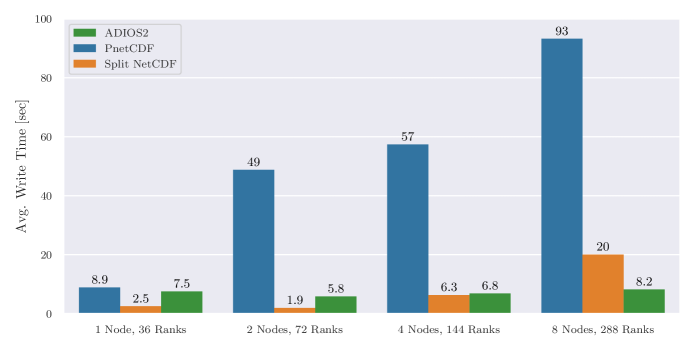
- RQ1기존의 MPI-I/O 및 PnetCDF 백엔드와 비교해 ADIOS2가 WRF의 I/O 쓰기 시간을 크게 줄일 수 있는가?
- RQ2ADIOS2의 SST 엔진에 통합된 UCX 기반 전송 방식이 WRF에서 데이터 전송 성능과 지연 시간에 어떤 영향을 미치는가?
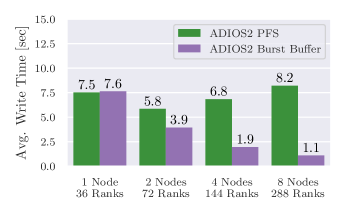
- RQ3ADIOS2의 버스트 버퍼 및 인라인 압축 기능이 WRF 시뮬레이션에서 효과적인 I/O 스루풋을 얼마나 향상시키는가?
- RQ4ADIOS2를 활용한 인라인 분석 파이프라인은 WRF 예측 워크플로우의 전체 솔루션 도달 시간을 줄일 수 있는가?
- RQ5다양한 전송 백엔드에 대해 ADIOS2의 SST 엔진에서 QueueLimit 파라미터를 튜닝할 경우 성능에 어떤 영향을 미치는가?
주요 결과
- ADIOS2 통합으로 인해 기존의 MPI-I/O 및 PnetCDF 백엔드 대비 WRF I/O 쓰기 시간이 10배 이상 감소하였다.
- UCX 기반 전송 방식을 사용한 ADIOS2 SST 엔진을 통해 WRF 예측 워크플로우의 전체 솔루션 도달 시간이 50% 감소하였다.
- 스케일이 증가함에 따라 UCX 기반 데이터 전송 방식이 EVPATH 미들웨어 레이어보다 스루풋과 지연 시간 모두에서 뛰어난 성능을 보였다.
- QueueLimit 파라미터를 0(비동기)로 설정하여 최적화함으로써 UCX 및 EVPATH 전송 방식 모두에서 성능 향상이 뚜렷하게 나타났다.
- WRF의 핵심 코드를 수정하지 않고도 노드 로컬 버스트 버퍼 쓰기 및 인라인 손실 없음 압축 기능이 활성화되어 I/O 효율성이 향상되었다.
- 이 연구는 ADIOS2의 인라인 분석 기능이 WRF에 원활하게 통합될 수 있음을 입증하였으며, 후처리에 대한 의존도를 줄이고 과학 워크플로우의 가속화를 가능하게 하였다.
이 논문 읽기
누빈트 뷰어에서 원문을 열고, 읽으면서 궁금한 곳을 바로 물어보세요.
누빈트에서 이 논문 읽기이 리뷰는 AI가 논문 원문을 바탕으로 만들었습니다. 인용하기 전에 원문을 확인해 주세요.