
[논문 리뷰] Accurate deep learning sub-grid scale models for large eddy simulations
두 가지 계열의 심층 학습 서브그리드 규모 모델이 LES용으로 개발되었습니다: 전체 불변성을 갖는 텐서 기반 신경망과 더 단순한 갈리안 불변 네트워크; 더 단순한 모델은 SGS 응력을 더 효과적으로 학습하며 두 모델 모두 Reτ ≈ 395 및 590의 채널 흐름에 대한 a priori 및 a posteriori 테스트에서 잘 작동합니다.
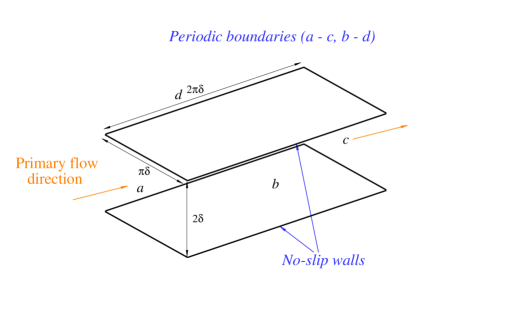
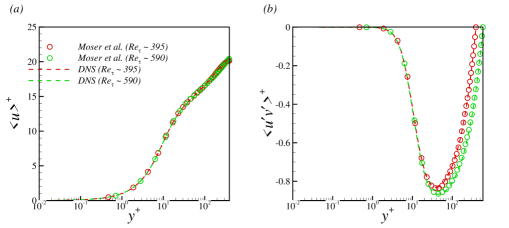
We present two families of sub-grid scale (SGS) turbulence models developed for large-eddy simulation (LES) purposes. Their development required the formulation of physics-informed robust and efficient Deep Learning (DL) algorithms which, unlike state-of-the-art analytical modeling techniques can produce high-order complex non-linear relations between inputs and outputs. Explicit filtering of data from direct simulations of the canonical channel flow at two friction Reynolds numbers $Re_τ\approx 395$ and 590 provided accurate data for training and testing. The two sets of models use different network architectures. One of the architectures uses tensor basis neural networks (TBNN) and embeds the simplified analytical model form of the general effective-viscosity hypothesis, thus incorporating the Galilean, rotational and reflectional invariances. The other architecture is that of a relatively simple network, that is able to incorporate the Galilean invariance only. However, this simpler architecture has better feature extraction capacity owing to its ability to establish relations between and extract information from cross-components of the integrity basis tensors and the SGS stresses. Both sets of models are used to predict the SGS stresses for feature datasets generated with different filter widths, and at different Reynolds numbers. It is shown that due to the simpler model's better feature learning capabilities, it outperforms the invariance embedded model in statistical performance metrics. In a priori tests, both sets of models provide similar levels of dissipation and backscatter. Based on the test results, both sets of models should be usable in a posteriori actual LESs.
연구 동기 및 목표
- 벽면 경계 난류를 위한 DL 기반 SGS 모델링에 물리적 불변성(갈리안, 회전, 반사)을 포함한다.
- DL 프레임워크 내에서 분석적 SGS 응력 전개를 활용하여 견고성과 일관성을 향상시킨다.
- 전 불변성 포함 확장을 갖춘 텐서 기반 신경망(A1)과 갈리안 불변성에 집중하는 더 단순한 네트워크(A2)를 비교한다.
- 다양한 필터 폭과 Reynolds 수에서 DNS 유도 데이터를 사용해 모델 성능을 평가하여 신뢰 가능한 LES 폐쇄를 가능하게 한다.]
- method용_한국어_변환은,_두_ DL/ SNS_모델_계열이_ Reτ ≈ 395_및_590의_명시적으로_필터링된_DNS_데이터를_사용해_학습한다.
제안 방법
- 채널 흐름의 명시적 필터링된 DNS 데이터로 학습된 두 DL/SNS 모델 계열(Reτ ≈ 395 및 590).
- 아키텍처 A1: 갈리안, 회전, 반사 불변성을 보장하기 위해 Pope–Lund–Novikov SGS 전개 형태를 삽입하는 텐서-베이스 신경망(TBNN).
- 아키텍처 A2: 완전한 불변성 대신에 무결성 기저 텐서와 불변 입력을 사용하되 갈리안 불변성에만 중점을 둔 더 단순한 네트워크.
- 해석된 속도 구배의 대칭/비대칭 부분(S, R)과 이들로부터 얻은 불변 스칼라에서 추출된 입력 특징.
- SGS 예측의 갈리안 불변성을 유지하기 위한 명시적 필터링에 대해 스펙트럴 리밋 컷오프 필터를 사용.
- 다수의 필터 폭과 Reynolds 수에 걸쳐 예측된 SGS 응력에 대한 a priori 및 a posteriori 평가.]
- research_questions용_한국어_번역은,_DL-기반 SGS_모델이_명시적으로_필터링된_DNS_데이터를_학습할_경우_wall-경계_난류에_대한_SGS_응력을_정확하게_재현할_수 있는가?
- DL_아키텍처에_내재된_불변성(갈리안, 회전, 반사)이Wall-경계 흐름에서의_SGS 예측_성능을_향상시키는가?
- 두_아키텍처(A1의 TBNN를_통한_전면적_불변성_포함 대 A2의_Galilean_불변성만_포함)의_다양한_필터 폭과 Reynolds 수에서의_정적_평가(a priori)와 실행적_평가(a posteriori)에서의_비교는_어떤가?
- 학습된_SGS_모델이_다른_DNS유도_훈련/테스트 데이터셋과_그리드 해상도에서_강건한가?
실험 결과
연구 질문
- RQ1DL 기반 SGS 모델이 walls-bounded 난류에 대해 명시적으로 필터링된 DNS 데이터로 학습되었을 때 SGS 응력을 정확하게 재현할 수 있는가?
- RQ2아키텍처에 내재된 불변성(갈리안, 회전, 반사)이 벽면 경계 흐름의 SGS 예측 성능을 향상시키는가?
- RQ3두 아키텍처(A1: TBNN을 통한 전면적 불변성 vs A2: 갈리안 불변성만)의 a priori 및 a posteriori 평가에서 서로 어떤 차이가 있는가?
- RQ4학습된 SGS 모델이 서로 다른 DNS 유도 훈련/테스트 데이터셋과 격자 해상도에서 강건한가?
주요 결과
- 둘 다의 모델 계열은 a priori 테스트에서 유사한 수준의 소산(dissipation)과 역상(backscatter)을 제공한다.
- 더 단순한 아키텍처(A2)가 불변성 내재 모델(A1)보다 통계적 지표에서 더 우수한 특징 학습 능력을 보여 성능이 더 좋다.
- 아키텍처가 다름에도 두 모델 모두 테스트 결과를 기반으로 a posteriori LES 응용에 사용 가능하다고 간주된다.
- 불변성 내재 접근(A1)은 분석적 SGS 전개 형태를 삽입하는 이점이 있고, A2는 기저 텐서의 교차 성분으로부터 더 강한 특징 추출을 통해 이점을 얻는다.
- 학습은 두 가지 Reτ 값에서 명시적으로 필터링된 DNS 데이터를 사용했으며, SGS 응력은 다양한 필터 폭과 Reynolds 수에 대해 예측되었다.
이 논문 읽기
누빈트 뷰어에서 원문을 열고, 읽으면서 궁금한 곳을 바로 물어보세요.
누빈트에서 이 논문 읽기이 리뷰는 AI가 논문 원문을 바탕으로 만들었습니다. 인용하기 전에 원문을 확인해 주세요.