
[논문 리뷰] Advancing LLM Reasoning Generalists with Preference Trees
Eurus는 UltraInteract로 미세조정된 오픈소스 LLM 세트로, 트리 구조 선호 데이터 접근법과 새로운 보상 모델링을 활용해 도전적 벤치마크에서 오픈 모델 중 최첨단 추론 성능을 달성하고 GPT-3.5 Turbo에 비견되는 결과를 얻는다.
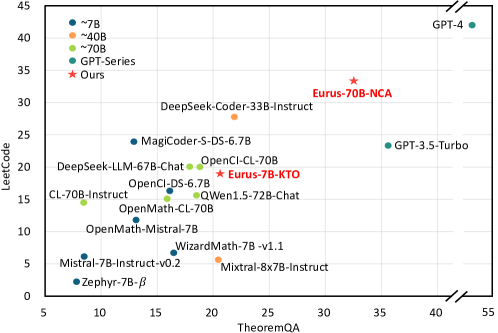
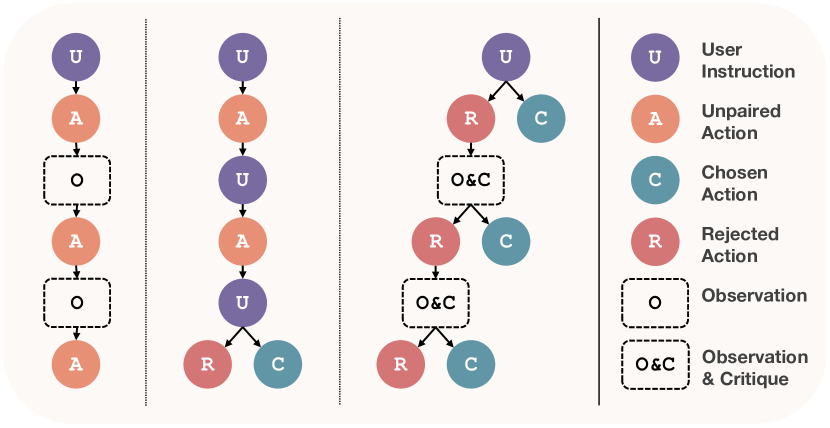
We introduce Eurus, a suite of large language models (LLMs) optimized for reasoning. Finetuned from Mistral-7B and CodeLlama-70B, Eurus models achieve state-of-the-art results among open-source models on a diverse set of benchmarks covering mathematics, code generation, and logical reasoning problems. Notably, Eurus-70B beats GPT-3.5 Turbo in reasoning through a comprehensive benchmarking across 12 tests covering five tasks, and achieves a 33.3% pass@1 accuracy on LeetCode and 32.6% on TheoremQA, two challenging benchmarks, substantially outperforming existing open-source models by margins more than 13.3%. The strong performance of Eurus can be primarily attributed to UltraInteract, our newly-curated large-scale, high-quality alignment dataset specifically designed for complex reasoning tasks. UltraInteract can be used in both supervised fine-tuning and preference learning. For each instruction, it includes a preference tree consisting of (1) reasoning chains with diverse planning strategies in a unified format, (2) multi-turn interaction trajectories with the environment and the critique, and (3) pairwise data to facilitate preference learning. UltraInteract allows us to conduct an in-depth exploration of preference learning for reasoning tasks. Our investigation reveals that some well-established preference learning algorithms may be less suitable for reasoning tasks compared to their effectiveness in general conversations. Inspired by this, we derive a novel reward modeling objective which, together with UltraInteract, leads to a strong reward model.
연구 동기 및 목표
- 오픈소스와 독점 모델 간의 복잡한 추론에서의 격차를 해소하기 위해 추론을 위한 정렬 데이터 품질과 선호 학습을 개선한다.
- UltraInteract 정렬 데이터를 이용해 Eurus 모델을 Mistral-7B 및 CodeLlama-70B로 미세조정한다.
- 추론 작업에 대한 선호 학습 알고리즘(DPO, KTO, NCA)의 효과를 조사하고 보상 모델링 목적을 도출한다.
- 감독 학습 미세조정 및 선호 학습을 위한 고품질의 트리 구조 정렬 데이터세트(UltraInteract)를 제공한다.
제안 방법
- UltraInteract를 생성: 다중 턴 추론을 위한 선호 트리로 구성된 86K 지시문 및 220K 행동 쌍.
- 문제를 부분 작업으로 분해하고, 텍스트나 코드로 단계별 행동을 생성하며, 환경(Python 인터프리터)과 비판 모델과 상호 작용한다.
- Leaf만 정답인 행동과 데이터 혼합(UltraChat, ShareGPT2, OpenOrca)을 사용해 Eurus-7B-SFT와 Eurus-70B-SFT를 훈련한다.
- 다중 턴 궤적 쌍을 사용해 세 가지 선호 학습 알고리즘(DPO, KTO, NCA)을 탐색하고, 데이터-보상 정규화항으로 Bradley-Terry 목적을 보강한다.
- 선정된 행동의 보상을 증가시키고 거부된 보상의 보상을 감소시키는 수정된 목적을 가진 Eurus-RM-7B 보상 모델을 개발하고 RM 벤치마크에서 평가한다.
실험 결과
연구 질문
- RQ1UltraInteract의 트리 구조적 다중 턴 정렬 데이터가 전통적인 단일 턴 데이터보다 오픈소스 LLM의 추론 능력을 더 향상시키는가?
- RQ2어떤 선호 학습 알고리즘이 추론 작업에 가장 효과적이며, 보상 강조(절대 보상 대 상대 보상)가 성능에 어떤 영향을 미치는가?
- RQ3UltraInteract를 다른 정렬 데이터와 혼합하면 지시 지킴 능력은 보존되면서 추론 및 도구 사용 능력은 향상되는가?
- RQ4전용 보상 모델(Eurus-RM-7B)이 추론 기반 평가 지표 및 재정렬 작업을 개선하는 데 얼마나 효과적인가?
주요 결과
- Eurus-7B 및 Eurus-70B가 유사한 규모의 오픈소스 모델 중 다양한 추론 벤치마크에서 전반적으로 최상의 성능을 달성합니다.
- Eurus-70B-SFT가 여러 벤치마크에서 GPT-3.5 Turbo와의 성능을 비교할 만한 수준에 도달하며, KTO/NCA를 추가하면 수학 및 다중 턴 평가가 향상됩니다.
- DPO는 많은 벤치마크에서 추론 성능을 악화시킬 수 있지만, KTO와 NCA는 일관되게 결과를 개선하며 선택된 해에 대한 절대 보상이 더 큰 경우 성능과 상관관계가 있습니다.
- Eurus-RM-7B는 강력한 보상 모델 기반 재정렬을 제공하며 종종 더 큰 기준선보다 우수하고 추론 작업에 대해 사람 판단과의 상관관계가 높습니다.
- UltraInteract 데이터 설계(다양한 추론 패턴, 도구 사용, 다중 턴 비판)가 표준 SFT 데이터와 혼합될 때 추론 능력의 향상에 결정적입니다.
이 논문 읽기
누빈트 뷰어에서 원문을 열고, 읽으면서 궁금한 곳을 바로 물어보세요.
누빈트에서 이 논문 읽기이 리뷰는 AI가 논문 원문을 바탕으로 만들었습니다. 인용하기 전에 원문을 확인해 주세요.