
[논문 리뷰] Aligning Language Models to Explicitly Handle Ambiguity
이 논문은 대규모 언어 모델(Large Language Models, LLMs)이 내재 지식을 활용해 자기 자신으로서의 모호함을 해소할 수 있도록 하는 새로운 정렬 방법을 제안한다. 모델의 시각에서 모호함을 식별하기 위해 프록시 작업과 정보량 지표(Infogain)를 사용함으로써, 명확한 질문에서의 성능 저하 없이 모호한 입력에 대한 강건성을 향상시킨다. 이는 여러 개의 QA 벤치마크에서 검증되었다.
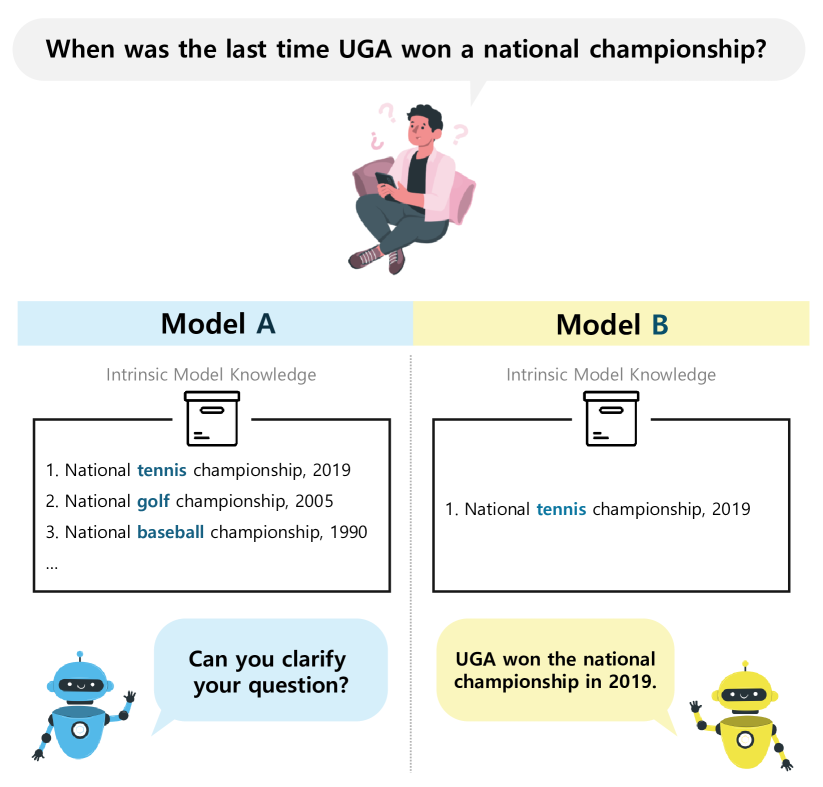
In interactions between users and language model agents, user utterances frequently exhibit ellipsis (omission of words or phrases) or imprecision (lack of exactness) to prioritize efficiency. This can lead to varying interpretations of the same input based on different assumptions or background knowledge. It is thus crucial for agents to adeptly handle the inherent ambiguity in queries to ensure reliability. However, even state-of-the-art large language models (LLMs) still face challenges in such scenarios, primarily due to the following hurdles: (1) LLMs are not explicitly trained to deal with ambiguous utterances; (2) the degree of ambiguity perceived by the LLMs may vary depending on the possessed knowledge. To address these issues, we propose Alignment with Perceived Ambiguity (APA), a novel pipeline that aligns LLMs to manage ambiguous queries by leveraging their own assessment of ambiguity (i.e., perceived ambiguity). Experimental results on question-answering datasets demonstrate that APA empowers LLMs to explicitly detect and manage ambiguous queries while retaining the ability to answer clear questions. Furthermore, our finding proves that APA excels beyond training with gold-standard labels, especially in out-of-distribution scenarios. The data and code are available at https://github.com/heyjoonkim/APA.
연구 동기 및 목표
- 모델가 모호한 사용자 질의를 인식하거나 적절히 응답하지 못하는 문제를 해결하기 위해, 모호함 처리를 위한 명시적 훈련이 부족하기 때문이다.
- 모델의 내재 지식에 따라 변하는 모델의 시각에서의 모호함 측정의 어려움을 해결하기 위해, 인간 레이블에 의존하지 않는 방법이 필요하다.
- 모델가 인식하는 모호함 기반의 데이터 선택 전략을 개발하여, 강건성을 향상시키기 위한 대상 정렬을 가능하게 한다.
- 이 정렬 방법이 모호한 입력에서의 성능을 평가하면서도 명확하지 않은 질문에서는 뛰어난 성능을 유지하는지 확인한다.
- LLM에서의 모호함에 대한 강건성 평가를 위한 보다 넓은 평가를 지원하기 위해 새로운 데이터셋인 AmbigTriviaQA를 기여한다.
제안 방법
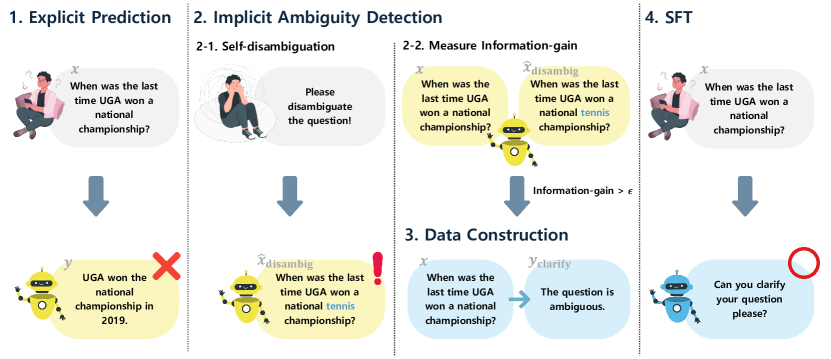
- LLM이 내재 지식을 활용해 주어진 질의를 자가 해석하도록 유도하는 프록시 작업을 도입한다.
- Infogain을 정의하여 해석으로 인한 정보량 증가를 측정하고, 이는 모델가 인식하는 모호함의 암묵적 지표로 기능한다.
- Infogain 점수를 사용해 모델의 시각에서 모호하다고 판단되는 샘플을 선별하여 후속 정렬에 활용한다.
- 감독적 미세조정(SFT)을 통해 선별된 모호한 샘플에 대해 LLM을 미세조정하며, 명확화 요청 생성에 집중한다.
- Valid Alignment Rate(VAR), Misaligned Clarification Rate(MCR), Overall Alignment Performance(OAP)와 같은 지표를 사용해 정렬 성능을 평가한다.
- LLM에서의 모호함 처리를 위한 종합적인 평가를 지원하기 위해 새로운 벤치마크 데이터셋인 AmbigTriviaQA를 구축한다.
실험 결과
연구 질문
- RQ1모델의 내재 지식만을 활용하여 모호한 질의를 효과적으로 인식하고 명시적으로 응답하도록 정렬할 수 있는가?
- RQ2인간 레이블에 의존하지 않고도 모델의 시각에서 모호함을 정량적으로 측정할 수 있는가?
- RQ3Infogain을 데이터 선택 기준으로 사용할 경우, 명확하지 않은 질의를 다루는 능력이 향상되면서도 명확한 질의에서의 성능이 저하되지 않는가?
- RQ4모델의 지식 기반에 따라 모델가 인식하는 모호함이 어떻게 변화하는가? 이를 더 나은 정렬에 활용할 수 있는가?
- RQ5제안된 정렬 방법이 분포 외 모호한 입력에 대해 얼마나 일반화되는가?
주요 결과
- 제안된 정렬 방법은 AmbigQA에서 기준 방법 대비 12.5% 향상된 Valid Alignment Rate(VAR)를 기록하며, 모호한 질의에 대한 명확화 요청 생성 능력을 크게 향상시켰다.
- Random 샘플링 대비 F1 점수 5포인트 향상되었고, Implicit 기준보다도 뛰어나, Infogain가 데이터 선택 기준으로 효과적임을 입증했다.
- Llama2 7B에서 제안된 방법의 전체 정렬 성능(OAP)은 0.84에 도달했으며, Honesty-tuned(0.71)과 Full-set(0.78)을 모두 앞서며, 모호함 처리와 명확한 입력에서의 정확한 응답 유지 간의 균형이 뛰어나다는 것을 시사한다.
- AmbigQA와 TriviaQA를 포함한 여러 데이터셋에서 분포 외 모호한 질의에 대해 일관된 성능 향상을 보이며 강건성을 입증했다.
- 사례 연구를 통해 모델가 지식이 부족할 경우 모호함을 정확히 식별하고, 질의가 명확할 경우 잘못된 경고를 피할 수 있음을 확인했지만, 일부 경우에서 다수의 매체 제목에 대한 지식 과잉 연관으로 오분류가 발생했다.
- 새로운 AmbigTriviaQA 데이터셋은 모호함에 대한 강건성 평가를 더 종합적으로 가능하게 하며, 향후 이 분야의 연구를 지원한다.
이 논문 읽기
누빈트 뷰어에서 원문을 열고, 읽으면서 궁금한 곳을 바로 물어보세요.
누빈트에서 이 논문 읽기이 리뷰는 AI가 논문 원문을 바탕으로 만들었습니다. 인용하기 전에 원문을 확인해 주세요.