
[논문 리뷰] Aligning Large Multimodal Models with Factually Augmented RLHF
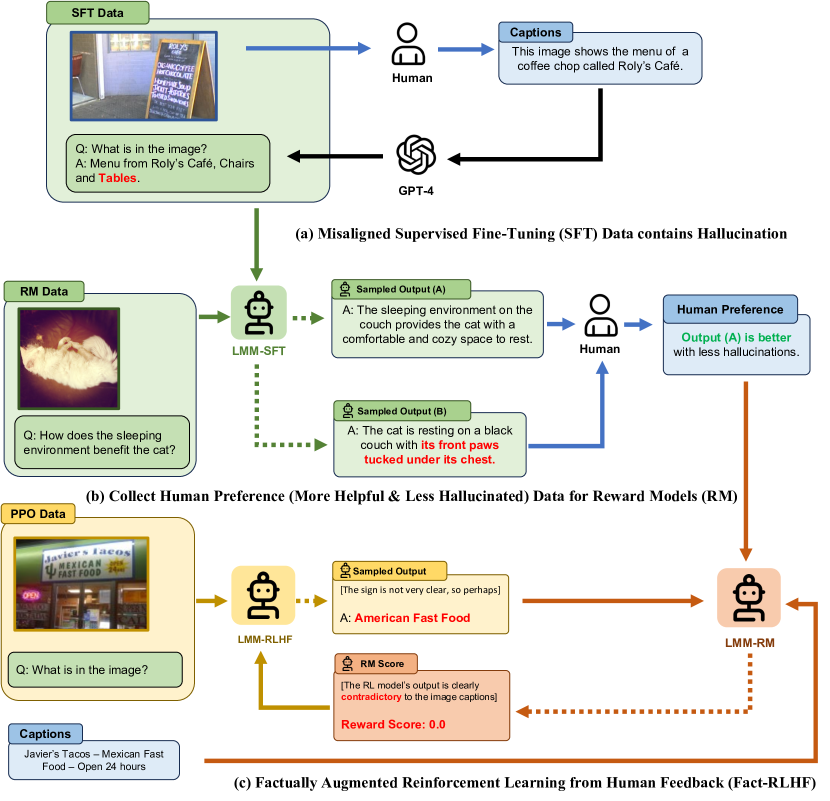
본 논문은 인간 피드백으로부터의 강화학습(RLHF)을 대형 다중모달 모델(LMMs)에 적용하고, 사실 정보 큐(캡션, 정답 옵션)를 보상 신호에 통합하여 망상을 감소시키는 Factually Augmented RLHF(Fact-RLHF)를 도입하며, 고품질 비전 안내 학습 데이터 및 새로운 MMHal-Bench 평가 벤치마크를 제시한다.
Large Multimodal Models (LMM) are built across modalities and the misalignment between two modalities can result in "hallucination", generating textual outputs that are not grounded by the multimodal information in context. To address the multimodal misalignment issue, we adapt the Reinforcement Learning from Human Feedback (RLHF) from the text domain to the task of vision-language alignment, where human annotators are asked to compare two responses and pinpoint the more hallucinated one, and the vision-language model is trained to maximize the simulated human rewards. We propose a new alignment algorithm called Factually Augmented RLHF that augments the reward model with additional factual information such as image captions and ground-truth multi-choice options, which alleviates the reward hacking phenomenon in RLHF and further improves the performance. We also enhance the GPT-4-generated training data (for vision instruction tuning) with previously available human-written image-text pairs to improve the general capabilities of our model. To evaluate the proposed approach in real-world scenarios, we develop a new evaluation benchmark MMHAL-BENCH with a special focus on penalizing hallucinations. As the first LMM trained with RLHF, our approach achieves remarkable improvement on the LLaVA-Bench dataset with the 94% performance level of the text-only GPT-4 (while previous best methods can only achieve the 87% level), and an improvement by 60% on MMHAL-BENCH over other baselines. We opensource our code, model, data at https://llava-rlhf.github.io.
연구 동기 및 목표
- LMM에서 다모달 불일치 및 환각 문제를 동기 부여하고 해결한다.
- 시각-언어 작업에 맞춘 RLHF 기반 정렬 파이프라인을 제안한다.
- 사실 정보를 보상에 반영하도록 보정하는 Factually Augmented RLHF를 도입한다.
- 고품질의 사람 주석이 달린 다중모달 데이터로 비전 안내 튜닝 데이터를 강화한다.
- 실세계 정렬을 평가하고 환각을 구체적으로 처벌하도록 MMHal-Bench를 개발한다.
제안 방법
- LMM에 세 단계 파이프라인으로 RLHF를 적용: 다중모달 감독 미세조정, 다중모달 선호도 모델링, 보상 모델을 이용한 강화학습.
- 보상 모델이 학습 및 추론 시 추가 사실 정보를 사용하여 보상 해킹을 억제하는 Fact-RLHF를 도입(이미지 캡션, A-OKVQA 추론, 정답 옵션 포함).
- 상징적 보상(정답 옵션) 및 길이 패널티를 도입하여 길고 환각에 취약한 출력 방지.
- VQA-v2, A-OKVQA, Flickr30k를 보다 구조화되고 고품질의 비전 안내 튜닝 데이터 세트로 변환하여 학습 데이터를 증가시킨다.
- 효율적인 RLHF를 위한 LoRA 기반 미세조정으로 모델 확장; 업데이트를 안정시키기 위해 KL 패널티를 갖춘 PPO를 사용한다.
실험 결과
연구 질문
- RQ1RLHF를 대형 다중모달 모델을 시각적 실제 true에 정렬하도록 효과적으로 어떻게 적응시킬 수 있는가?
- RQ2보상 모델에 사실 정보를 포함시키는 것이 다중모달 환각 및 보상 해킹을 줄이는가?
- RQ3고품질의 비전 안내 튜닝 데이터가 LMM의 능력과 정렬에 어떤 영향을 미치는가?
- RQ4전용 MMHal-Bench를 사용하여 LMM 출력의 환각을 어떻게 측정하고 벤치마크할 수 있는가?
- RQ5능력 및 정렬 벤치마크에서 표준 RLHF 대비 Fact-RLHF의 상대 이득은 무엇인가?
주요 결과
- Fact-RLHF는 인간 선호 벤치마크에서의 정렬을 향상시키고 표준 RLHF에 비해 환각을 줄인다.
- 고품질의 비전 안내 튜닝 데이터는 특히 큰 모델에서 MMBench와 POPE 같은 능력 벤치마크를 크게 향상시킨다.
- RLHF는 MMHal-Bench, LLaVA-Bench 같은 인간 정렬 벤치마크를 향상시키지만 소형 규모에서 능력 벤치마크에 대해 혼합 효과를 보일 수 있다.
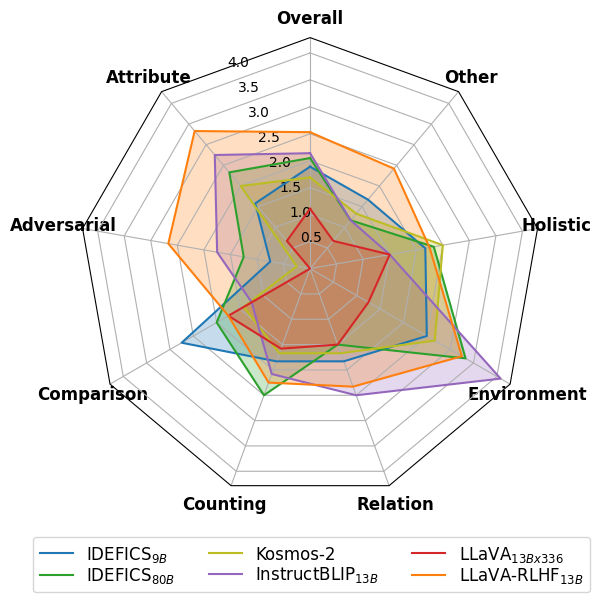
- MMHal-Bench는 LMM이 근거 없는 질문에서 환각하는 경향이 있음을 보여주며, Fact-RLHF는 이러한 오류를 줄인다.
- LLaVA- RLHF는 LLaVA-Bench에서 94%, MMHal-Bench에서 베이스라인 대비 60% 향상을 달성했으며, MMBench와 POPE에서도 경쟁력 있는 결과를 보인다.
이 논문 읽기
누빈트 뷰어에서 원문을 열고, 읽으면서 궁금한 곳을 바로 물어보세요.
누빈트에서 이 논문 읽기이 리뷰는 AI가 논문 원문을 바탕으로 만들었습니다. 인용하기 전에 원문을 확인해 주세요.