
[논문 리뷰] Ambient Diffusion: Learning Clean Distributions from Corrupted Data
확산 기반 프레임워크가 확산 중 추가 측정 왜곡을 주입하여 매우 손상된 샘플만으로도 깨끗한 데이터의 분포를 학습하고, 깨끗한 데이터가 없는 경우에도 진짜 분포에서 샘플링할 수 있게 한다.
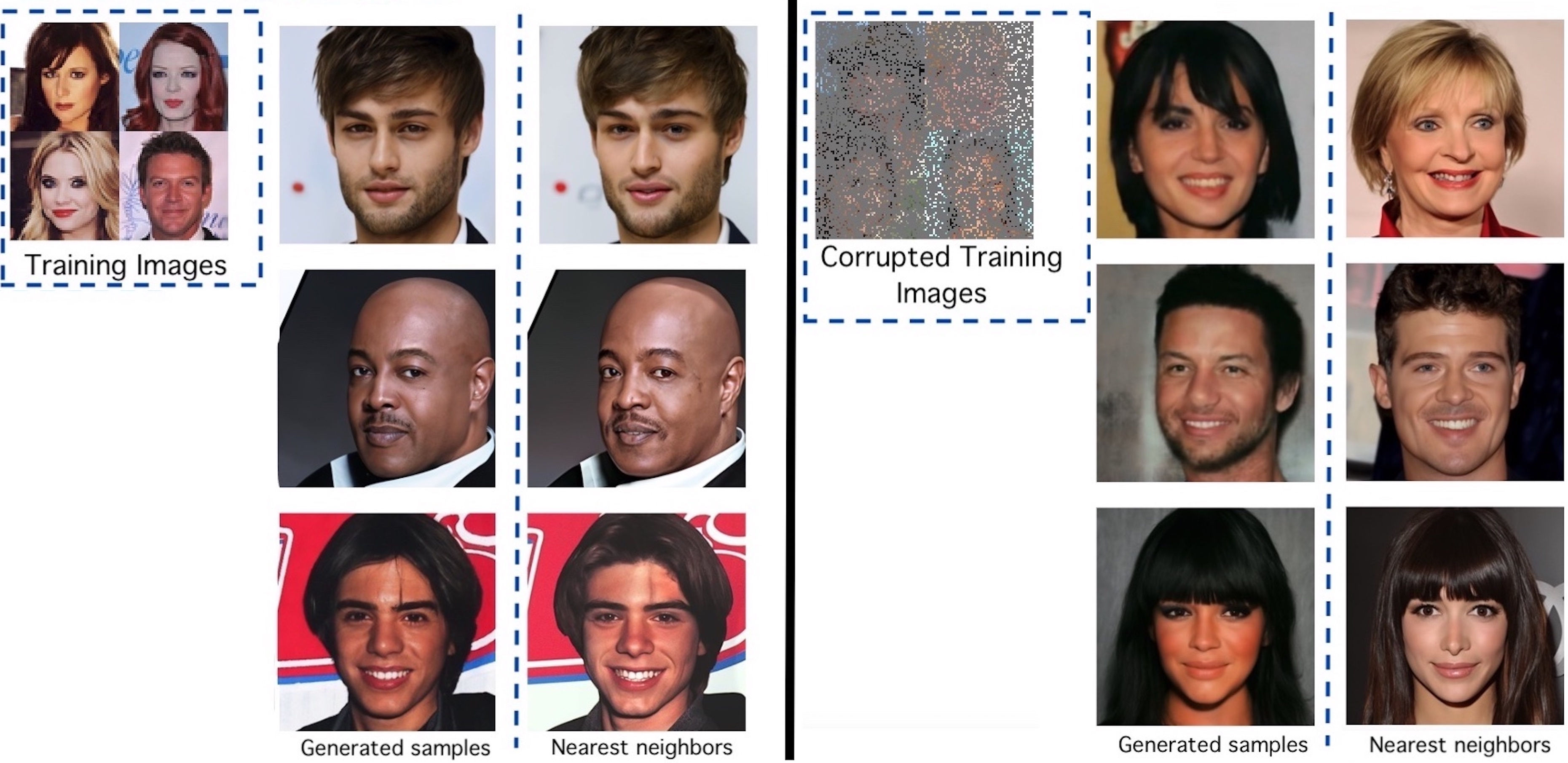
We present the first diffusion-based framework that can learn an unknown distribution using only highly-corrupted samples. This problem arises in scientific applications where access to uncorrupted samples is impossible or expensive to acquire. Another benefit of our approach is the ability to train generative models that are less likely to memorize individual training samples since they never observe clean training data. Our main idea is to introduce additional measurement distortion during the diffusion process and require the model to predict the original corrupted image from the further corrupted image. We prove that our method leads to models that learn the conditional expectation of the full uncorrupted image given this additional measurement corruption. This holds for any corruption process that satisfies some technical conditions (and in particular includes inpainting and compressed sensing). We train models on standard benchmarks (CelebA, CIFAR-10 and AFHQ) and show that we can learn the distribution even when all the training samples have $90\%$ of their pixels missing. We also show that we can finetune foundation models on small corrupted datasets (e.g. MRI scans with block corruptions) and learn the clean distribution without memorizing the training set.
연구 동기 및 목표
- 언손상 샘플이 불가하거나 비용이 많이 드는 상황에서 데이터 분포를 학습하는 것을 동기부여한다.
- 손상된 데이터를 사용하여 깨끗한 데이터의 조건부 기댓값을 학습하는 확산 프레임워크를 개발한다.
- 일반적인 손상 프로세스 하에서 손상 측정을 통해 학습의 이론적 보장을 제공한다.
- 표준 벤치마크 및 실제 손상 데이터 세트에서 실용적 효과를 입증한다.
- 작은 손상 데이터 세트에서 기초 확산 모델의 미세조정을 통해 memorization을 완화한다.]
- method_1
- Introduce additional measurement distortion during diffusion and train to predict the original corrupted image from the further corrupted image.
- method_2
- Train a score-network h_theta that, given a further corrupted input and A, estimates E[x0 | Ãx_t, Ã].
- method_3
- Use a training objective J_corr(theta) that minimizes ||A(h_theta(Ã, Ãx_t, t) - x0)||^2 across (x0, x_t, A, Ã).
- method_4
- Apply the theory showing the optimal model recovers E[x0 | Ãx_t, Ã] under broad corruption settings with full-rank A^T A conditional on Ã.
- method_5
- Perform sampling by approximating E[x0 | x_t] with E[x0 | Ãx_t, Ã] for chosen A and Ã, enabling practical generation.
- method_6
- Enhance sampling with Reconstruction Guidance to enforce consistency across masks during diffusion.
제안 방법
- method_1
- Introduce additional measurement distortion during diffusion and train to predict the original corrupted image from the further corrupted image.
- method_2
- Train a score-network h_theta that, given a further corrupted input and A, estimates E[x0 | Ãx_t, Ã].
- method_3
- Use a training objective J_corr(theta) that minimizes ||A(h_theta(Ã, Ãx_t, t) - x0)||^2 across (x0, x_t, A, Ã).
- method_4
- Apply the theory showing the optimal model recovers E[x0 | Ãx_t, Ã] under broad corruption settings with full-rank A^T A conditional on Ã.
- method_5
- Perform sampling by approximating E[x0 | x_t] with E[x0 | Ãx_t, Ã] for chosen A and Ã, enabling practical generation.
- method_6
- Enhance sampling with Reconstruction Guidance to enforce consistency across masks during diffusion.
실험 결과
연구 질문
- RQ1Can we learn the conditional expectation E[x0 | y_t, A] when only corrupted measurements y0 = Ax0 are available?
- RQ2If so, can we use the learned restoration to approximate E[x0 | x_t] and sample from the true distribution without clean data?
- RQ3How does introducing a small amount of additional corruption à during training affect the learned distribution and memorization in finetuned models?
- RQ4What is the performance trade-off between corruption level and generator quality across standard benchmarks?
- RQ5Can the method finetune foundation diffusion models on small corrupted datasets (e.g., medical images) while avoiding memorization?
주요 결과
- 방법은 일반적인 손상 A 및 Ã 하에서 조건부 기댓값 E[x0 | Ãx_t, Ã]를 최소한의 추가 왜곡(delta가 작아도 가능)으로 학습한다.
- 손상된 데이터로 학습된 확산 모델은 깨끗한 분포에 근접한 샘플을 생성할 수 있으며 많은 설정에서 AmbientGAN 및 베이스라인을 능가한다.
- CelebA-HQ, AFHQ, CIFAR-10 실험에서 최대 90% 누락 픽셀에서도 합리적인 생성 품질을 보이며 FID 및 Inception Scores로 측정된다.
- 학습된 복원은 베이스라인이 수백 번의 샘플링 단계가 필요한 경우에 비해 훨씬 적은 샘플링 단계로 역문제에서 경쟁력 있거나 우수한 성능을 가능하게 한다.
- 매우 손상된 데이터에서 미세조정된 확산 모델은 memorization을 줄이고, 생성 샘플과 학습 이미지 간의 유사성을 낮춰 도메인 전이(예: 뇌 MRI)를 가능하게 한다.
- 코드와 모델은 공개 소스되어 있다(논문에 GitHub 링크 제공).

이 논문 읽기
누빈트 뷰어에서 원문을 열고, 읽으면서 궁금한 곳을 바로 물어보세요.
누빈트에서 이 논문 읽기이 리뷰는 AI가 논문 원문을 바탕으로 만들었습니다. 인용하기 전에 원문을 확인해 주세요.