
[논문 리뷰] AssistGPT: A General Multi-modal Assistant that can Plan, Execute, Inspect, and Learn
AssistGPT는 언어 및 코드 추론(계획, 실행, 점검, 학습)을 교차시키는 일반적인 멀티모달 인공지능 시스템으로, 복합 시각 작업을 위한 다양한 도구를 조정하고 A-OKVQA 및 NExT-QA 벤치마크에서 최첨단 성과를 달성합니다.
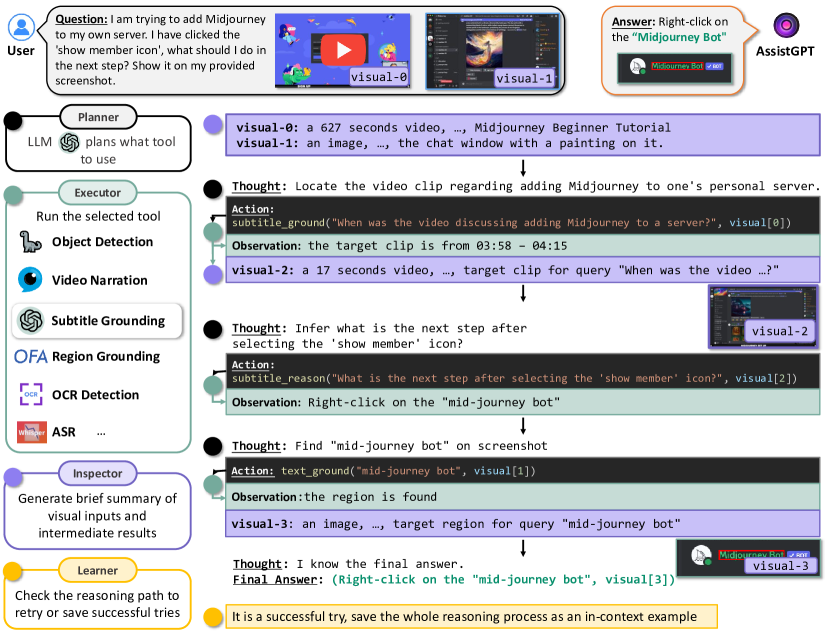
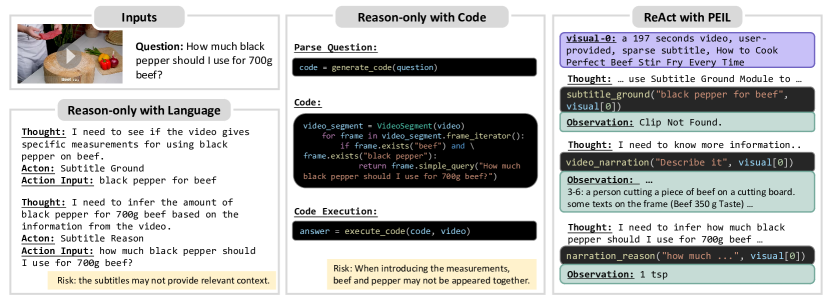
Recent research on Large Language Models (LLMs) has led to remarkable advancements in general NLP AI assistants. Some studies have further explored the use of LLMs for planning and invoking models or APIs to address more general multi-modal user queries. Despite this progress, complex visual-based tasks still remain challenging due to the diverse nature of visual tasks. This diversity is reflected in two aspects: 1) Reasoning paths. For many real-life applications, it is hard to accurately decompose a query simply by examining the query itself. Planning based on the specific visual content and the results of each step is usually required. 2) Flexible inputs and intermediate results. Input forms could be flexible for in-the-wild cases, and involves not only a single image or video but a mixture of videos and images, e.g., a user-view image with some reference videos. Besides, a complex reasoning process will also generate diverse multimodal intermediate results, e.g., video narrations, segmented video clips, etc. To address such general cases, we propose a multi-modal AI assistant, AssistGPT, with an interleaved code and language reasoning approach called Plan, Execute, Inspect, and Learn (PEIL) to integrate LLMs with various tools. Specifically, the Planner is capable of using natural language to plan which tool in Executor should do next based on the current reasoning progress. Inspector is an efficient memory manager to assist the Planner to feed proper visual information into a specific tool. Finally, since the entire reasoning process is complex and flexible, a Learner is designed to enable the model to autonomously explore and discover the optimal solution. We conducted experiments on A-OKVQA and NExT-QA benchmarks, achieving state-of-the-art results. Moreover, showcases demonstrate the ability of our system to handle questions far more complex than those found in the benchmarks.
연구 동기 및 목표
- 다양한 시각 입력과 단일 이미지 추론을 넘어선 유연한 작업을 처리할 수 있는 일반 멀티모달 어시스턴트의 필요성 제시
- 언어와 코드를 교차하는 네 가지 모듈의 PEIL 프레임워크를 제안하여 도구 사용을 계획하고 중간 결과를 관리
- A-OKVQA 및 NExT-QA에서의 최첨단 결과를 통해 시스템의 효과를 입증하고, 복합 현실 세계 시나리오의 처리 시연
- 학습자(Learner) 모듈이 문맥 내 학습 및 성공적 추적 재사용을 통해 자기 개선을 가능하게 하는 방식 시연
제안 방법
- 계획자는 LLM(GPT-4)을 사용하여 두 부분 출력 생성: 다음 단계를 안내하는 자연어 사유(Natural Language Thought)와 외부 도구를 호출하는 구조적 행동(Action)
- 실행자는 도구별 코드의 유효성 검사, 실행, 결과의 후처리를 통해 관찰(Observations)을 생성하고 이를 계획자에게 피드백
- 점검자(Inspector)는 시각 입력과 중간 결과를 메타데이터와 요약으로 기록하여 계획자가 소스와 도구를 선택하는 데 도움
- 학습자(Learner)는 추론을 평가하고 자체 점검을 수행하며, 향후 예측을 개선하기 위해 성공적인 추적을 문맥 내 예시로 저장
실험 결과
연구 질문
- RQ1AssistGPT가 언어와 코드 계획의 교차를 통해 복합 멀티모달 작업에서 강력한 성능을 달성할 수 있는가?
- RQ2각 PEIL 구성요소(Planner, Executor, Inspector, Learner)가 작업 성능과 로버스트성에 미치는 영향은 무엇인가?
- RQ3AssistGPT가 A-OKVQA 및 NExT-QA와 같은 벤치마크에서 기존 멀티모달 시스템과 어떻게 비교되는가?
- RQ4Learner가 시간에 따라 의미 있는 문맥 내 학습 및 자기 개선을 가능하게 하는가?
- RQ5이미지, 비디오, 트랜스크립트, 자막 등 유연한 입력은 Inspector와 도구 세트에 의해 효과적으로 처리되는가?
주요 결과
- AssistGPT 변형은 멀티선택 트랙에서 A-OKVQA에 대해 경쟁력 있는 최첨단 결과를 달성하며, 직접 답변 작업에서도 비슷한 성과를 보임
- 절삭실험(Ablation)을 통해 언어-코드 추론(P,E,I,L 포함)이 강력한 성능을 제공하며, Learner 구성 요소가 있을 때 가장 우수한 성능 달성
- NExT-QA에서 AssistGPT는 인과, 시간적, 서술형 질문 응답 점수에서 경쟁력 있는 성과를 달성하고 다수의 최신 벤치마크를 능가
- Learner의 자체 점검 및 GT-체크 변형은 로버스트성과 문맥 내 학습 능력을 크게 개선하고, 미래 쿼리를 위한 성공적 추적을 저장
- 과거의 LLM 기반 모듈형 시스템과 비교할 때, AssistGPT는 복잡하고 다중 소스의 시각 입력 및 장편 비디오 추론 처리에서 개선된 성능을 보여줌
- 정성적 결과는 복잡한 질문의 효과적인 분해 및 계획 수정과 도구 재호출을 통한 자기 교정 행동을 시연
이 논문 읽기
누빈트 뷰어에서 원문을 열고, 읽으면서 궁금한 곳을 바로 물어보세요.
누빈트에서 이 논문 읽기이 리뷰는 AI가 논문 원문을 바탕으로 만들었습니다. 인용하기 전에 원문을 확인해 주세요.