
[논문 리뷰] Audio-Visual Efficient Conformer for Robust Speech Recognition
이 논문은 경량적인 Efficient Conformer 백엔드를 사용하여 음성과 시각적(입술 움직임) 입력을 융합함으로써 노이즈에 강건한 멀티모odal 음성 인식 모델인 Audio-Visual Efficient Conformer (AVEC)을 제안한다. 중간 CTC 손실을 Inter CTC 잔차 모듈을 통해 통합하고, 그룹화된 어텐션을 더 효율적인 패치 어텐션 메커니즘으로 대체함으로써, AVEC는 LRS2에서 2.3%의 SOTA WER와 LRS3에서 1.8%의 SOTA WER를 달성하며, 오직 음성 기반 기준보다 4배 적은 학습 스텝 수로 더 낮은 오류율을 달성한다.
End-to-end Automatic Speech Recognition (ASR) systems based on neural networks have seen large improvements in recent years. The availability of large scale hand-labeled datasets and sufficient computing resources made it possible to train powerful deep neural networks, reaching very low Word Error Rate (WER) on academic benchmarks. However, despite impressive performance on clean audio samples, a drop of performance is often observed on noisy speech. In this work, we propose to improve the noise robustness of the recently proposed Efficient Conformer Connectionist Temporal Classification (CTC)-based architecture by processing both audio and visual modalities. We improve previous lip reading methods using an Efficient Conformer back-end on top of a ResNet-18 visual front-end and by adding intermediate CTC losses between blocks. We condition intermediate block features on early predictions using Inter CTC residual modules to relax the conditional independence assumption of CTC-based models. We also replace the Efficient Conformer grouped attention by a more efficient and simpler attention mechanism that we call patch attention. We experiment with publicly available Lip Reading Sentences 2 (LRS2) and Lip Reading Sentences 3 (LRS3) datasets. Our experiments show that using audio and visual modalities allows to better recognize speech in the presence of environmental noise and significantly accelerate training, reaching lower WER with 4 times less training steps. Our Audio-Visual Efficient Conformer (AVEC) model achieves state-of-the-art performance, reaching WER of 2.3% and 1.8% on LRS2 and LRS3 test sets. Code and pretrained models are available at https://github.com/burchim/AVEC.
연구 동기 및 목표
- 환경 노이즈 하에서 심각하게 성능이 저하되는 엔드 투 엔드 자동 음성 인식(ASR) 시스템의 노이즈에 대한 강건성을 향상시키기 위해.
- CTC 기반 모델이 조건부 독립성에 의존하는 한계를 해결하기 위해, 중간 CTC 감독을 도입하여 이 가정을 완화시키기 위해.
- 경량적이고 효율적인 아키텍처를 사용하여 음성과 시각 모odal을 융합함으로써 학습을 가속화하고 성능을 향상시키기 위해.
- 특히 멀티모달 환경에서 인식 정확도를 훼손하지 않으면서 어텐션 메커니즘의 계산 복잡도를 감소시키기 위해.
제안 방법
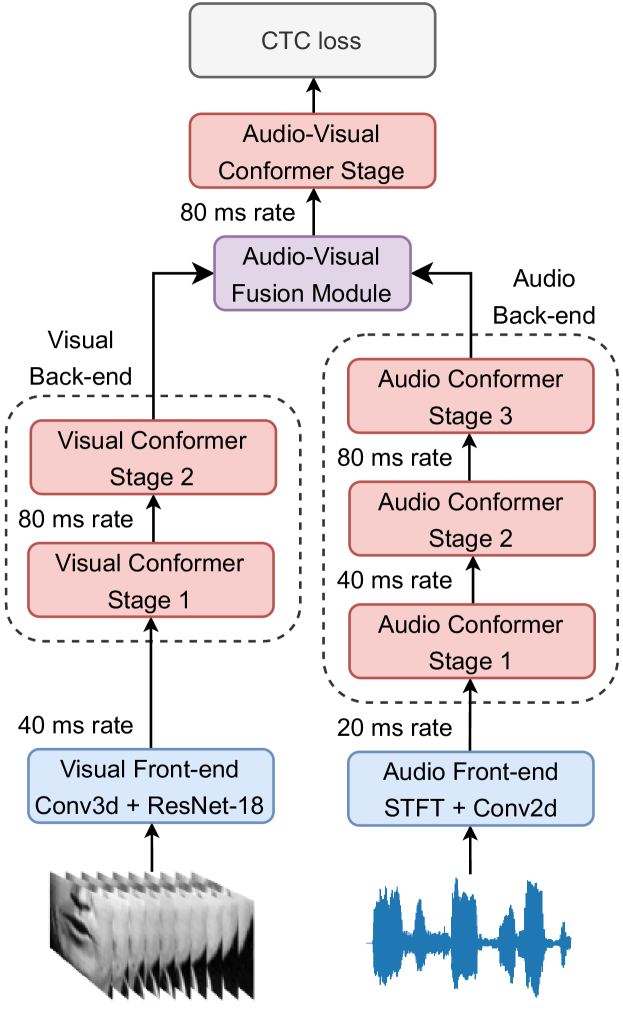
- 입술 움직임에서 시공간적 특징을 추출하기 위해 ResNet-18 시각 프론트엔드를 채택하며, 이를 원시 음성 웨이브폼과 융합한다.
- FLOPs를 감소시키기 위해 그룹화된 어텐션을 더 단순하고 효율적인 패치 어텐션 메커니즘으로 대체한 경량적이고 효율적인 Efficient Conformer 백엔드를 사용한다.
- 에코더 블록 간에 Inter CTC 잔차 모듈을 통해 중간 CTC 손실을 도입하여 블록 수준의 특징을 초기 예측에 조건화하고 CTC의 조건부 독립성 가정을 완화한다.
- 에코더 이전에 음성과 시각 특징을 조기에 융합함으로써 네트워크의 시작 단계부터 양 모달을 함께 모델링할 수 있도록 한다.
- 원시 음성과 영상 입력에서 텍스트로의 변환을 최적화하기 위해, 다중 모달 입력을 사용하여 Connectionist Temporal Classification(CTC) 손실을 기반으로 엔드 투 엔드 모델을 훈련시킨다.
- 특히 저 SNR 조건에서의 강건성을 향상시키기 위해 다양한 노이즈 유형(예: 번잡함, 백색, 거리 노이즈)을 사용하여 훈련 데이터를 증강한다.
실험 결과
연구 질문
- RQ1오디오와 시각 입력의 멀티모달 융합이 엔드 투 엔드 ASR 시스템의 노이즈 강건성에 상당한 향상을 이끌 수 있는가?
- RQ2에코더 블록 간에 중간 CTC 감독을 도입하면 인식 성능이 향상되고, 순차적 모델과 비순차적 모델 간의 격차가 줄어드는가?
- RQ3패치 어텐션과 같은 단순화된 어텐션 메커니즘이 그룹화된 어텐션의 성능을 유지하면서도 계산 복잡도를 감소시킬 수 있는가?
- RQ4노이즈가 있는 데이터로 훈련하면 저-SNR 환경에서 일반화 및 강건성이 얼마나 향상되는가?
- RQ5특히 도전적인 노이즈 조건에서 음성 신호가 손상되었을 경우, 시각 모달 특징이 음성 인식을 효과적으로 안내할 수 있는가?
주요 결과
- Audio-Visual Efficient Conformer(AVEC)는 LRS2 테스트 세트에서 2.3%의 SOTA WER와 LRS3 테스트 세트에서 1.8%의 SOTA WER를 달성하여 이전 방법들을 능가한다.
- LRS2에서 -5 dB의 번잡한 노이즈 조건 하에서, AVEC는 기존 연구(Ma 등 [29])의 16.3% 대비 16.3%포인트 감소한 9.7% WER를 기록하여 성능 향상을 입증한다.
- 학습 스텝 수를 4배 줄임에도 불구하고, AVEC는 오직 음성 기반 기준보다 더 낮은 WER를 달성하여 학습 가속화의 효과를 입증한다.
- 20 dB SNR에서 번잡한 노이즈 조건 하에서도 LRS3에서 2.0% WER를 기록하였고, 백색 노이즈 조건에서도 2.0% WER를 달성하여 다양한 노이즈 유형에 대해 강력한 강건성을 보였다.
- Inter CTC 잔차 모듈을 통한 중간 CTC 감독은 시각 모달의 과도한 사용을 방지하고 예측과 특징 간의 정렬을 향상시킨다.
- 패치 어텐션은 그룹화된 어텐션과 유사한 성능을 달성하면서도 계산 복잡도를 감소시켜 실시간 응용에 더 효율적인 모델을 구현한다.

이 논문 읽기
누빈트 뷰어에서 원문을 열고, 읽으면서 궁금한 곳을 바로 물어보세요.
누빈트에서 이 논문 읽기이 리뷰는 AI가 논문 원문을 바탕으로 만들었습니다. 인용하기 전에 원문을 확인해 주세요.