
[논문 리뷰] Boosting Adversarial Attacks by Leveraging Decision Boundary Information
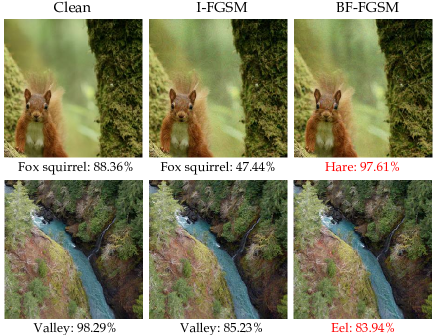
이 논문은 결정 경계 근처의 경계점에서의 기울기 정보를 활용하여 전이성(transferability)을 향상시키는 새로운 전이 기반 적대적 공격인 경계 적합 공격(Boundary Fitting Attack, BFA)을 제안한다. 여러 경계점에서의 기울기를 평균화하여 더 효과적인 적대적 방향을 생성함으로써, 피해자 모델의 결정 경계를 더 효율적으로 초월한다. 이로 인해 최신 기술 대비 공격 성공률이 정상 CNN에서는 5.6% 향상되고, 방어 CNN에서는 14.9% 향상되었으며, CNN을 대체 모델로 사용할 경우 트랜스포머에 대해 58.2%의 평균 공격 성공률을 기록하였다.
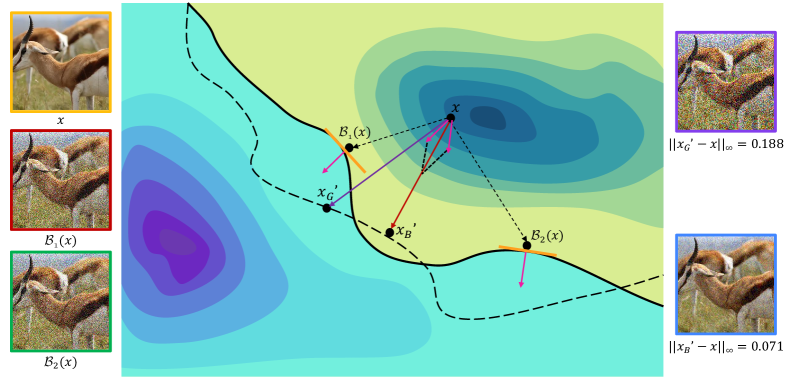
Due to the gap between a substitute model and a victim model, the gradient-based noise generated from a substitute model may have low transferability for a victim model since their gradients are different. Inspired by the fact that the decision boundaries of different models do not differ much, we conduct experiments and discover that the gradients of different models are more similar on the decision boundary than in the original position. Moreover, since the decision boundary in the vicinity of an input image is flat along most directions, we conjecture that the boundary gradients can help find an effective direction to cross the decision boundary of the victim models. Based on it, we propose a Boundary Fitting Attack to improve transferability. Specifically, we introduce a method to obtain a set of boundary points and leverage the gradient information of these points to update the adversarial examples. Notably, our method can be combined with existing gradient-based methods. Extensive experiments prove the effectiveness of our method, i.e., improving the success rate by 5.6% against normally trained CNNs and 14.9% against defense CNNs on average compared to state-of-the-art transfer-based attacks. Further we compare transformers with CNNs, the results indicate that transformers are more robust than CNNs. However, our method still outperforms existing methods when attacking transformers. Specifically, when using CNNs as substitute models, our method obtains an average attack success rate of 58.2%, which is 10.8% higher than other state-of-the-art transfer-based attacks.
연구 동기 및 목표
- 대체 모델에서 생성된 적대적 예제의 전이성에 한계가 존재하는 문제를 해결하기 위해.
- 원래 입력 위치의 기울기보다 결정 경계에서의 기울기가 서로 더 유사한지 여부를 조사하여 전이성을 향상시키기 위해.
- 결정 경계의 평탄성과 기하학적 성질을 활용하여 공격 성공률을 향상시키는 방법을 개발하기 위해.
- 전이 기반 공격에서 트랜스포머와 CNN 간의 견고성(robustness)을 평가하고, 양 사양에 대해 공격 효과성을 향상시키기 위해.
- 경계 기울기 평균화 전략을 통해 더 전이성이 높은 적대적 방향을 찾는 데 이론적 및 실험적 근거를 제공하기 위해.
제안 방법
- 입력 이미지를 무작위 방향으로 변형하면서 모델의 예측이 변경될 때까지 경계점들을 샘플링함으로써, 결정 경계 근처에 위치한 점들을 확보한다.
- 이 경계점들에서 기울기를 계산하고 이를 평균하여 피해자 모델의 결정 경계와 더 잘 일치하는 정밀한 적대적 업데이트 방향을 생성한다.
- 기존의 기울기 기반 공격(FGSM, MI-FGSM 등)과 호환되어 표준 공격 파이프라인에 통합될 수 있다.
- 경계 탐색 중 단계 크기를 조절하기 위해 수축 인자 γ를 사용하며, 경계 근접성과 계산 효율성 사이의 균형을 맞춘다.
- 전이성을 최적화하기 위해 샘플링된 경계점 수 N을 조정하며, N=20이 성능과 비용 사이의 최적 균형을 이룬다.
- 모델의 견고성에 대한 프록시로 '결정 경계 거리' 개념을 도입하였으며, 자연 방향에 따라 거리가 클수록 더 높은 견고성을 의미한다.
실험 결과
연구 질문
- RQ1다른 모델의 기울기는 원래 입력 위치보다 결정 경계에서 더 유사한가?
- RQ2결정 경계 기울기 정보를 활용하면 다양한 모델 간에 적대적 예제의 전이성이 향상되는가?
- RQ3결정 경계의 평탄성이 경계 기울기에서 유도된 적대적 방향에 더 효과적인가?
- RQ4CNN과 트랜스포머 간의 전이 기반 공격 성능는 어떻게 비교되며, 본 방법은 양 사양에서 공격 성공률을 향상시킬 수 있는가?
- RQ5전이성을 극대화하기 위해 최적의 초모델 설정(예: 수축 인자 γ, 경계점 수 N)은 무엇인가?
주요 결과
- 제안된 경계 적합 공격(BFA)은 최신 기술 대비 정상 CNN에서 평균 공격 성공률을 5.6% 향상시키고, 방어 CNN에서는 14.9% 향상시켰다.
- CNN을 대체 모델로 사용할 경우, 트랜스포머에 대해 평균 58.2%의 공격 성공률을 기록하였으며, 이는 다른 최신 기술 대비 10.8% 높은 성능이다.
- 트랜스포머에서 CNN으로 전이할 경우, 평균 78.1%의 공격 성공률을 기록하여 다른 방법보다 13.6% 높은 성능이다.
- SIM을 추가한 결과, 트랜스포머에서 CNN으로 공격할 경우 평균 82.6%의 공격 성공률을 기록하여 강력한 전이성을 입증하였다.
- 실험 결과 경계 기울기가 원래 기울기보다 모델 간에 더 유사함을 확인하여, 본 방법의 핵심 가정을 뒷받침한다.
- 제거 실험 결과, γ=0.6과 N=20가 성능와 계산 비용 사이의 최적 균형을 이룬다.
이 논문 읽기
누빈트 뷰어에서 원문을 열고, 읽으면서 궁금한 곳을 바로 물어보세요.
누빈트에서 이 논문 읽기이 리뷰는 AI가 논문 원문을 바탕으로 만들었습니다. 인용하기 전에 원문을 확인해 주세요.