
[논문 리뷰] Boosting galactic outflows with enhanced resolution
본 논문은 국지 가스 냉각 길이를 해상도로 해결하도록 해상도를 높이면 은하 바깥 흐름의 다상 구조와 에너지가 강화되어 질량 로딩 계수, 금속 로딩 계수, 에너지 로딩 계수가 은하로부터 멀어질수록 증가한다는 것을 보여준다.
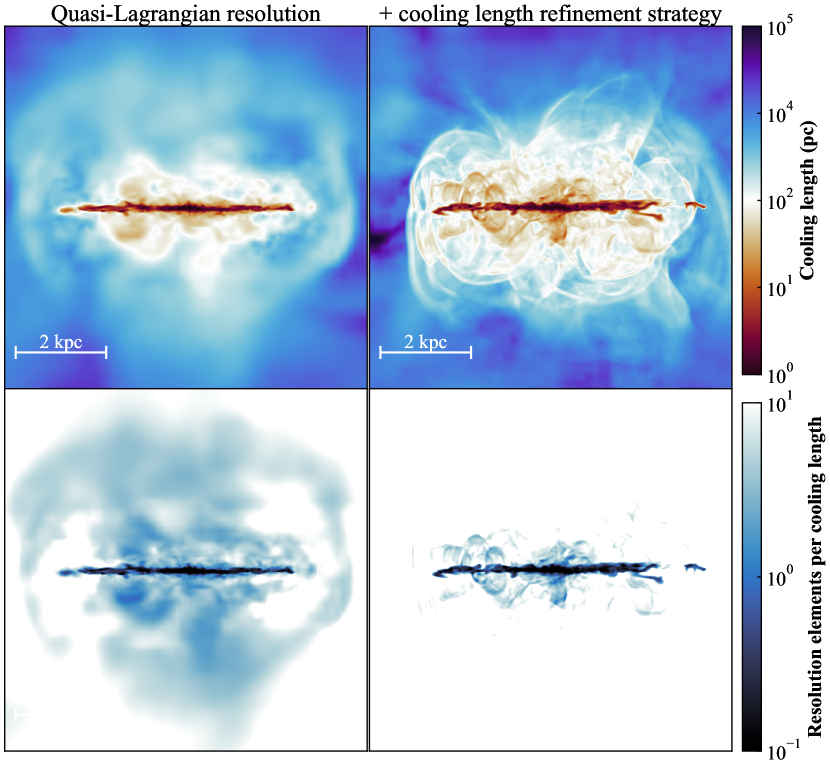
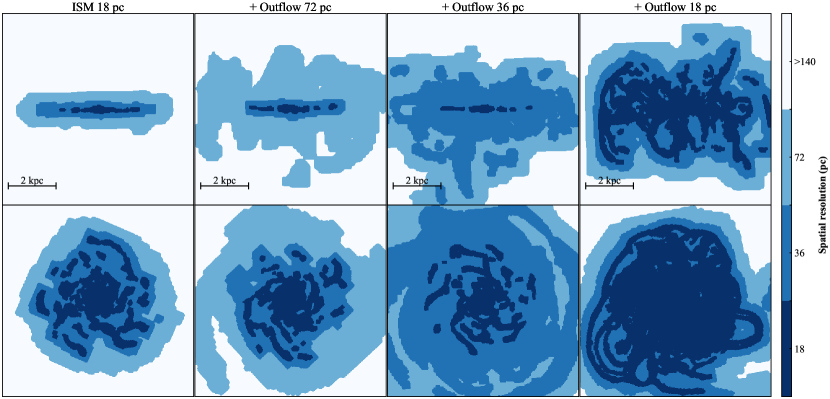
We study how better resolving the cooling length of galactic outflows affect their energetics. We perform radiative-hydrodynamical galaxy formation simulations of an isolated dwarf galaxy ($M_{\star}=10^{8}\, \mathrm{M}_\odot$) with the Ramses-RTZ code, accounting for non-equilibrium cooling and chemistry coupled to radiative transfer. Our simulations reach a spatial resolution of $18 \, \mathrm{pc}$ in the interstellar medium (ISM) using a traditional quasi-Lagrangian scheme. We further implement a new adaptive mesh refinement (AMR) strategy to resolve the local gas cooling length, allowing us to gradually increase the resolution in the stellar-feedback-powered outflows, from $\geq 200 \, \mathrm{pc}$ to $18 \, \mathrm{pc}$. The propagation of outflows into the inner circumgalactic medium (CGM) is significantly modified by this additional resolution, but the ISM, star formation and feedback remain by and large the same. With increasing resolution in the diffuse gas, the hot outflowing phase ($T > 8 imes 10^{4} \, \mathrm{K}$) systematically reaches overall higher temperatures and stays hotter for longer as it propagates outwards. This leads to two-fold increases in the time-averaged mass and metal outflow loading factors away from the galaxy ($r=5\, \mathrm{kpc}$), a five-fold increase in the average energy loading factor, and a $\approx$50 per cent increase in the number of sightlines with $N_{ ext{OVI}} \geq 10^{13}\, \mathrm{cm}^{-2}$. Such a significant boost to the energetics of outflows without new feedback mechanisms or channels strongly motivates future studies quantifying the efficiency with which better-resolved multiphase outflows regulate galactic star formation in a cosmological context.
연구 동기 및 목표
- 국지 가스 냉각 길이를 해결하는 것이 은하 바깥 흐름의 에너지에 미치는 영향을 이해한다.
- 해상도 증가에 따른 흐름의 상(차갑고, 따뜻하고, 뜨거운) 구조의 변화를 정량화한다.
- 킬로파섹스 규모에서 질량, 금속, 에너지 로딩 계수에 대한 해상도의 영향을 결정한다.
- 향상된 해상도의 바람에서 O VI 와 같은 이온화 추적자들을 통해 관측적 함의를 평가한다.
제안 방법
- ramses-rtz를 사용하여 고립된 드워프 은하의 복사-유체역학 시뮬레이션을 수행한다.
- 60종이 넘는 이온 종에 대해 현시점의 방사 전달과 결합된 비평형 냉각 및 화학 반응을 풀다.
- local gas cooling length를 겨냥한 새로운 AMR 정제를 구현하여 급류를 >200 pc에서 18 pc로 정제한다.
- 해상도 간에 별 형성과 피드백 예산을 일관되게 유지하여 해상도 효과를 고립한다.
- 여러 높이에서의 흐름 특성을 비교하고(예: r=5 kpc) PDF를 통해 상 분포를 분석한다.
- 초기 이완 기간 이후 약 500 Myr에 걸쳐 시간 평균 진단을 사용한다.
실험 결과
연구 질문
- RQ1확산성 흐름의 국지 냉각 길이를 해결하는 것이 흐름의 에너지와 상 구조에 어떤 영향을 미치는가?
- RQ2해상도가 향상될 때 질량, 금속, 에너지 로딩 계수의 정량적 변화는 무엇인가?
- RQ3더 나은 냉각 길이 해상도가 내부 CGM에서 O VI와 같은 관측 가능한 이온 추적자를 바꿔 놓는가?
- RQ4드워프 은하에서 별 형성 및 피드백 히스토리를 변화시키지 않으면서 향상된 해상도를 달성할 수 있는가?
주요 결과
- 향상된 냉각 길이 해상도는 더 차갑고 조밀한 성분과 더 뜨거운 확산 성분을 가진 다상 흐름을 만들어낸다.
- 5 kpc에서의 확산 가스의 시간 평균 질량 로딩 계수는 해상도 증가로 거의 두 배로 증가한다.
- 5 kpc에서의 시간 평균 금속 로딩 계수도 질량 로딩 계수와 유사한 정도로 증가한다.
- 더 잘 해상된 유출에서 평균 에너지 로딩 계수는 약 다섯 배 증가한다.
- N(O VI) >= 1e13 cm^-2인 시야선의 비율이 약 50% 증가한다.
- ISM 특성과 전반적인 별 형성률은 해상도 간에 큰 변화 없이 남아 있어 유출의 에너지에 대한 영향만 남긴다.
이 논문 읽기
누빈트 뷰어에서 원문을 열고, 읽으면서 궁금한 곳을 바로 물어보세요.
누빈트에서 이 논문 읽기이 리뷰는 AI가 논문 원문을 바탕으로 만들었습니다. 인용하기 전에 원문을 확인해 주세요.