
[논문 리뷰] Brain Captioning: Decoding human brain activity into images and text
요약: 이 논문은 다중모달 언어 모델(GIT)을 이용하여 fMRI 뇌 활동을 텍스트 캡션으로 해독하고, 예측된 텍스트와 깊이/초기 시각 정보를 바탕으로 잠재 확산 파이프라인을 통해 그럴듯한 이미지를 재구성하는 방법을 제시한다. NSD COCO 자극에 대한 선행 연구와 비교하여 캡션 지표의 개선과 이미지 품질 지표의 경쟁력을 보여준다.
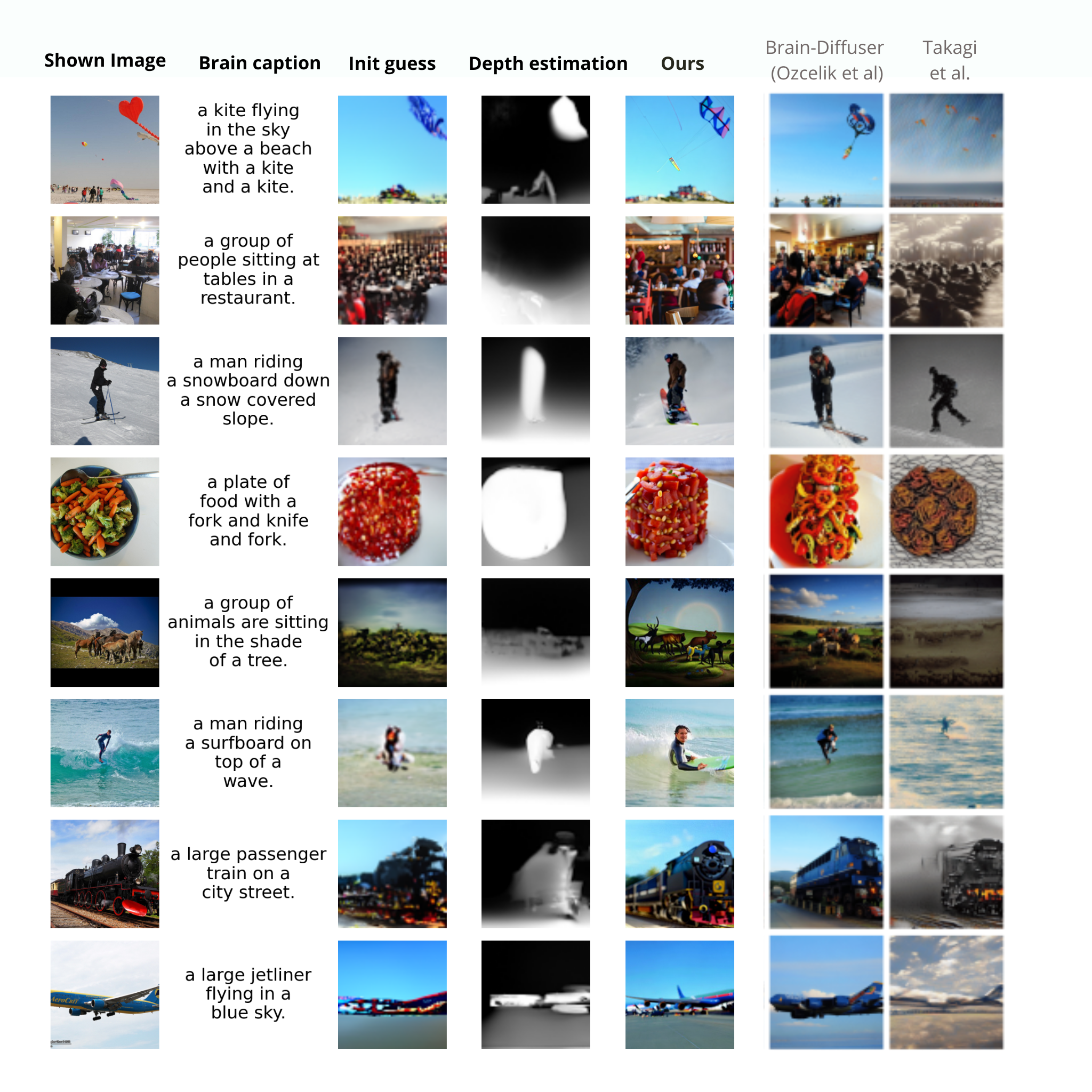
Every day, the human brain processes an immense volume of visual information, relying on intricate neural mechanisms to perceive and interpret these stimuli. Recent breakthroughs in functional magnetic resonance imaging (fMRI) have enabled scientists to extract visual information from human brain activity patterns. In this study, we present an innovative method for decoding brain activity into meaningful images and captions, with a specific focus on brain captioning due to its enhanced flexibility as compared to brain decoding into images. Our approach takes advantage of cutting-edge image captioning models and incorporates a unique image reconstruction pipeline that utilizes latent diffusion models and depth estimation. We utilized the Natural Scenes Dataset, a comprehensive fMRI dataset from eight subjects who viewed images from the COCO dataset. We employed the Generative Image-to-text Transformer (GIT) as our backbone for captioning and propose a new image reconstruction pipeline based on latent diffusion models. The method involves training regularized linear regression models between brain activity and extracted features. Additionally, we incorporated depth maps from the ControlNet model to further guide the reconstruction process. We evaluate our methods using quantitative metrics for both generated captions and images. Our brain captioning approach outperforms existing methods, while our image reconstruction pipeline generates plausible images with improved spatial relationships. In conclusion, we demonstrate significant progress in brain decoding, showcasing the enormous potential of integrating vision and language to better understand human cognition. Our approach provides a flexible platform for future research, with potential applications in various fields, including neural art, style transfer, and portable devices.
연구 동기 및 목표
- 고수준 장면 의미를 포착하기 위해 뇌 디코딩의 방향을 이미지 재구성에서 캡션 생성으로 전환하는 동기를 제시한다.
- fMRI에서 얻은 특징으로부터 캡션을 생성하기 위해 다중 모달 캡션 모델(GIT)을 활용하는 뇌-특징 매핑을 개발한다.
- 예측 텍스트, 초기 추정치, 깊이 맵을 사용하여 잠재 확산 모델로 그럴듯한 이미지를 생성하는 이미지 재구성 파이프라인을 도입한다.
- METEOR, CLIP, SentenceTransformer 등 텍스트 기반 지표와 PixCorr, SSIM, AlexNet/Inception/CLIP, FID 등 이미지 기반 지표를 사용해 기법을 기준선과 비교 평가한다.
- 신경과학 및 AI 응용 분야를 위한 뇌 캡션화와 다중모달 디코딩의 가능성과 응용 가능성을 시연한다.
제안 방법
- 여덟 명의 피험자를 포함한 NSD 데이터를 사용하고 subj01 및 subj02에 중점을 두며, 교차 검증된 정규화(α = 50,000)를 가진 규제 선형 회귀를 통해 fMRI를 이미지 특징으로 매핑한다.
- 예측된 이미지 특징으로부터 캡션을 생성하기 위해 생성형 이미지-텍스트 변환기(GIT)을 캡션 백본으로 사용한다.
- 캡션 디코딩 전에 예측 특징을 이미지 특징의 분포와 일치하도록 정규화한다.
- 뇌 활동에서 매핑된 고정된 VDVAE 잠재 표현으로 초기 추정 이미지를 먼저 생성한 다음 깊이 맵을 추정하고 이를 VDVAE 잠재로 맵핑하여 이미지 재구성 파이프라인을 구성한다;
- 예측 텍스트, 초기 추정치 및 깊이 정보를 사용하여 ControlNet과 함께 Stable Diffusion v2를 조건으로 설정하고 30스텝, 가이드 스케일 9(컨트롤 네트 가중치 0.8)로 최종 재구성을 생성한다.
- 학습 중에는 뇌 활동으로부터 이미지 특징의 잠재 표현 및 VDVAE 깊이/초기 잠재 공간으로의 릿지 회귀를 학습하고, 뇌 기반 예측과 목표 잠재 공간 간 분포를 맞추기 위한 재정규화를 사용한다.

실험 결과
연구 질문
- RQ1뇌 활동을 해독하여 직접 이미지 재구성 대신 의미 있는 이미지 캡션을 생성할 수 있는가?
- RQ2캡션 모델의 잠재 공간으로 매핑된 fMRI 유래 특징이 인간 작성 또는 COCO 스타일의 캡션을 얼마나 잘 생성하는가?
- RQ3초기 추정 이미지와 깊이 정보를 포함시키면 확산 기반 재구성의 그럴듯함과 공간적 관계가 향상되는가?
- RQ4NSD-COCO 자극에서 캡션 기반 지표와 이미지 기반 지표가 기초선과 어떻게 비교되는가?
- RQ5뇌 캡션화의 한계와 신경과학 및 AI 분야의 잠재적 응용은 무엇인가?
주요 결과
- 제안된 뇌 캡션 생성 방법은 두 피험자에 대해 텍스트 기반 지표에서 기본 CNN+LSTM 접근법보다 우수하다(예: METEOR, CLIP 유사도, SentenceTransformer 유사도).
- 뇌 캡션으로 생성된 출력은 기초선 및 선행 연구보다 뇌 캡션에 대해 더 높은 CLIP 및 문장 기반 점수를 달성한다.
- 깊이 맵과 초기 VDVAE 기반 추정치를 활용한 이미지 재구성 파이프라인은 저수준 이미지 지표(PixCorr, SSIM)에서 경쟁력 있고 초반 CNN/인셉션 계층에서 강한 성능을 보이며, 파이프라인 전개 과정에서 캡션 오류가 고수준 지표에 다소 영향을 주는 Trade-off를 보인다.
- 정량적 결과는 제안된 방법이 여러 지표에서 기초선보다 더 높은 점수를 달성해 뇌 활동을 의미론적으로 의미 있는 캡션 및 그럴듯한 재구성으로 효과적으로 해독됨을 시사한다.
- 정성적 결과는 캡션이 주요 장면 내용을 포착함을 보여주고 남은 오류는 구체적인 물체 세부사항이나 장면 문구와 관련되는 경우가 많아 캡션 모델의 한계나 뇌-특징 매핑의 한계를 반영할 수 있다.
이 논문 읽기
누빈트 뷰어에서 원문을 열고, 읽으면서 궁금한 곳을 바로 물어보세요.
누빈트에서 이 논문 읽기이 리뷰는 AI가 논문 원문을 바탕으로 만들었습니다. 인용하기 전에 원문을 확인해 주세요.