
[논문 리뷰] Calibrated One-class Classification for Unsupervised Time Series Anomaly Detection
이 논문은 정상성 모델링을 향상시키기 위해 이상치 오염과 이상치 지식 부족 문제를 해결하는 보정된 일종 분류 방법인 COUTA를 제안한다. 비지도 시계열 이상 탐지에 적용되며, 예측의 불확실성에 기반한 보정과 본질적 이상 기반 보정을 통해 노이즈가 많은 예측을 억제하고 현실적인 비정상 패턴을 통합하여, 여섯 개인 실세계 데이터셋에서 최신 기술 대비 F₁ 스코어 6%–31% 향상됨.
Time series anomaly detection is instrumental in maintaining system availability in various domains. Current work in this research line mainly focuses on learning data normality deeply and comprehensively by devising advanced neural network structures and new reconstruction/prediction learning objectives. However, their one-class learning process can be misled by latent anomalies in training data (i.e., anomaly contamination) under the unsupervised paradigm. Their learning process also lacks knowledge about the anomalies. Consequently, they often learn a biased, inaccurate normality boundary. To tackle these problems, this paper proposes calibrated one-class classification for anomaly detection, realizing contamination-tolerant, anomaly-informed learning of data normality via uncertainty modeling-based calibration and native anomaly-based calibration. Specifically, our approach adaptively penalizes uncertain predictions to restrain irregular samples in anomaly contamination during optimization, while simultaneously encouraging confident predictions on regular samples to ensure effective normality learning. This largely alleviates the negative impact of anomaly contamination. Our approach also creates native anomaly examples via perturbation to simulate time series abnormal behaviors. Through discriminating these dummy anomalies, our one-class learning is further calibrated to form a more precise normality boundary. Extensive experiments on ten real-world datasets show that our model achieves substantial improvement over sixteen state-of-the-art contenders.
연구 동기 및 목표
- 일종 시계열 이상 탐지에서 레이블이 없는 학습 데이터 내 이상치 오염 문제를 해결하는 데 초점을 맞춘다.
- 정상성 학습 과정에서 진정된 비정상 행동에 대한 지식이 부족한 기존 방법의 한계를 극복한다.
- 이상치 오염에 강건하고 이상치 지식을 반영한 일종 분류 프레임워크를 개발하여 정상성 모델링 정확도를 향상시킨다.
- 고차원적이고 장수열인 실세계 시계열 응용 분야에서 강력하고 확장 가능한 이상 탐지 기능을 제공한다.
- 복잡한 아키텍처나 목적 함수 없이도 모델의 신뢰도와 일반화 능력을 향상시키는 단순하면서도 효과적인 보정 메커니즘을 제공한다.
제안 방법
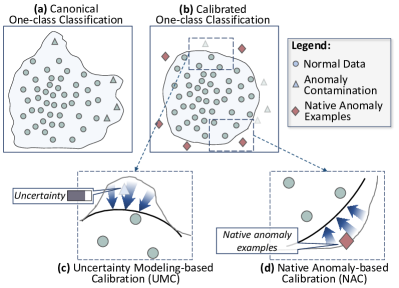
- 일종 거리 값에 대한 사전 분포를 활용해 예측 불확실성을 모델링하는 불확실성 기반 보정(UMC)을 도입한다.
- 높은 불확실성 예측에는 경미한 페널티를 적용하면서도, 어려운 정상 샘플에 대해 확신 있는 예측을 유도하는 새로운 학습 목표를 설계한다.
- 기존 시계열 데이터에 도메인 특화의 변형을 적용하여 현실적인 이상 예시를 생성하는 본질적 이상 기반 보정(NAC)을 제안한다.
- 점 이상, 문맥 이상, 집단 이상 등의 변형 연산을 사용해 레이블이 없는 이상치가 필요 없이 진정된 비정상 행동을 시뮬레이션한다.
- UMC와 NAC를 통합한 유일한 학습 목표를 구성하여 모델의 강건성과 정상 경계 학습 능력을 향상시킨다.
- 시간적 종속성을 포착하기 위해 가변 차원 H를 갖는 가속 창 기반 특징 추출 전략을 사용한다.
실험 결과
연구 질문
- RQ1불확실성 인식 보정은 학습 데이터 내 이상치 오염에 대해 일종 모델의 강건성을 향상시킬 수 있는가?
- RQ2데이터 변형을 통한 현실적인 비정상 패턴 지식 통합은 비지도 환경에서 정상성 모델링을 향상시킬 수 있는가?
- RQ3제안된 보정 프레임워크는 다양한 이상 유형에 걸쳐 F₁ 스코어, AUC-PR, 일반화 능력 측면에서 최신 기술 대비 어떻게 비교되는가?
- RQ4변형 유형, 손실 가중치, 창 길이와 같은 하이퍼파rameter의 영향은 탐지 성능에 어떤가?
- RQ5실세계 시스템에서 흔히 볼 수 있는 장수열 및 고차원 시계열 데이터에 대해 이 방법은 효과적으로 확장 가능한가?
주요 결과
- COUTA는 여섯 개인 실세계 시계열 데이터셋에서 12개의 최신 기술 대비 6%–31% 높은 F₁ 스코어를 달성한다.
- 이상치 오염에 대해 뛰어난 강건성을 보이며, 훈련 데이터에 알려지지 않은 이상치가 포함되어 있어도 높은 성능을 유지한다.
- 모든 변형 연산 풀(Ω)을 활용한 본질적 이상 기반 보정(NAC)이 가장 뛰어난 성능을 보이며, 특히 ASD 데이터셋에서 두드러진다.
- COUTA는 다양한 하이퍼파rameter 설정에서도 안정적인 성능을 보이며, α, β, l에 대해 최소한의 민감도를 보여 강력한 일반화 능력을 입증한다.
- 모델은 뛰어난 확장성을 보이며, 특히 장수열 및 고차원 시퀀스에서 경쟁하는 딥러닝 기반 방법보다 훈련 시간이 현저히 적다.
- 장수열 및 고차원 설정에서 TranAD, USAD, MSCRED와 같은 방법보다 성능이 뛰어나며, 이는 메모리 제약으로 인한 실패를 피함.
이 논문 읽기
누빈트 뷰어에서 원문을 열고, 읽으면서 궁금한 곳을 바로 물어보세요.
누빈트에서 이 논문 읽기이 리뷰는 AI가 논문 원문을 바탕으로 만들었습니다. 인용하기 전에 원문을 확인해 주세요.