
[논문 리뷰] Can Large Language Models Be an Alternative to Human Evaluations?
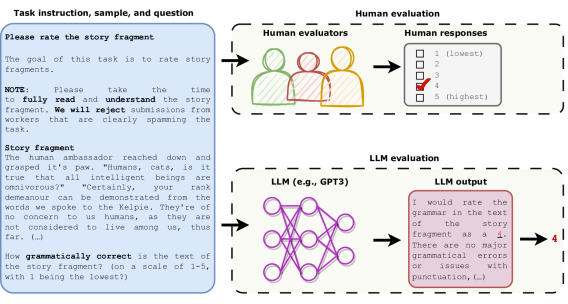
논문은 인간 평가의 대안으로 대형 언어 모델(LLMs)을 활용하여 인간 평가에 사용된 동일한 지시사항, 샘플, 질문을 제공하고 개방형 이야기 생성 및 적대적 공격에서 출력을 평가하는 방법을 조사한다.
Human evaluation is indispensable and inevitable for assessing the quality of texts generated by machine learning models or written by humans. However, human evaluation is very difficult to reproduce and its quality is notoriously unstable, hindering fair comparisons among different natural language processing (NLP) models and algorithms. Recently, large language models (LLMs) have demonstrated exceptional performance on unseen tasks when only the task instructions are provided. In this paper, we explore if such an ability of the LLMs can be used as an alternative to human evaluation. We present the LLMs with the exact same instructions, samples to be evaluated, and questions used to conduct human evaluation, and then ask the LLMs to generate responses to those questions; we dub this LLM evaluation. We use human evaluation and LLM evaluation to evaluate the texts in two NLP tasks: open-ended story generation and adversarial attacks. We show that the result of LLM evaluation is consistent with the results obtained by expert human evaluation: the texts rated higher by human experts are also rated higher by the LLMs. We also find that the results of LLM evaluation are stable over different formatting of the task instructions and the sampling algorithm used to generate the answer. We are the first to show the potential of using LLMs to assess the quality of texts and discuss the limitations and ethical considerations of LLM evaluation.
연구 동기 및 목표
- NLP에서 인간 평가의 신뢰성 부족과 재현성 저하로 인한 도전 과제에 대해 동기를 부여한다.
- LLM 평가를 인간 평가에 사용된 동일한 지시사항, 샘플, 질문을 제공함으로써 대안으로 제시한다.
- 개방형 이야기 생성 및 적대적 텍스트 공격에 걸쳐 LLM 평가를 전문가 인간 평가와 실증적으로 비교한다.
- 지시문의 변화와 샘플링 하이퍼파라미터에 따른 LLM 평가의 안정성을 분석한다.
- LLM 기반 평가의 채택에 따른 한계, 윤리 및 실용적 고려사항을 논의한다.
제안 방법
- 인간 평가에 사용된 동일한 작업 지시사항, 샘플 및 질문을 LLM에 제공하고 LLM 출력에서 Likert 스타일의 등급을 추출한다.
- nucleus 샘플링을 사용하여 여러 LLM(T0, text-curie-001, text-davinci-003, ChatGPT)을 사용해 등급을 생성한다.
- 200개의 인간이 작성한 이야기와 200개의 GPT-2가 생성한 이야기에서 전문가 영어 교사의 등급과 LLM 등급을 비교한다.
- 지시 및 샘플링 온도 variations로 실험을 반복하여 견고성을 평가한다.
실험 결과
연구 질문
- RQ1LLMs가 전문가 인간 평가자와 일치하는 방식으로 텍스트 품질을 평가할 수 있는가?
- RQ2작업 지시, 질문 및 샘플링 설정의 변화에 대해 LLM 평가는 얼마나 안정적인가?
- RQ3적대적 텍스트 품질(유창성 및 의미 보존)에 대해 LLM 평가가 인간 판단과 일치하는가?
주요 결과
- 강력한 모델(특히 text-davinci-003)과 함께하는 LLM 평가는 전문가 인간 평가와 일치하는 것으로 나타나고, 인간이 작성한 텍스트가 GPT-2가 생성한 텍스트보다 여러 속성에서 선호된다.
- 다른 작업 지시 및 샘플링 온도에 따른 LLM 평가 결과의 변동은 제한적이며, 인간 작문과 모델 생성 텍스트 간의 상대 순위를 보존한다.
- ChatGPT는 추론을 설명할 수 있으며 인간이 작성한 텍스트를 더 높게 평가하는 경향이 있지만, 일부 속성에서 절대 점수에 차이가 발생하기도 한다.
- LLMs는 악성 샘플과 양호한 샘플의 유창성 및 의미 보존 측면에서 전문가 판단과 일치하는 방향으로 순위를 잘 매길 수 있지만, 일부 모델별 편향이 존재한다(예: 안전 정책이 평점에 영향을 미침).
- 이 접근법은 재현성을 개선하고 비용을 낮추는 효과가 있지만, 잠재적 지식 편향 및 LLM의 안전 제약과 같은 한계를 인정한다.
이 논문 읽기
누빈트 뷰어에서 원문을 열고, 읽으면서 궁금한 곳을 바로 물어보세요.
누빈트에서 이 논문 읽기이 리뷰는 AI가 논문 원문을 바탕으로 만들었습니다. 인용하기 전에 원문을 확인해 주세요.