
[논문 리뷰] Can Large Language Models Understand Context?
이 논문은 생성형 LLM의 맥락 이해 벤치마크를 제시하고, 인-context 학습과 사후 학습 3비트 양자화를 평가하며, 작업에 따라 더 크거나 양자화된 모델이 더 작은 밀집 모델보다 성능이 다르게 우수하다는 것을 보인다.
Understanding context is key to understanding human language, an ability which Large Language Models (LLMs) have been increasingly seen to demonstrate to an impressive extent. However, though the evaluation of LLMs encompasses various domains within the realm of Natural Language Processing, limited attention has been paid to probing their linguistic capability of understanding contextual features. This paper introduces a context understanding benchmark by adapting existing datasets to suit the evaluation of generative models. This benchmark comprises of four distinct tasks and nine datasets, all featuring prompts designed to assess the models' ability to understand context. First, we evaluate the performance of LLMs under the in-context learning pretraining scenario. Experimental results indicate that pre-trained dense models struggle with understanding more nuanced contextual features when compared to state-of-the-art fine-tuned models. Second, as LLM compression holds growing significance in both research and real-world applications, we assess the context understanding of quantized models under in-context-learning settings. We find that 3-bit post-training quantization leads to varying degrees of performance reduction on our benchmark. We conduct an extensive analysis of these scenarios to substantiate our experimental results.
연구 동기 및 목표
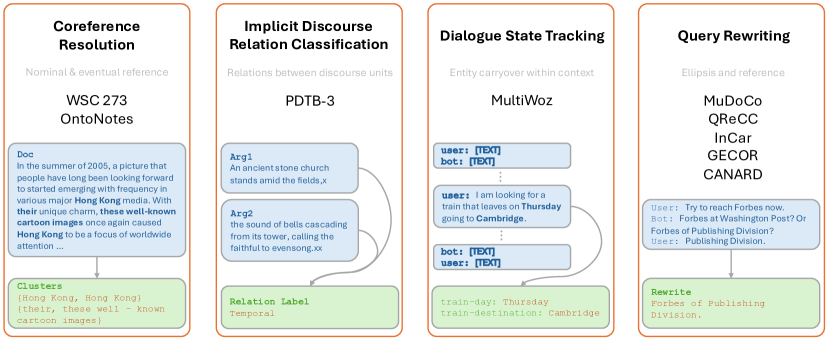
- 생성형 LLM을 평가하기 위해 네 가지 과제로 구성된 아홉 개 데이터셋에 걸친 맥락 이해 벤치마크를 도입한다.
- 벤치마크에서 서로 다른 크기와 계열(OPT, LLaMA, GPT-3.5)의 모델에 대한 인-context 학습 성능을 분석한다.
- 사후 학습 3비트 양자화(GPTQ)가 맥락 이해 과제에 미치는 영향을 평가한다.
- 맥락 처리에서 모델이 성공하거나 실패하는 영역에 대한 자세한 언어학적 및 과제 수준 분석을 제공한다.
제안 방법
- 인-context 학습에 맞춘 프롬프트를 사용하여 9개 데이터셋에서 네 가지 맥락 중심 작업(coreference resolution, dialogue state tracking, implicit discourse relation classification, query rewriting)를 구성한다.
- ZERO-샷에서 10샷까지 설정에서 OPT 125M–2.7B, LLaMA 7B–65B 계열의 Dense 사전 학습 모델과 GPT-3.5-turbo를 평가한다.
- 동일 과제에서 포스트 트레이닝 3비트 양자화된 LLaMA 모델(GPTQ)을 밀집 기준선과 비교한다.
- 작업별 지표를 사용하여 성능을 정량화한다(예: 코어퍼런스에 대한 CoNLL F1, DST의 joint goal accuracy, PDTB-3의 정확도, QR의 BLEU/ROUGE).
- 오류 유형과 모델 동작을 이해하기 위한 정성적 오류 분석 및 질의 재작성에 대한 사례 연구를 포함한다.
실험 결과
연구 질문
- RQ1인-context 학습 하에서 네 가지 맥락 중심 과제에서 LLM이 맥락 특성을 얼마나 잘 이해하는가?
- RQ2모델 크기와 계열(OPT, LLaMA, GPT-3.5)이 맥락 이해 성능에 어떤 영향을 미치는가?
- RQ3사후 학습 3비트 양자화가 과제 전반에 걸친 맥락 이해에 미치는 영향은 무엇인가?
- RQ4양자화된 모델이 규모를 통해 작은 크기를 보완하는가, 그리고 언어적으로 어디에서 실패하는가?
- RQ5맥락 관련 과제에서 흔한 오류 유형은 무엇이며 밀집 모델과 양자화 모델 간에 어떻게 다른가?
주요 결과
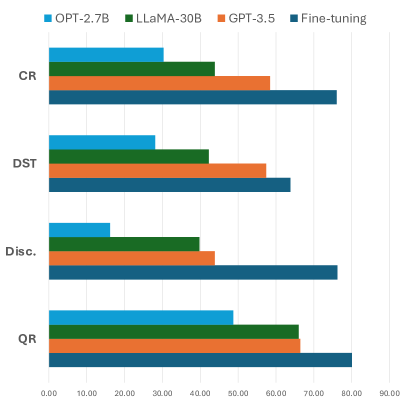
- 사전 학습된 LLM에서의 인-context 학습은 대부분의 맥락 과제에서 미세 조정 모델과의 격차를 좁히지 못한다.
- 양자화된 3비트 LLaMA(GPTQ)는 과제마다 감소 폭이 다르게 나타나며, 30B로 확장될 때 특정 담화 과제에서 일부 이득을 보인다.
- 30B 양자화 LLaMA 모델은 여러 과제에서 종종 7B 밀집 모델보다 우수한 성능을 보여주며, 맥락 이해에서 규모가 양자화를 상회할 수 있음을 시사한다.
- GPT-3.5는 대화 상태 추적에서 미세 조정된 모델 수준에 도달하지만, 전반적으로 FT 모델이 많은 과제에서 여전히 우수하다.
- 질의 재작성에서 큰 모델이 미세 조정과의 격차를 좁히는 반면, 작은 모델은 상당한 실패를 보이며 생성 과제에서의 ICL 한계를 강조한다.
- 과제에 걸쳐 양자화는 QR 데이터셋에서 일부 생성 지표(BLEU/ROUGE)를 향상시키지만, 다른 과제에서 일반적으로 핵심 맥락 이해를 저하시킨다.
이 논문 읽기
누빈트 뷰어에서 원문을 열고, 읽으면서 궁금한 곳을 바로 물어보세요.
누빈트에서 이 논문 읽기이 리뷰는 AI가 논문 원문을 바탕으로 만들었습니다. 인용하기 전에 원문을 확인해 주세요.