
[논문 리뷰] Classification of symmetry-enriched topological quantum spin liquids
이 논문은 2차원에서 임의의 전역 대칭군—격자, 내부, 반유니터리, anyon 순열 대칭을 포함—모든 위상 순서(아벨 및 비아벨)에 대해 대칭을 부여받은 위상적 양자 스핀 액체(SETQSL)를 분류하기 위한 종합적인 프레임워크를 제시한다. 이 방법은 이상 지표와 리브-슐라이퍼-매티스 유형의 이상을 사용하여 동일한 대칭군을 갖지만 격자 실현 방식이 다른 SETQSL을 구분하며, 이전에 접근하기 어려웠던 '파트온을 초월한' $ζ_2$ SETQSL과 같은 위상 상태를 성공적으로 규명한다.
We present a systematic framework to classify symmetry-enriched topological quantum spin liquids in two spatial dimensions. This framework can deal with all topological quantum spin liquids, which may be either Abelian or non-Abelian, chiral or non-chiral. It can systematically treat a general symmetry, which may include both lattice symmetry and internal symmetry, may contain anti-unitary symmetry, and may permute anyons. The framework applies to all types of lattices, and can systematically distinguish different lattice systems with the same symmetry group using their Lieb-Schultz-Mattis anomalies. We apply this framework to classify $U(1)_{2N}$ chiral states and non-Abelian Ising$^{(ν)}$ states enriched by a $p6 imes SO(3)$ or $p4 imes SO(3)$ symmetry, and $\mathbb{Z}_N$ topological orders and $U(1)_{2N} imes U(1)_{-2N}$ topological orders enriched by a $p6m imes SO(3) imes\mathbb{Z}_2^T$, $p4m imes SO(3) imes\mathbb{Z}_2^T$, $p6m imes\mathbb{Z}_2^T$ or $p4m imes\mathbb{Z}_2^T$ symmetry, where $p6$, $p4$, $p6m$ and $p4m$ are lattice symmetries, while $SO(3)$ and $\mathbb{Z}_2^T$ are spin rotation and time reversal symmetries, respectively. In particular, we identify symmetry-enriched topological quantum spin liquids that are not easily captured by the usual parton-mean-field approach, including examples with the familiar $\mathbb{Z}_2$ topological order.
연구 동기 및 목표
- 2차원 공간에서 대칭을 부여받은 위상적 양자 스핀 액체(SETQSL)에 대한 체계적인 분류 프레임워크를 개발하는 것.
- 특히 비아벨 및 고차원 $N$의 anyonic 위상 순서에 대해 표준 파르톤-평균장 방법의 한계를 해결하는 것.
- 공간군(예: $p6$, $p4m$), 내부 대칭($SO(3)$), 시간 역전($\mathbb{Z}_2^T$)를 포함한 일반 대칭군, 특히 반유니터리 및 anyon 순열 대칭을 포함하는 것.
- 동일한 전역 대칭군을 갖는 서로 다른 격자 시스템을 리브-슐라이퍼-매티스 이상을 통해 구분하는 것.
- 이전에 접근하기 어려웠던 SETQSL 위상, 예를 들어 '파트온을 초월한' $ζ_2$ 위상 순서를 식별하고 분류하는 것.
제안 방법
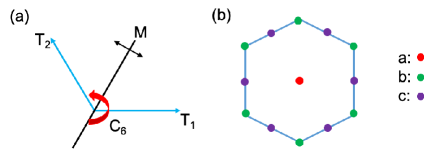
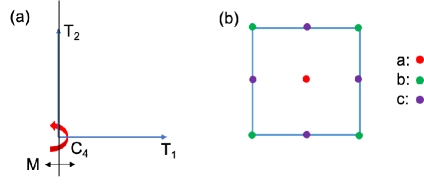
- 위상 순서, 전역 대칭, 그리고 그 이상성(크리스탈 이상 포함)을 위한 일반적 특성화를 활용한다.
- 동일한 공간군을 갖는 서로 다른 격자 시스템 간의 이상을 연결하기 위해 크리스탈 등가 원칙을 적용한다.
- 군 코homology와 대칭 분할 클래스로부터 유도된 이상 지표를 사용하여 SET 위상을 탐지하고 분류한다.
- 동일한 전역 대칭을 갖지만 격자 실현 방식이 다른 SETQSL을 구분하기 위해 리브-슐라이퍼-매티스(LSM) 이상을 활용한다.
- 다양한 위상 순서에 대해 다양한 대칭군 하에서 명시적인 대칭 분할 패턴과 anyon 순열 규칙을 구성한다.
- 이 프레임워크를 $p6\times SO(3)$, $p4\times SO(3)$, $p6m\times SO(3)\times\mathbb{Z}_2^T$, $p4m\times \mathbb{Z}_2^T$ 대칭 하에서 $U(1)_{2N}$, 이징($\nu$), $\mathbb{Z}_N$, $U(1)_{2N} \times U(1)_{-2N}$ 위상 순서를 분류하는 데 적용한다.
실험 결과
연구 질문
- RQ1격자 대칭과 내부 대칭—특히 반유니터리 및 anyon 순열 대칭이 동시에 존재할 경우, 어떻게 대칭을 부여받은 위상적 양자 스핀 액체를 체계적으로 분류할 수 있는가?
- RQ2리브-슐라이퍼-매티스 이상은 동일한 전역 대칭군을 갖지만 서로 다른 격자 구조를 가진 SETQSL을 어떻게 구분하는가?
- RQ3이 프레임워크는 표준 파르톤-평균장 방법으로 접근이 어려운, 비아벨 또는 고차원 $N$의 anyonic 위상 순서를 분류할 수 있는가?
- RQ4$p4m\times \mathbb{Z}_2^T$ 대칭 하에서 $\mathbb{Z}_2$ 위상 순서에 대해 구별되는 대칭 분할 클래스와 anyon 순열 패턴은 무엇인가?
- RQ5이상 지표와 군 코hom로지 데이터는 $U(1)_{2N}$ 및 $U(1)_{2N}\times U(1)_{-2N}$ 위상 순서에 대해 가능한 SET 위상들을 어떻게 결정하는가?
주요 결과
- 이 프레임워크는 $p6\times SO(3)$ 및 $p4\times SO(3)$ 대칭 하에서 $U(1)_{2N}$ 채널 스핀 액체와 비아벨 이징($\nu$) 상태를 성공적으로 분류하며, anyon 순열가 포함된 경우도 포함한다.
- 이 방법은 $p4m\times \mathbb{Z}_2^T$ 대칭 하에서 $\mathbb{Z}_2$ 위상 순서에 대해 이전에 접근하기 어려웠던 '파트온을 초월한' 위상까지 포함해 총 53개의 구별되는 대칭 분할 클래스를 규명한다.
- 동일한 전역 대칭군을 갖는 서로 다른 격자 시스템을 리브-슐라이퍼-매티스 이상을 통해 구분함으로써 SET 분류의 모호함을 해결한다.
- $U(1)_{2N}\times U(1)_{-2N}$ 위상 순서에 대해서는 $p6m\times SO(3)\times\mathbb{Z}_2^T$ 및 $p4m\times \mathbb{Z}_2^T$ 대칭 하에서 새로운 SET 위상을 규명한다.
- 분석 결과, $N\geq 3$인 $\mathbb{Z}_N$ 위상 순서는 이 이상 기반 접근을 통해 체계적으로 분류 가능하며, 파르톤 방법의 한계를 극복할 수 있다.
- 이 프레임워크는 $\mathbb{Z}_2$ 코hom로지에서 유도된 이상 지표를 사용하여 시간 역전 대칭이 anyon을 순열시키는 SET 위상을 탐지하고 분류한다. 예를 들어 $p4m\times \mathbb{Z}_2^T$ 시스템에서의 경우이다.
더 나은 연구,지금 바로 시작하세요
논문 읽기부터 검토까지, 연구 시간을 획기적으로 줄여보세요.
카드 등록 없음 · 무료 플랜 제공
이 리뷰는 AI가 만들고, 인간 에디터가 검토했습니다.